3 Ways to Better Date Your Wife

Guys…let’s be real: you love the lady in your life. You love her smile, the way she moves, how she wears it, makes it…I’m sure I could go on.

But let’s be honest: how well do you actually show it? Perhaps not as much as you’re capable of, right?

Well, fear not. If you’re here hoping to spice up your marital dating relationship or simply mature as a pursuer, I got you covered. Granted, I can only give you a head start in your quest for better connection, but hey…a boost is a boost and that’s, in part, why HGF exists.

That said, let’s dive in and discuss three ways we, as husbands, can better date our wives…

  1. Date her, not the moment

As an adventure aficionado, I love a good time. Whether dinner and a movie, pizza in the park, or a concert on the green, it’s hard to top a night out with the ‘better half’.

Still, if you’re like me in the sense you take pride in being a skilled date night architect, then heed the reminder: a date is about the person you’re with, not the setting or seconds it happens in.

Not to suggest the man shouldn’t effort in laying down the proverbial red carpet. After all, dating and wooing should never be mutually exclusive; however, if you’re a guy who tends to pursue the moment more than the ‘so’ (significant other), it’s fair to question not only where your heart is anchored, but also who (or what) you’re actually dating.

My advice? Always remember while framing the moment is key, at the end of the day a) the woman is why you’re on the date in the first place, b) intimacy trumps entertainment, and c) it’s not about you.

Apply this formula in unison and I guarantee the moment will be where it needs to (i.e. secondary to the relationship).

Bottom line: 1) What makes a date is your date, not the date. 2) Don’t pursue what can’t pursue you back; instead, dare to align your focus and priorities on what ultimately lasts.

anigif_enhanced-23112-1444905303-5

  1. Make love a present rhythm

No question, time is a valuable commodity; hence, the reason ‘date’ (the engagement) shares the same word as ‘date’ (the occasion); however, have you ever wondered what would happen if the two dates became less synonymous?

For instance, if you’re on date wanting to ignite nostalgia into the moment, can you honestly say what you’re on is a ‘date’?  Or are you simply trying to regurgitate a throwback to feel closer to ‘first love’?

And hear me, men: I’m not trying to gut punch your moxy here. I’m just sayin’ for those who may be in the routine of dating as opposed to the rhythm, it’s worth exercising caution when comparing the current edition of your ‘better half’ to the edition you first met. ‘Cause truth is: your wife isn’t who she used to be…and the love you’ve built isn’t what it used to be. Rather, both are continually upgrading  on account of precious time and energy being invested into a deeper connection fermenting with time.

Therefore, if you can resist the comparisons, then chances are you’ll be in much better position to revive love in the present, not an outdated version from years past.

Bottom line: 1) The best way to ‘carpe diem’ your date starts with sparking love where it’s at, not where it’s been. 2) Be in the rhythm, not routine, of dating your wife.

nickandjess

  1. Make her the center of attention

While I may seem like a ‘hitch’ for dating, I admit there are times I [almost] take the opportunity for granted.

Yet, whenever I’m lucky fortunate enough to catch myself, I’ve learned the best adjustment is to find my wife within my attention and make her the center.

To do this, I subscribe to the following formula…

  1. Turn off your cell phone. Note: If you’re more controlled than I am, you can get away with silencing, but as one who likes to check scores, fantasy teams, social media post-‘post’, etc…I’ve learned it’s better/safer to go the extra yard here).
  2. Sit back turned to screens. Exception: Your wife has agreed to join you on a Buffalo Wild Wings date to watch the Predators, Titans (or the team of your choice) dominate.
  3. Seek a new compliment and/or question. Guys, if you can relate to point #2, then you’re going to want to deviate from distraction in a way that blends creativity with challenge. For me, this comes in the form of asking, ‘What’s new’ without actually saying ‘what’s new’.

Examples:

a) ‘I noticed you talking with ____ on the phone earlier? How did your conservation go? What did you talk about?’ (Note: Don’t EVER stop a thread after one question. See how the second question gives dialogue more trail options?)

b) ‘I noticed the casserole tasted different. What extra ingredient did you use? Whatever it was, I liked it!’ (Note: Some may consider ‘different’ to be a dangerous word; however, if you use it, make sure the connotation is positive. Yes, you could say ‘better’, but in case her reply is, ‘What was wrong with it before?’…make sure you have an answer ready).

c) ‘How was your admin tech meeting?’ What did your team talk about?

d) ‘If I remember correctly, you had a lunch date today with _____’ (repeat ‘a’ in follow-up)

e) Plan a future getaway and inquire bucket-list activities while also linking them to adventures of old (i.e. did you ever do this as a family back in the day; great way to blend past, present, and future together).

Bottom line: Regardless of what route you choose, remember a) whenever you give authentic inquisition and humility permission to dig, you ultimately discover places within your spouse you didn’t realize were there, b) your wife is a tome, not a spark note…thus why not read every word of every page as opposed to just skimming, and c) as husbands, we were made to reflect perfect love in perfecting fashion…which can’t happen unless we make it known.

So what are we waiting for? Let’s show our wives what they were made to be shown…and relish the time we have to be a part of something bigger than ourselves.

Assurance

Stay tuned next time for Lyssah‘s installment on how wives can better relate and connect to their husbands.

Cover photo creds: Mental Floss

3 Ways to Handle Unfair Criticism

If you’ve worked a job long enough, chances are you know what it’s like to be falsely accused. After all, rumors, gossip, backstabbing = just another day in the workplace, right?

Yet, while we can all agree condemnation is never fun, not all may agree on how to overcome; still, as an advocate of reconciliation, I submit even on the darkest of days, there’s always a roadmap to resolve.

To get us there, here are three basic truths we can rely on when coping with unfair rebuke…

1. Don’t take it personally

Let’s be honest: when we receive unfair rebuke, it’s easy to lock into defense mode (i.e. shutting down, walling up, and basing every thought/action around hurt prevention). Sure, we may take the punches, turn the other cheek, heck, we may even get back up again…but at the end of the day, we’re often far too content remaining frozen in cynicism and analysis paralysis (i.e. over-thinking a situation towards indifference).

Perhaps you can relate to a colleague dishing out unnecessary criticism or a supervisor unwilling to hear your side of the story. Maybe you once wanted to rightfully confront an issue, but fearing job security, kept quiet in hope ‘this too shall pass’.

If so, then it’s important no matter what situation you’re in to not take it personally.

‘Cause while offense may feel good in the moment, truth is: it’s never the answer to reproach or resolution.

But Cam…all I want is to be heard and understood. What’s so wrong about that?

Technically, nothing; however, if offense is your default reaction whenever a finger is pointed at you, are you not doing unto the ‘offender’ what you don’t want them doing unto you?

Bottom line: Rather than stack shoulder chips, dare to defend against offense rather than with it. That way you deactivate pride and open the door for humility1 to enter, which as I’ll explain in my next point, makes taking offense a lot harder.

tenor.gif

2. Respond with class

As mentioned in point #1, when unwarranted criticism strikes, human nature often gravitates towards silence. For some of us, this can be a good thing initially (key word) as ‘quiet time’ allows us to process and collect our thoughts; however, at some point, it’s important we respond to critique rather than sweep it under the carpet pretending it didn’t happen.

Case and point: A few years back I had a supervisor who called me out in front of some colleagues before apologizing on my behalf without my consent. At first I was offended.  Not only did I have no idea what I’d done wrong, but also why my supervisor would jump the gun without discussing the matter with me one-on-one.

With the wind knocked out of me, I sank in discouragement…disguising hurt as focus. Yet, after realizing my processing was teetering on pouting, I decided if I didn’t want a repeat, I had to confront the issue head on in humility.

To do this, I first acknowledged what I could have done better to diffuse defensiveness and establish submission. Then, I addressed the misunderstandings in a way where context could be delivered and exchanged. Granted, I could have started the dialogue here and the conversation turn out okay; however, I knew if wanted to better learn where my boss was coming from, I had to lay down my walls first.

Thus, if you’re like me in the sense you crave context, always ensure it’s both deliverable and receivable when discussing difficult subject matter. That way you come across as understanding, not withstanding.

Bottom line: In the wake of reproach, keep your responses discernably demonstrative, not irrationally remonstrative.

tumblr_nvx5u41PKB1qzq9uzo1_500

3. Follow through

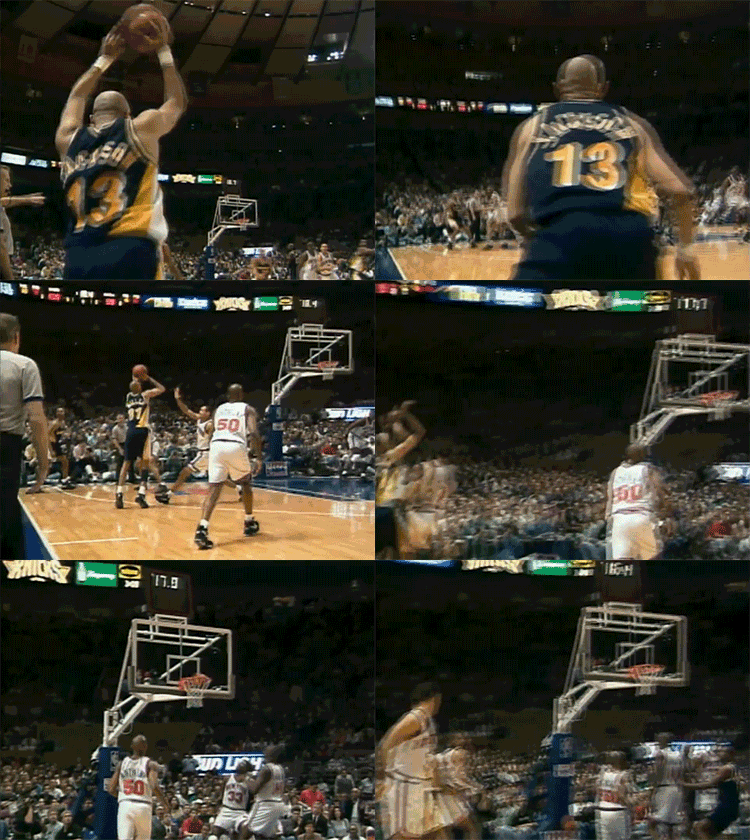
As a basketball connoisseur, I’ve always been fascinated with jump shooting. I remember as a little kid riding my bike to the library each summer, picking up some VHS tutorials of Reggie Miller and Ray Allen, and watching them over and over until I mastered that elegant, fluid release (i.e. ‘follow-through’; see definition/instruction/animation below).

How to follow-through (basketball)

  1. Your wrists should be floppy (relaxed).
  2. Fingers should be pointed at the target (rim).
  3. Finish high. You should see your fingers at the top square of the back board.
  4. Hold your follow through position until the ball hits the rim.

10bc86c7fe8697b03f7022c559a01e5c

Ray-Allen-Hits-Three-to-Force-OT-Game-6-NBA-Finals

What does this have to do with handling wrongful accusation, you say?

Well, in the same way the follow-through allows the hand to maintain motion and guides the ball’s trajectory closer to the basket, focusing on smaller wins2 (i.e. baby steps/progress points on your way to recovery/restoration; see examples below) can maintain confidence and guide selflessness after a bruising experience.

Remember who you are is loved and what you’re called to is love. So if you want to ‘peace’ yourself together, why not give yourself an outlet to express that? Yeah, I know it can be overwhelming at first to reach out, especially when you’re trying to mask pain, but as I’ve learned in recent years, when you invest in those small wins, it’s amazing what can result.

Bottom line: If you’re unjustly critiqued, don’t stay low, finish highand follow-through.

Footnotes

  1. Humility = the pathway to ‘nowhere but up’
  2. ‘Small win’ examples = initiating conversation with colleague, seeking advice from mentor, reading the Word/referencing God, praying, taking ungodly thoughts captive, random acts of kindness, re-focusing energy and attention away from pain, etc.)

Cover image creds: Psychology Today (edited by Cameron Fry)

4 Ways to Level ↑ Your Lock-in

It’s the bane of all youth leaders.

Lock-ins. A time when youth gather to chill, leaders long to chill out, and parents rejoice ‘cause they can chillax’. A time when sugar rushes increase, pizza slices decrease…and, of course, a time when the whole world starts to smell like Mountain Dew and corn chips.

No question, if you’ve ever served in youth ministry, you know what it’s like to love and hate lock-ins; yet, regardless how you feel about them, one thing is for sure: youth show up! Thus, how we approach and frame the event is worth discussion.

Note: While future resources will break down lock-in strategy accordingly to group size, location, and infrastructure, for now, I’m going to focus on four practical points that can help you in your lock-in prep…

Let’s dive in…

source

1. Don’t just plan in advance; pray in advance.

As an architect of nine lock-ins, I’ve found two of the biggest mistakes youth leaders make is overvaluing entertainment and forgetting to pray before planning. I know for me, there have been many times when I started brainstorming connection strategies (i.e. youth to God, youth to youth) only to get sucked into the “this can’t happen apart from recreation” undertow.

Granted, dance-offs, Wii/Guitar Hero tournaments and ice cream sundae bars all have a place; however, it’s only when their ‘place’ becomes defined in the context of ‘primary objective’ that the event they happen in can reach its full potential.

While it’s true the key to quality prep is developing a game-plan from rightfully aligned priorities, when you pray before you plan, not only do you surrender yourselves to God’s agenda, but you free yourself from prematurely tackling your own.

Bottom line: If you want your lock-in to reach its potential, don’t rely on what’s worked in the past or for ‘x’ group; rather reset the slate and pray before you plan.

2. Don’t ‘dele-hate’; delegate.

If you’re like me in the sense that delegating, as a skill, is more acquired than natural, seeking assistance can seem like a last resort; however, with premiere events like lock-ins, not only can sharing responsibility be a freeing experience for adult leadership, but an empowering one for students and families as well.

I remember during one particular lock-in, our team had the youth serve neighboring communities through random acts of kindness before returning to church. The problem was since we didn’t have a church bus at our disposal, I couldn’t transport all our youth at once. Consequently, I had no choice but to call a few parents and request assistance.

Now, I admit: as an independent introvert, I wasn’t too excited making my needs known at first; however, as it turned out, talking to parents proved to be liberating in the sense it allowed me to shed light not only on event vision but group vision.

As for my youth team, I gave each leader a different contact sheet with instructions on inviting their list of youth and reminded them it wasn’t about numbers or outcomes, but making as many youths aware they were welcome.

giphy

Bottom line: Never hesitate to delegate. When you invite parents and youth leaders to get involved, you spread the word more effectively.

3. No free admission.

I know many believe lock-ins should be zero-dollar events, but to be honest, I’m not one of them. While I respect the approach, I’ve found ditching the free admission concept to be more beneficial since it gives youth the chance to turn cash into something they can contribute.

For example, with our lock-ins, I remind the youth each year to bring an ice cream sundae bar topping instead of an admission fee. In this way, each attendee has an opportunity to provide something that makes the lock-in better.

Bottom line: Convert lock-in admission into provision. After all, it’s not about the money; it’s about the giving.

4. Turn out the lights.

Not to sound contrarian, but lock-ins and all-nighters don’t have to be synonymous.

Yeah, I know there’s this notion that says staying up just for the sake of staying up is cool, but as many a youth leader will tell you, a cat nap at a lock-in is often a wise move.

Case in point: A few years ago, my wife and I hosted a “Minute to Win It” lock-in that featured games at the top of every hour. While the theme proved to be a huge hit, perhaps the smartest move for that event was establishing the grand finale game at 2:00 am and using it as ‘halftime’ dividing high-energy activity from wind-down time.

Is it ideal to have every fifteen-minute segment blocked? Technically, yes; however, the way I see it, with any lock-in, the second half should be the most customizable. Personally, I prefer designating the 2:00-6:00 am time frame for watching movies, playing cards/board games or contained group activities conducive to dimmed lighting. That way youth who need rest can find it and those who don’t need it can continue on with slightly quieter forms of fun.

IQ_ULg

Bottom line: Don’t be afraid to encourage rest during a lock-in. Yeah, it may not be ideal for your nocturnal/extroverted youth; however, as long as you frame quiet[er] time with engaging opportunities, you have nothing to lose.

Footnotes

  1. Under discretion, of course 😉

Cover photo creds: themocracy.com

3 Keys to Communicating Vision

When it comes to quality leadership, no question, one of the hardest challenges is communicating vision (i.e. important information necessary for growth and progress). From filtering content to personal interaction, the marriage of progress to relationship can be a messy process. Thankfully, where there’s a will, there’s a way, even if it doesn’t happen the way we want or when we want.

That said…here are three keys to communicating vision effectively…

  1. Say What You Need to Say

When casting vision, it’s important to remember conciseness is more valuable than eloquence. After all, a platform should never be about exposing what you know (i.e. show off), but rather what your audience needs to know (i.e. show how)…which brings me to my first point:

When communicating what an audience needs to know, start with what you need to say first.

More specifically, don’t just filter your content; break it down into lucid, bite-sized bits. That way, you can better discern what is necessary and what is footnote material before you communicate.

For instance, as a wordsmith in youth ministry, I’ve learned my best points, whether delivering a sermon or leading a team meeting, are best received when they lack syntactic ambiguity. In other words, when I use words and phrases that don’t mean different things to different people, not only do I enable my content to be coherent, but I empower my students to interpret it the way it was intended.

Bottom line: Vision doesn’t just point people in the right direction (i.e. makes it plain; see Romans 1:19), it shows them how to get there (bonus points if you include illustrations). Therefore, if you want your audience to capture the vision, make sure you say what you need to say and what your audience needs to hear, not what you want to say or what they think they want to hear.

giphy

  1. Speak the Truth in Love

Yeah, yeah…you get this in theory, but if you’re like me in the sense this doesn’t come as easy in execution, remember you may be in a time crunch, you may have a lot on your plate; however, if you’re not communicating truth in love along the way, not only do you risk a discouraged team, but a disjointed vision split from purpose.

To piggy-back off point #1: what you need to say can’t be what you need to say if love isn’t a part of it. Sure, you may be brimming with epiphanies and award-winning ideas, but if vision isn’t vision without truth and truth isn’t truth without love, then vision can’t be vision detached from best intention.

Remember vision not only seeks the best possible corporate outcome, but inspires love among its enforcers.  Thus, if you aim to love, not only will team morale enhance, but  the bond between vision and audience will tighten as well.

Bottom line: 1) Without love, vision is nothing more than a good idea. 2) Vision, in the context of love, motivates people to keep pursuing it. 3) If you know the truth, speak it in love; if you don’t, love as you pursue it. Either way, it’s a win-win.

giphy-1

  1. Make it Memorable

While vision, at its core, is the mergence of point #1 and #2, if it lacks conviction or captivation, chances are it’s not memorable either. Granted, truth should never be a function of marketability; however, while good vision knows its audience, great vision considers what they’ll remember.

Hence, it’s worth asking: how do you take an entire vision and frame it into something that’s easy to remember and hard to forget?

For starters, it’s always best to keep it simple and straightforward. Focus on syntax and word selection. Use correct grammar.  Be exact in meaning. Then, if necessary, add some flair and poetic license (i.e. turn it into a jingle, structure it ABC style, pose it with rhyme scheme, integrate a relatable metaphor/simile, etc.) Whatever method you apply, remember the goal is to make sure your audience can extend the vision. While making vision plain may seem contrary to making it memorable, if you consider ‘plain’ as the foundation, it will ultimately enable you to build your vision in a way people can understand and promote.

Bottom line: When vision becomes memorable, the impacts become inevitable.

giphy-2

Photo creds: Trendy Bloggers, Giphy

Halftime: 3 Life Lessons From 2017 So Far

As we approach that magical time when people finally stop shooting fireworks, it’s crazy to think we’re only days past the year’s mid-point. Seriously, does anyone else think the first six months of 2017 had twelve embedded in them?

Either way, if you’re like me, then chances are you’ve experienced quite a lot since the time all acquaintances were last forgot.  And while a single blog wouldn’t do justice in capturing the year’s magnitude, it does allow me to reflect on three life lessons learned and re-learned…

  1. More social, less social media

I admit: In my 20’s…I was on social media a little way too much. In fact, it got so bad, I remember arguing with my wife early in our marriage about my perceived unlikability citing red notification bubbles as evidence. Shallow, I know; however, in hindsight, that was a bane I bore…hiding behind the need to ‘turn off’ and catch up on ‘news’, exchanging security for smoke and mirrors as mind went one way and thumbs went another.

But these days the tables have turned. The foremost reason being: I’ve allowed God’s perspective to outweigh all others. Granted, I had to get to that point (which I’ll get to in a second). Still, for the journey to even start, I had to…

a) …die to God’s truth needing validation…

b) …stop using social media as a ‘magic mirror on the wall’ and…

c) …engage my fear of God into the places of rest I was shielding it from.

To do this…I revamped my socio-spiritual diet. I got more intentional having God time before networking time, took ‘leisure’ out of my social media vocabulary, made more concerted efforts to connect in person, and yes, even started removing social media apps after posting. The goal? To dive out of the worlds I wish I could be a part of and re-stake my focus into the one I was in.

Flash-forward to today and I’m still on the recovery road; however, I’m proud to say the distance between ‘social’ and ‘media’ has never been further. Thanks to this first lesson, I’m well on my way moving forward.

  1. To get free, sometimes you gotta get help 

When this year started, I was in a depressive rut. I had just come off the worst December of my life after a solid summer/fall stretch. It literally got to the point where I was at my church worshiping with food poisoning thinking I was having a normal Sunday morning experience. Underwater and disoriented, it’s like I didn’t know what was up or down anymore.

Yet, even in my despair, I recall that still, small voice gently whispering, ‘You’re infected. Get help!’ and (*click play*)…

And so the story of 2017 began…not as a climber looking to scale Everest, but an ex-defeated enthusiast eager  to learn what would heal him to make another run…

….which brings me to Restoring the Foundations (i.e. the ‘help’).

Honestly, I haven’t yet found the words to describe the impact of my RTF week. All I can say for now is I’ve never been so happy to love myself again…to know hope in my helplessness and joy in my brokenness. Yeah, I may not be satisfied where I’m at, but I am satisfied knowing I am Cameron. I may not be a lot of things, but who I am is a catalyst, a fighter in Christ who finally doesn’t need to be understood to be content. While it’s too early to write a book on this, I can sure as heck write a future blog’s worth so stay tuned on this point…

3. Seasons change so you will too

As mentioned, 2017 has been a year of big (yet mostly under the radar) change as the transition current has picked up. Yet, while the flavor of life has sweetened in recent months, there have been some bitter moments…the kind you wish could be out of mind, but seem out of control.

That said, I’ve been rediscovering how being overwhelmed can be ideal to the extent we allow God’s goodness to overflow us more intimately and intentionally. For instance, in my case, having more responsibility spread out on my plate lately has allowed me to distribute my emotional investments more evenly among different people and situations. Now personalities and assignments I would have struggled with in prior years are easier to handle having learned to let pressure refresh the way I prioritize and manage my care.

So I guess you could say: while the breakthrough has certainly been nice, it couldn’t have possibly happened without God turning up the heat. Perhaps that’s why they say seasons change so we can too.

Selah.

Cover photo creds: Pinterest – Pinimg Originals; video creds: Olan Rogers – “A Cut From the Picture”