3 More Things I’m [Really] Sorry For

If you’re like me, you like to reflect.

So much to say, so much to do…how can either happen when there’s so much to think.

Yet, as we journey another January, the heart behind this series, as made known last year, is still the same:

If we want to think right, then we must get right, if we want to get right, then we must get real…and if we want to get real, we must value cleanse before change.

Not to suggest such internal inventory is easy. Certainly putting all things on the table for examination requires courage, humility, vulnerability…among other things; however, since my goal with these posts is to help us embrace God’s ‘next’, it only makes sense to pray into the substitutions¹ God has for us.

That said, here are three things I’m owning as we turn the page to 2019…

1) Making sense of my surroundings

It’s remarkable the ways we justify our surroundings. I know for me, whenever I find myself in what I can’t explain, living in the moment can almost seem secondary to knowing why it has to exist. ‘If only I can solve the mystery, perhaps then I can find the satisfaction and peace I crave,’ I sometimes think.

But as we know, the journey of life is far from cut and dry. As much as we want to reconcile all our relationships and circumstances, we’ll never be able to given sin and free will’s response to it among other things.

Granted, God’s sovereignty isn’t confined by man’s weakness. But it’s also not restricted by our ability to ‘sherlock’ the past. And it’s this temptation I believe trips many of us up. We long to feel affirmed when we’re down. We yearn to feel validated when we smell injustice. We burn to make sense of our surroundings when they don’t make sense. Yet, in our quest to solve our voids, little do we realize the size of our ego and the numbing effect it has on our attitudes and heart postures.

It’s not always fun to accept, but the way I see it: Often the reason we are where we are is because God wants to help us find our kneel…to show us where our independencies have become idolatries…and to learn reliance within the unforced rhythms of grace. Perhaps you’ve struggled to grasp this feeling in seasons of idleness or stress…in settings where you felt more like a fish in an aquatic Pandora’s box.

If so, take a bite of my 2018 testimony. Our free will exists so we can choose Jesus to find freedom. No 12-step program full of striving. Just a simple decision to resist the fear of man and the impulse to make sense of our surroundings.

Accordingly, if you sense the temptation but not the exit, yield to surrender, voice the heartcry, and receive the serenity of stilled waters. God has not abandoned you, so don’t you abandon ship.

giphy

2) The Nazareth complex

I suppose this could be a subset of point #1, but the nature of this conviction alone is worth emphasizing.

As alluded to in my 2018 Year in Review post, when last year started, going back to The Gate was far from an option. Having phased out of LEGACYouth weeks prior, my hope had clung to a sunset narrative where my last days of youth ministry would coincide with where it took place. While there were many reasons I emotionally did not want to return, the core of my withdrawal² centered on what I call the Nazareth complex.

The Nazareth complex is based out of Luke 4:14-30 when Jesus is driven out of his hometown (i.e. Nazareth) after revealing his true identity at the synagogue. While obviously I’m no Jesus, the personal correlation was this: Among whom whose eyes I had been under for years, there was no way for me to be known as God knew me. As such, what Nazareth was to Jesus, The Gate/local church was to me. To move on with my life, I had to leave the church to find anyone who not only would listen, but see me sans past and last name.

Of course, it’s safe to say Jesus never employed such a self-absorbed attitude. Still, it’s not hard to see why my deception took months to dissipate with resentment rooted in deception and victimization fixed in misapplied Scripture. To justify my isolated ego, I had to constantly cite the past, church gossip, unsurrendered soul/spirit hurts…even assumed vain assumptions (sounds confusing, but that’s unholy fear for you).

Yet, as the story goes, I eventually woke up, realizing if I truly wanted to move on and take hold of the new, I couldn’t keep holding on the way I had been. Six months later, the exchange is still ongoing…however, the door to freedom is much wider, in large part, to having repented of this complex.

tumblr_nikl8pxddz1tq4of6o1_5003) Financial fitness

For many couples, one spouse is the buyer, the other is the saver. In my relationship with Lyssah, the contrast is evident. While I’m a buyer who lives well within his means, Lys is much better at budgeting and sticking to it.

Ironically, you would never know by where our financial anxieties lie. As co-bread winners, to make ends meet, we both must work…whatever the cost with whatever time we can give. Unfortunately, the drive for excellence doesn’t always extinguish the entitlements and justifiers we use to buy (or even save for) momentary contentment/peace.

I know for me, I can only afford to invest so much as I near the end of paying off student loans. The white lie, then, is if I can’t currently invest as much as I want for my family, I should be frugal in my giving and employ generosity through alternative means. Yet, as I’ve been convicted, often my lack of giving ties to a lack of trust manifest as leverage against God for not opening certain doors. And I think for some of us, we forget withdrawing doesn’t just apply to our presence and/or banking transactions. It’s applies to trusting God with our finances…our energy…our time…not just what to sow, but where to sow and how much.

All that said, if you feel financial weak starting 2019, you’re not alone. Yeah, I’m an ex-Ramsey spouse. I have content, lessons, and principles I can pass down to future generations. But I also know…

  • If I’m not maturing my stewardship, those values can only go so far.

  • If’ I’m not maturing my stewardship, my intentionality in inviting God into my budget will be compromised.

As for 2019, no longer will I reduce God to an on-call financial counselor and over-rely on my wife’s strengths to make up the difference. Rather, I’m going to pursue financial fitness, embrace frugality under the context of stewardship, and flex into shape accordingly.

Think of it this way: Even though money isn’t the end-all, be-all of extending God’s providence, in no way should we want God’s faithfulness to be restricted by what we’re not trusting Him in.

Besides if you’re reading this, chances are you have enough and know God as more than enough. Not do you have what it takes…but you can do this. Why not do it together?

giphy-1.gif

Selah.

Footnotes

  1. Where I’m letting go of a stronghold, sin, negative thought pattern, etc. to replace it with something better
  2. Albeit an indefinite sabbatical was necessary
Photo creds: https://buzzerg.com

Bearing Forbearance: A SOAP Study on Philippians 4:4-5

Scripture: Phil. 4:4-5

Rejoice in the Lord always; again I will say, rejoice. Let your reasonableness[d] be known to everyone. The Lord is at hand.” (ESV)

d – or gentleness (NIV) or graciousness (HCSB) or considerate (NLT)

Celebrate God all day, every day. I mean, revel in him! Make it as clear as you can to all you meet that you’re on their side, working with them and not against them. Help them see that the Master is about to arrive. He could show up any minute!” (MSG)

Rejoice in the Lord always [delight, take pleasure in Him]; again I will say, rejoice! Let your gentle spirit [your graciousness, unselfishness, mercy, tolerance, and patience] be known to all people. The Lord is near. ” (AMP)

Rejoice in the Lord always: again I will say, Rejoice. Let your [b]forbearance be known unto all men. The Lord is at hand.” (ASV)

Other mentions of forbearance…

✓ O Lord, you know; remember me and visit me, and take vengeance for me on my persecutors. In your forbearance take me not away; know that for your sake I bear reproach.” ~ Jeremiah 15:15

✓ Or do you presume on the riches of his kindness and forbearance and patience, not knowing that God’s kindness is meant to lead you to repentance?” ~ Romans 2:4

✓ Whom God put forward as a propitiation by his blood, to be received by faith. This was to show God’s righteousness, because in his divine forbearance he had passed over former sins.” ~ Romans 3:25

✓ Where your fathers tried Me by testing [My forbearance and tolerance], And saw My works for forty years [And found I stood their test].” ~ Hebrews 3:9

✓ Put on therefore, as the elect of God, holy and beloved, bowels of mercies, kindness, humbleness of mind, meekness, longsuffering; Forbearing one another, and forgiving one another.” ~ Colossians 3:12–13 1

Observations:

1. Forbearance, a word generally found in the King James Version, has two meanings: One is to delay repayment of a debt and the second is an attribute of God’s nature, specifically holding back rightful judgment in favor of patience, mercy, and kindness.

2. Forbearance’s short-term benefit is repentance and its long-term benefit is freedom.

Or do you show contempt for the riches of his kindness, forbearance, and patience, not realizing that God’s kindness is intended to lead you to repentance?” (Romans 2:4, KJV).

In this instance, Paul is warning us not to confuse a delay in discipline/judgment as disinterest or a lack of grace. Instead, Paul is emphasizing the fact we should forbear to judge others given God is constantly forbearing in judging the world.

3. Forbearance is a versatile quality God highly esteems. In fact, several of its facets connect to the fruit of the Spirit in Galatians 5:22. Whether manifest as patience, endurance or gentleness, forbearance is woven throughout the Bible (Proverbs 25:15Ephesians 4:2).

Applications:

1. We live in a world where much comes down to bandwidth and margin. Whether in business, law, or real estate, we tend to think of forbearance has a negative term as it implies the inevitability of a negative outcome…a turning over the keys, if you will. And I think for many of us this results in seeing forbearance as a surrender of control when it reality it’s a surrender of immediate judgment.

Conviction: We talk about making room for Jesus (“prepare Him room” – a popular phrase in worship circles), but often we don’t emphasize making room for forgiveness. Forbearance, while a present action, invests in the future and says when someone wrongs me…when someone offends me…I’m going to be ready. Not for retaliation, not for revenge or manipulation, but for patient grace, for meekness as the model of humility. Hence, why forbearance is an extension of 1 Peter 3:15: “Always be prepared to give an answer to everyone who asks you to give the reason for the hope that you have. But do this with gentleness and respect.” Forbearance has been said to be a honorary fruit of the Spirit; however, the more I think about it, forbearance is perhaps better described as a fruit basket of the Spirit.

2. A repeated command in Scripture is “wait on the Lord” (Psalm 27:14Proverbs 20:221 Corinthians 4:5Isaiah 40:31). Thus, it could be said…

God requires us to wait upon Him in order to help us develop forbearance.

For when we wait upon the Lord, we ultimately increase our capacity to forbear with those around us (1 Peter 3:8).

giphy

Furthermore, sometimes the best place/time to wait on the Lord is when we’re working. As a finance employee, being single-focused on a particular task can come in handy, not only for the job at hand, but in my aim to hear God. Sure, there may be days I feel I’m sinking in the mud of mundanity; however, if I choose to see my effort as an opportunity to listen to my Creator, not only will I develop a more sensitive ear, but a more forbearing heart in the sense I’m cultivating yieldedness as opposed to self-sufficient tolerance.

3. If we’re meant to bear fruit, each others burdens, and with each other in love with all humility and patience forsaking self-righteousness, then forbearance helps get us there. It’s embracing the fact we can reflect the very nature of God without using it our advantage (Phil 2:6-8) as we make every effort to keep the oneness of the Spirit in the bond of peace (Eph. 4:3). It’s a remarkable tool in our spiritual arsenal as it flips the legal IOU mentality for a selfless IOU reality that says. ‘I owe you nothing more than what God shows me every day.’

4. Unfortunately, for many of us, it’s easy to ‘conditional-ize’ forbearance among those we’re comfortable with. We compartmentalize and ration it as we please…as we see fit. I’m sure many of us have seen this demonstrated in secular settings…in the workplace…in the field and beyond. And part of this ties to the obvious…not all are saved, following the Lord, or aiming to be like him so we can’t expect to be on the receiving end of what, rather who, we’re trying to emulate.

At the same time, we can’t give up in being the change we crave, specifically respect to forbearance, being an agent of unbiased unity. When we zoom at Philippians 4 as a whole, note how Paul structures the chapter. Before he talks about how to think and act purely, how he’s learned to be content in all things…how he can do all things through Christ who strengthens him, he first talks about being united. He’s taking vacuum out of the equation.

Forbearance isn’t an exclusive right or privilege, it’s part of a corporate calling that goes beyond the bandwidths and margins we so often quantify. If we truly want to lead a full life, we must be open to full kindness as it’s part of how God leads us to repentance. And shouldn’t we ultimately want this for everyone?

Bottom line: The bridge between being ‘slow to anger’ and ‘abounding in love’ (Psalm 86:15) is forbearance.

Prayer: (see 20:51-22:19)

Footnotes

  1. The New Living Translation words it this way: Make allowance for each other’s faults, and forgive anyone who offends you.
Photo creds: Wallpaper Studio 10

Visions of Vocation (Part 1)

So lately, I’ve been thinking…

…in my quest to resource the church on marketplace ministry, have I been wrong in using the term, ‘bivocational’?

Have I been misleading people through a lack of definition, context…

…or even worse, discouraging people implying the expression as elite?

If so, please know…

  1. My intent is to encourage people where they’re at as opposed to elevating where I’m at.
  2. My goal is to inspire anyone and everyone to run their race to the fullest.
  3. If I’ve given any evidence to the contrary, I sincerely apologize.

Having said that, permit me to press the ‘reset’ button and clean house…

DD4 reset button image2

Going back to our founding in 2014, no question, Lyssah and I were stirred by lessons learned as we balanced jobs in church and out. A quick jaunt to our ‘about’ page confirms this as its composition datestamps a time when our vision, mission, and target audience were finding their niche.

But somewhere during the writing of, ‘The Bottom Line’ in 2016, the tent pegs of what I had thought about ‘bivocational ministry’ began to expand. Suddenly, I saw how ‘bivocational’ in a bifunctional and spiritual gifting context could apply to anyone. As such, by the time I completed the e-book, my thinking had changed so dramatically, what started as a tool for a minority was now a resource for a majority.

Flash-forward to today and the evolution of thought, heart, and content change is still tough to gauge on the outside looking in; hence, why I wanted to take this minute to inform you while we believe occupation and vocation are related, they are not the same thing.

For example, as a youth pastor, what came first: my job or my calling?

If you answered the latter, you’d be correct.

Before I was alive to have an occupation1, God had a specific vocation or klḗsisover my life the same way he had a vocation (i.e. calling) over your life.

2 Timothy 1:8-9 (ESV) confirms this…

Therefore do not be ashamed of the testimony about our Lord, nor of me his prisoner, but share in suffering for the gospel by the power of God, who saved us and called us to a holy calling, not because of our works but because of his own purpose and grace, which he gave us in Christ Jesus before the ages began.

The problem is we often think of ‘calling’ as this one great thing we’re supposed to do whether it’s writing a New York best seller or rising as a top executive at a fortune 500 company; however, when we consider how “in all things God works for the good of those who love him, who have been called according to his purpose” (Romans 8:38), we find God gives us more than one calling.

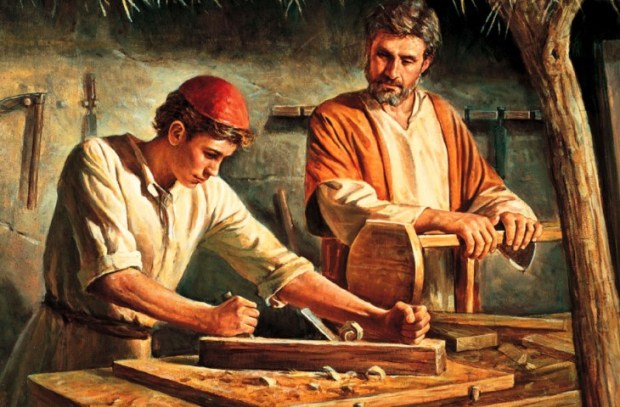
Take Jesus for example: as a child, he was a faithful student; as a teenager, he was a faithful carpenter (with special guest temple cameos); and by thirty, he was a faithful minister.

Now, we can nit-pick whether ‘student’ and ‘carpenter’ are vocations or occupations. Personally, if you used this model to suggest God designated various occupations to prepare His Son for his ultimate vocation (i.e. Matthew 28:19) – “Go therefore and make disciples of all the nations, baptizing them in the name of the Father and the Son and the Holy Spirit“), I wouldn’t disagree.

jesus-nazareth-110-730x480

Whatever the case, my thoughts are…

  1. At each season in Jesus’ life, God was preparing him for his rabbinical destiny.
  2. While there may be seasons we don’t like what we do, God is always preparing us for what we’re meant to do (a truth that exists today just as much as it exists tomorrow).
  3. Therefore, even if our occupations (what we do) and vocations (what we’re meant to do) don’t seem to line up, we can rest in the common denominator of reflecting Jesus.

In essence, while pastors and ministers are multi-occupational in the sense their time is occupied with multiple responsibilities, given we’re all called to ordained vocations3, it makes no sense to promote one “ational” above the other and accordingly, be offended, trip over semantics, or fear political incorrectness.

After all, if we see “bivocational” as God giving us multiple skills and avenues to be salt and light, then divisive misinterpretations (i.e. clergy is on one level, laity is on another) waste away.

As a wise man recently told me…

Every believer has several vocations (rooted in bearing and restoring the image of God) and many occupations. A pastor or minister working 2-3 jobs is no less ordained than one fully supported.”

To this, I 100% agree.

Bottom line: Whether you refer yourself as bivocational and/or multi-occupational, at the end of the day, a) one is not better than the other and b) on a lifetime scale, we are all bivocational and multi-occupational. Remember being bivocational isn’t about having an occupational ministry outlet, but understanding what you’re meant to do (and more importantly, meant to be) regardless of what you do/want to do. It’s knowing no matter how you’re getting paid, the hope of glory (Colossians 1:27) always resides in you.

Selah.

Stay tuned next time when I’ll dive into a recent forum post from a bivocational colleague that testifies to why His Girl Fryday exists.

In the meantime, in all you say and do, remember what and who you’re meant for.

Peace…

~ Cameron

Footnotes

  1. Hebrew translation – Avodah
  2. Vocation in Greek: klḗsis– “to call, summon”) – a calling or invitation into something, specifically receiving God’s gift of salvation – with all His blessings that go with it (Romans 11:29; Ephesians 4:4; 2 Peter 1:10).
  3. And all bear multiple responsibilities

Ephesians 4:1 conveys this…

* NAS: in a manner worthy of the calling with which
* KJV: worthy of the vocation wherewith
* INT: to walk of the calling in which you were called

Cover photo creds: Medium

The Naked Truth: Why Church Needs a Sex Talk

Since its inception, His Girl Fryday has served as a resource helping bivocational/ marketplace leaders mature their influence…and while our mission has always been to bridge sacred and secular, when it comes to absolute truth, ultimately we’re just as passionate outside our niche as within it.

Thus, as we tackle a hot topic in sexuality, understand this message has not only been internally simmering for years (having been ignited during last week’s Messenger Fellowship summit), but also represents one of my deepest pastoral regrets having rarely addressed it1 during my youth ministry tenure. Of course, much could be said in a testimonial setting; for now, let’s focus on how sexuality has been and should be addressed to effectively equip the emerging generation.

—————————————————————————————————————————————–

When it comes to modern day sexuality, no question we live in a unique time caught up in the crossfire of change. On one hand, we have church and culture experiencing seismic shifts in how intimacy and its abuse are perceived. On the other, we have integrity and cross-generational tension in how the Word is interpreted and behaviorally applied².

Yet, while the divide may seem like a slippery slope, how we close the gap is worth discussion given we all struggle (or have struggled) with sexual identity, temptation, compromise, or at the very least, our identity in Christ.

Take my case for example…

As a child of the ’90’s, I grew up in a time when intimacy was seen as forbidden fruit. Not only was sex not talked about outside ‘the birds and the bees’, but hardly anyone wanted to…apart from a few exceptions.

I remember during one 8th grade chapel, my school brought in a young Christian couple to share their “love story”, a PG-13 account of why they waited. Unfortunately, while their testimony captured the wonder of affection, it failed to connect sex to Scripture leaving many peers in a wake of armor-less intrigue.

A few months later, I invited a friend to summer camp during which the last guest speaker defined purity as avoiding promiscuity. But again, like the married couple, though the message conveyed the mystique of sex, the big picture only grew more convoluted, especially for those like me who had become skilled in evading Cosmopolitan without knowing why.

Enter the day my sophomore year when I discovered Victoria Secret in my parent’s mailbox.

Yes, I had learned not to go looking for lust; however, I hadn’t learned what to do when lust came looking for me. Factor in a freshman year marred by peer rejection and bullying and suddenly those scantily clad women were more than just tempting…they were void-filling.

And so began a decadal stretch where self-gratification and fantasy lust not only became on-and-off defaults to loneliness and self-loathing, but self-seeking manifests in romantic relationships3 (more on this in a future post). Thankfully, after years of denial and compromise, the Spirit would meet me in a point of surrender and reset my course.

qtq80-CYVMS1

But by then, the damage had been done. Despite the fact I was a new creation relearning grace, forgiveness, and perseverance in the midst of shame, insecurity, and depression, the weight of deferred awareness -what could have been had I just trashed the lingerie clippings instead of stashing them ten years earlier – bore heavily on my mind.

Not to mention all the ‘what if’s’…

…like what if someone had taught me the wrongs of self-gratification?

…what if someone had taught me the boundaries of intimacy in dating relationships?

…what if I had a mentor who connected taking thoughts captive to pornographic temptation?

…what if the message of sexuality in my youth had involved discovering God’s intent as opposed to guilting people from living outside it?

Maybe then we wouldn’t be having this conversation.

But the reality is we are…because I believe God not only wants to reshape and ‘de-grey’ the way we teach sex, but purge our family lines of where it’s been abused.  Like me, you may have wrestled with a checkered past, but this doesn’t mean God can’t use your fearless voice to stir implicit trust in places of explicit exposure.

The question is: are we willing to be entirely honest and sensitive when we need to?

For as long as sex is minimally approached and swept under the rug, we set our children up to learn the hard way; however, if we truly desire our youth to see sex through the fear of the Lord/their identity in Christ, if we truly long for them to be content in their singleness, and to understand the positives of purity, the rewards of repentance, and the repercussions of sexual sin4, only then will we set a foundation on which they can stand firm.

‘Til then, I submit the church refreshens her approach on teaching intimacy. To paraphrase John Piper…

the problem with the church’s guide to sex education isn’t her instruction on walking in light, but her negligence in modeling a hatred of darkness.

As a result, youth are growing up aware sex has a time and place, like fire in a fireplace, but are far less aware of what to do when the chimney starts to crack or when the fire breaches the home. At some point, we must be willing to convey the fire of intimacy not only through the fatherheart of God, but in eager fashion as people unashamed of the Gospel and our testimony (Romans 1:15-16 AMP). Perhaps then will today’s young people know how to ‘house’ their sexuality where the fireplace was designed to be.

tenor

As for me, all I know is far too long I’ve been on my knees crying for help, but now that help has come…and in its wake…my heart yearns to see future generations know the warning signs that flare in the night and proceed against greed in light of the stronger, holy fire burning within5.

In closing, I encourage you, my friends, let’s be unified in advancing a more vulnerable talk on sex while praying generational healing into the roots of our family trees. After all, as great as the struggle or freedom we’re walking in, how much more glorious the triumph when we embrace the legacy of God’s highest?

Selah.

Footnotes

  1. Granted, the effort was made multiple times; at least we got this far
  2. Hence, why sexuality is such a challenging subject given its taboo label and sandpapery effect on identity/ego/security
  3. Specifically, the lie of ‘as long as it’s not intercourse, it’s okay’
  4. Including the various forms of pornography and self-gratification
  5. Yes, I have DC Talk’s ‘The Hardway’ in my head now; again, I’m a child of the ‘90’s 😉

Cover photo creds: Pond5, Called to be Free

Integrating Ministry & Marketplace: The Temple Template

The vocational life is hard work.

Early mornings, long days, rough nights…if you wear many hats and juggle multiple responsibilities…you know the drill.

Yet, as tempting survival/‘just get ‘er done’ mode may be, truth is: we were never meant to live this way.

Yes, strategic compartmentalization can center the gravity of focus and break busy days into doable, bite-sized moments; however, when we consider our identity as effective influencers in light of Jesus’ ministry,  we ultimately find…

a) Work (what we commit our hands and minds to) and faith (what we commit our beliefs to) were never meant to be mutually exclusive.

b) The marketplace can be just as much a hub of powerful, life-changing ministry as the church1.

Take Matthew 21:12-17 for instance…

After Jesus kicks off the triumphal entry (v. 1-11), note the first place he targets (i.e. the temple – v. 12) and the reason why (i.e. to cleanse it).

I don’t know about you, but when I consider the fact Jesus deliberately went to the temple to make its original intent known as opposed to simply stopping for a cup of coffee and the ‘Daily Jerusalem’…that speaks to me.

Granted, Jesus channels his inner Adele for time, turning tables and all (v. 12b), but the key here isn’t so much Jesus reacting in frustration as much as Jesus setting things right, being fearlessly intentional in speaking truth and breathing life into what had become a lifeless environment.

So while this passage reference may seem random, when we talk about what pastoral ministry in the marketplace looks like and how to rightfully use our spiritual gifts in similar arenas, I believe there’s important application to be found.

First off, to be an effective marketplace minister, we must be courageous and purposeful with the truth. Yes, we can be highly skilled with the gifts God has given us; yes, we can be articulate, persuasive, and emit confidence, but if what we’re divinely given is utilized with limited integrity, it’s like trying to build a sturdy structure on quicksand.

Secondly, when we consider what grieved Jesus most, we deduce how wise marketplace leaders understand the time and place to deal with financial affairs as they understand the providence of God (i.e. the difference between a love for money and a love for God who provides the money2 ;more on this in future posts).

And finally, when we consider Jesus straight up calls the temple “my house(v. 13 – “My house will be called a house of prayer…”), we find the a) confirmation of marketplace as an extension of sanctuary and b) value in declaring God’s original design over an establishment intended for our good.

In this case, Jesus calls the temple a “house of prayer” not only to reveal the truth of its purpose3 (i.e. a place of dwelling, influence, and vertical communication), but to set the stage for the spiritually/physically impaired to better know that purpose (v. 14).

I-Was-There-at-the-Temple-Image

Hence, it should be no surprise to see a completely transformed temple by the time Jesus peaces out in v. 17.

Bottom line: when we reflect on how Jesus integrated his ministry and spiritual gifts into the marketplace, we see…

  1. Jesus was intentional (in going to the temple courts)…
  2. Jesus was bold with the truth and how he handled conflict…
  3. Jesus lived out the identity he declared over the temple…
  4. Jesus loved at every opportunity…

Thus, I submit if we’re going to thrive in employing our spiritual gifts in our areas of business, we must be willing to live on purpose, be bold with the truth, pray without ceasing, be the change we long for…and most importantly…love at all cost, at all times.

Next time, I’ll look to build upon this foundation with more specifics, more real-life application, but for now, if any of this hits home with you (or if you want to add a point to the list above), feel free to comment below. And as always, if you have a prayer request/praise report, you’re more than welcome to drop us a line.

‘Til then, may you find peace and joy in abundance as you go about your week…

~ Cameron

Footnotes

  1. Sure, the church may be the heart of the operation, but what’s to say the marketplace can’t be the hands and feet?
  2. Seriously…how often are good leaders corrupted by sneaky, under-the-table, ‘will do anything to get an advantage’ maneuvers? More than we’d like to admit, right?
  3. As well as His authority

Photo creds: gospelmovements.org (edited by Cameron Fry) & lds.net