Cultivating Compassion: The Power of Empathy at Work (Part 1)

When we assess intelligence in the marketplace, we often refer to one’s aptitude. If one can critically think and problem-solve under pressure, chances are they’re qualified enough to do the job. But in an increasingly tolerant and diverse era, executive priorities are changing. Long gone are leadership committees prioritizing the paper and potential. These days, employers are not only looking to scale one’s ability to reason but also their capacity to relate to colleagues, clients, and social climates.

Essentially, while intellectual ceilings are still being explored, how one nurtures endurance is being implored all the more. In the construct of empathy, this promotes some imperative questions with candidates. Are they willing to broaden their perspective to extend awareness and morale? Can they pierce through emotional dissonance in high-stress situations? Are they able to resonate with the thoughts and feelings of others?

As for those in leadership, are we taking thorough inventory? Have we corporately inquired, ‘What space are we making for cognitive empathy in our workplaces? Heck, do we even know how to define and refine it, let alone shine it?

Regardless, to best answer these inquiries, we must start our examination in the Word. As always, let’s dive in…

Although empathy is not directly stated in Scripture, the concept is conveyed through the behaviors of Jesus and apostolic teachings on love, kindness, and understanding (Romans 12:15, 1 Peter 3:8, Philippians 2:4, and 1 John 3:17-18). While secular approaches paint empathy as little more than emotional sensitivity and selfless concern, when we consider the empathy of Christ, we discover how the virtue goes beyond shared feelings into hands-on support.

One of my favorite examples of this takes place in Luke 13:10-17. In this passage, we find Jesus teaching in the synagogue on the Sabbath when he notices a woman with a disabling spirit. Unable to stand up straight, the woman seeks him in desperation anticipating her deliverance. Upon seeing her, Jesus calls her over, declares her freedom, and proceeds to heal her condition. No longer crooked, she gives glory to God stunning the Sanhedrin.

To me, this story has profound implications in the marketplace. For starters, if we want to lead effectively, we must seek the Lord and apply what He loves with whom He loves. As John 15:13 alludes, no greater love has no hidden agenda, and we must abide accordingly. As leaders, we shouldn’t wait for opportune moments to find us. Rather, we should pursue them with aligned surrender and humility. Christ in us, we don’t need to prove our solicitude, but with eager attentiveness, comfort those who struggle and rejoice with the joyful, allowing our fear of God to be set in motion. In this life, there will be times when we must bear another’s burdens; however, there will also be moments when we must enter into the victory God is unlocking within us as well as those around us. Hence, the significance of empathy in that it keeps us ready to act selflessly in any circumstance!

Furthermore, if we desire empathy, we must aspire to inspire unity in community. Depending on your vocation, this may involve relating to a customer’s experiences, playing peacemaker between colleagues, or offering help on a challenging project. No matter the opportunity, empathy allows you to take heart as you give heart. Within boundary and bandwidth, you can enter into one’s grief, talk to those who may be lonely or hurting, even approach correction with compassion. Honestly, the possibilities are endless!

Bottom line: You have a valuable part in not only enhancing the well-being of your colleagues but also improving the health of your workplace culture. Applying Scripture to your surroundings, you have everything to gain living like Jesus. The more empathy abounds, the more peaceful and effective your organization will be. No need to fear what others say or think as long as your aim is anchored to the voice and heart of God. As for those wrestling with idolatry in the form of craving influence, remember Jesus didn’t passively connect to gain followers but intentionally pursued the salvation and heart change of others. May it be so in our respective surroundings as we believe and minister in greater confidence!

Stay tuned next time when I’ll break down different types of empathy and tie them to various Scriptures and scenarios. Until then…

Selah.

Cover graphic creds: PeopleTalk Online

3 Ways to Overcome Labeling at Work

Labels.

They can be tough to handle. As one who has endured his fair share, my heart is sensitive to those wrestling with identity, to those struggling in the shadow of slander and prejudice. While some people know the truth of who you are, the fact is many are in the dark to what makes them unique. And if we’re to mature in wisdom and influence within our communal arenas, how we stand firm when assailed by this demographic is worth discussion.

Regardless of what we do or where we’re at, whenever vulnerability strikes, having a game-plan is vital in our quest to be more than conquerors (Romans 8:37). Accordingly, here are three ways we can bust the boxes people put us in and prevent their labels from becoming our tags.

1. Anchor Your Belief

Before we take any action, the best way to deal with backbiting is to resist fear through the Scriptures. While how we respond as follow-through is important, how we react in the moment is just as, if not more, crucial. Here’s a check-down of some verses I quote when I sense typecasting, favoritism, or neglect:

For God did not give us a spirit of timidity or cowardice or fear, but [He has given us a spirit] of power and of love and of sound judgment and personal discipline [abilities that result in a calm, well-balanced mind and self-control].” ~ 1 Timothy 2:7 (AMP)

There is no fear in love, but perfect love casts out fear. For fear has to do with punishment, and whoever fears has not been perfected in love. We love because he first loved us.” ~ 1 John 4:18-19 (ESV)

I sought the Lord, and he answered me and delivered me from all my fears.” ~ Psalm 34:4 (ESV)

Do not be anxious about anything, but in everything by prayer and supplication with thanksgiving let your requests be made known to God.” ~ Philippians 4:6 (ESV)

Note how this is merely a shortlist; obviously, you can customize your ‘fear resistant’ prayer guide however you please. Just be advised when you’re on the clock in real-time, our tendency to misread and misjudge what we observe is constantly tested; hence, why it’s important not only to know what you believe but also how to take captive what doesn’t align.

Bottom line: When you suspect attitudinal shifts, be slow to believe what you perceive. Don’t be afraid to resist unnecessary judgments, labels, and deceptions. Even if all you can do initially is defer, defer in faith with the hope of casting all anxieties on the Lord (1 Peter 5:7)

This slideshow requires JavaScript.

2. Pray into the Offense

When we suspect people are labeling us, it’s hard not to take offense. Even if we can’t prove a typecast, the temptation to rationalize what we’re sensing is real, sometimes tantalizing. I know for me, when I perceive a relational distancing from colleagues or co-workers, I start to crave reconciliation before it’s necessary. On one level, I feel a surge of self-perseveration desperate to find a reason why; on another, I’m frustrated to have to own anything in the first place. It’s like a winless tug-of-war: I want to be heard, understood, and not given up on, but in case those fears verify, I want to, at least, be the next best thing…to be right. Not exactly a sustainable formula if community is to be a pure pursuit.

For those wondering why the transparency: I have no problem being vulnerable because I know I’m not alone. The fact is in most cases, insecurity fuels our offenses and if we don’t acknowledge and repent of them, they can pollute our view of relationships, identity, place and purpose, etc.

So what then? If people are nice one day and suddenly stop acknowledging our existence the next, we’re supposed to keep our mouth shut and be okay with it? Well, no, I’m not saying we neglect the opportunities to bridge divides. Conversely, I’m saying if grudges or walls emerge, we must first lean on God’s understanding to accurately see the situation. From there, we can take rest knowing we’re proactively sowing peace as opposed to reactively striving for peace. For there is one God and one mediator between God and men, the man Christ Jesus. Through Him, we can persevere in prayer and thanksgiving that all men be saved and come to the knowledge of the truth (1 Timothy 2:1-5).

Bottom line: Seek correction before direction. Let God be the space between your hurts and emotions. Release the want to control, manipulate, and be a victim. All the while, pray into the offense and don’t be overcome by the absence of good. Rather be the good in the voids you sense, real or imagined.

3. Turn the Cheek…and the Tide

For most of us, we’re familiar with Matthew 5:38-40:

You have heard that it was said, ‘An eye for an eye and a tooth for a tooth.’ But I say to you, Do not resist the one who is . But if anyone slaps you on the right cheek, turn to him the other also. And if anyone would sue you and take your tunic, let him have your cloak as well.

While the general meaning of this passage is to approach evil in the opposite spirit, the concept of turning the other cheek can still be confusing. Is Jesus suggesting we tolerate the presence of malice, gossip, passive-aggressiveness, even silos in our workplaces? Is he hinting we embrace suffering and survivalism as socially acceptable? Not at all. Au contraire, he’s implying we encourage all people through a double portion of his nature.

For instance, if we encounter a void of good, when people are intentionally forsaking us, don’t respond by doing the same. Why lower your standards and behaviors to a level outside your faith? Instead, know your power source and abide in the current of his grace. In this way, you defuse offense, inspire virtue as a contagious overflow, and preserve what needs to be said in a spirit of love.

Bottom line: In the presence of evil, in the absence good, you can’t turn the tide if you don’t turn the cheek. Don’t live in defeat in a moment’s heat but be true to what is right as you stir others to do the same.

Selah.

Stay tuned next time when I’ll dive back into my ‘Trinity as Structure‘ series to discuss the Trinity’s influence on teamwork. For now, I bid you adieu with an inspiring video from New Hope Church:

Cover photo creds: https://medium.com

Say the Words: The Bridge Between Forgiveness and Identity

Okay, so I know I promised a ‘part 2’ in my last post; however, I figured a) I’d delay for some storytime and b) You guys wouldn’t mind a change of pace. Accordingly, I’ll retarget the aforementioned sequel to next weekend. 

So yesterday, I’m eating lunch with some colleagues when suddenly an open question becomes an answer to my silence. An opportunity to share now a moment to care…just without the words.

Deep down, my subconscious begins to skew…

I thought they said life wasn’t supposed to a spectator sport? I should be in the game, not the sidelines! Why did I accept this invitation anyway?

Granted, I’m embarrassed having assumed the question was for me when it was for someone else. Still, I’m desperate to quench this oral craving. Time to take the plunge and jump in, I think to myself.

And so I do. Five minutes in…the first unforced tangent, I carpe diem the crap out of it. Like an open book, I’m elated knowing where I’m going, where I’m stopping, and where I’m headed in this midday manuscript.

What could go wrong’, I wonder. ‘I just need to wrap up my say and head back to the bleachers. Get in, get out, and go home happy.’

And for a while I’m right. After a relay question to stitch the rabbit trail, I‘m not only out, but home happy – the start of 18 hours of muted conscious.

That is until this morning’s 5:30 am wake-up call – a muffled ‘Beautiful Day’ ringtone softened by the tune of leftfield conviction.

You totally hijacked that conversation,” I hear.

Sensing that familiar twilight echo, I quickly realize God is talking to me.

When you go to work today, make sure you apologize to the person you cut off.”

*Sigh* “Okay, God. I get it. You got it. Like my most popular Slack, ‘Will do’.”

Hours later, I’m back in the office, a couple convos into a steady rhythm when my time comes to apologize. Without hesitation, I pivot off a talk of the times to the words of the time.

About yesterday. I know you probably thought nothing of it. Certainly didn’t mean anything by it. But I just gotta say…I totally hijacked that conversation yesterday. It would have been better for me to listen than chime in out of fear of not being heard. Will you forgive me?

Like butter to burnt toast, I smell the melting – this friend of mine, a fairly recent acquaintance, touched by such sensitivity.

Wow, you’re a man of God, aren’t you,” she says.

Uhhh…yes. Yes, I am a man of God. This is true. Can’t argue…” I stagger.

At this point, I’m reeling like a teenage pop-fan in 2012, stunned by this one direction¹. In no way did I expect the dialogue to end up here of all places.

Yet, as I reflect back, maybe I shouldn’t have been so surprised.

‘Cause truth is: Whether we’re owning a misgiving or repenting for a fault, asking for forgiveness always helps us rediscover who we are. Sure, we may feel like a horse being led to water, eager to rid ourselves the yoke of apology. But as I learned this morning, there’s not only grace behind an “I’m sorry”, but identity calibration as well.

As for the apology, some would say I had nothing to apologize about. But for me, I’m glad I had something to own. For when we own something, it only proves we’ve accepted what’s been given in the first place. And while this could look a number of different ways, I submit at the core of it all is a gentle, gracious reminder that we are loved in and through weakness. Even when we’re not perfect, there’s at least room to be perfected – the space in between the sweet spot of our identity.

Selah.

Later this spring, I’ll discuss this forgiveness/identity dichotomy in greater detail. For now, here are some verses we can revisit for next time…

And you, child, will be called the prophet of the Most High;
for you will go before the Lord to prepare his ways, to give knowledge of salvation to his people in the forgiveness of their sins, because of the tender mercy of our God, whereby the sunrise shall visit us from on high.~ Luke 1:76-78 (ESV)

Therefore I tell you, her sins, which are many, are forgiven—for she loved much. But he who is forgiven little, loves little.”  – Luke 7:47 (ESV)

Anyone whom you forgive, I also forgive. Indeed, what I have forgiven, if I have forgiven anything, has been for your sake in the presence of Christ…” 
~ 2 Corinthians 2:10 (ESV)

I am writing to you, little children, because your sins are forgiven for his name’s sake.”  – 1 John 2:12 (ESV)

‘Til then, you got this, people of God…

giphy

Footnotes

  1. Youth pastor joke from my LEGACYouth days (see linked text)…
Photo cover creds: Healthy Beginnings


The Trail We Blaze: 4 Convictions for 2020 (Part 1)

They say life’s a highway…

… like a road you travel on where one day’s here and the next day gone.

But for me, I side with the converse…

…that the highway of life is life-inducing…where one day’s here and the next undone.

At least, that’s the thought as I drive this prairie paradise, my road, my view covered in white. The bleak mid-winter suddenly a meek lid-printer inking this retreat from reality. If only the weather could be as cold as the past three months, maybe then I wouldn’t need an escape to nowhere to tell me what’s up.

But I supposed this is why I’m writing this. Because somehow, someway…I needed to get away to look that direction. Hopefully next time, I can be less spontaneous and more strategic. For now, I want to share four convictions (over two posts) from the past three days that will hopefully change the narrative for me and you in 2020.


On your mark, get set, let’s go…

  1. Rethink ‘More’

If I’ve done anything right in 2020, revisiting ‘The Prayer of Jabez’ (both the verse and Bruce Wilkinson’s book) tops the list. In case you need the refresher…

Oh, that You would bless me indeed, and enlarge my territory, that Your hand would be with me, and that You would keep me from evil, that I may not cause pain.” ~ 1 Chronicles 4:10

Upon first glance, it’s easy to assume ‘enlarge my territory’ is the patented phrase of this passage; granted, for many, these three words can be the critical takeaway at a given point. However, it’s crucial we see a different three-word set as more significant overall.

‘Cause truth is: While asking God to enlarge the territory of our influence has its place, it’s the Immanuel essence of ‘God with us’ – in Jabez’s case, the ‘be with me’ – that’s the core blessing.

Consider this: Jabez could have easily paused after ‘enlarge my territory’ and ended with ‘that I may not cause pain’. But he didn’t. Why? Because he knew the bedrock of what he was asking, specifically that the ‘enlarge my territory’ was dependent on what came next, ‘that Your hand would be with me’. Accordingly, I submit the ‘bless me’ is the ‘be with me’ more than the ‘enlarge my territory’.

Now, before you all get your briefs twisted, understand I’m not trying to smite the Prosperity Gospel though I vehemently disagree with it. If anything, I just want to caution us as vocationals to examine what is driving our requests to God. For many a new year starts and we’re off the races urging God to give us more leadership, more opportunities, and more favor. As if our concept of ‘more’ is perpetually rooted in ‘me’.

But what if I told you we can submit these supplications (Philippians 4:6-7) in a way our intentionality flows from humility, not the other way around?

Would not our initial approach to God’s sovereignty be based in what we’re continually receiving as opposed to what we hope to employ?

Bottom line: While God is certainly for us, this is already established by the fact He is with us. As such, when we ask God for the tent pegs to expand (Isaiah 54:2), remember the point of what you’re asking is “for your sake, so that as grace extends to more and more people it may increase thanksgiving, to the glory of God.” (2 Corinthians 4:15)

giphy

  1. Burn for Longing

We all know time is precious…that every thought, every word, every action has a beginning and an end. Yet, while we know for everything there is a season (Ecclesiastes 3:1-8), we also know for anything we may not have a reason. And if you’re like me, this can be an intimidating prospect.

Sure, we can tell ourselves there’s a time for every purpose under heaven, but let’s be real: How often do we think that ‘time’ is never near…or fear His hand is idle when we need it?

Whatever the case, it’s fair to say…

  1. Anxiety is everywhere with many bogged down by worry, doubt, and uncertainty.
  2. The core of such angst is not only a misuse of trust but a lust for control1.
  3. Such lust often elevates contingency plans above courageous risks.
  4. Consequentially, more people would rather have a reason for everything than a season for anything.

Think of this way: Whenever we yield to anxiety, we’re essentially wanting something right the wrong way. For instance, we may desire what is good, what is true, what is healthy…yet at the end of the day, what’s fuels the desire is a fear of lacking, not a burn for longing. If that’s the case, should it really surprise us when we catch ourselves preempting the possibility of failure for false contentment and security? Or are we so numb by way of self-preservation, we no longer see our ego cheating us from the fill we crave?

If only people knew the pursuit of promise starts with still and ends with will, maybe then we’d be more motivated by longing than lacking.

For now, let’s consider this scriptural rundown of what it means to long and go from there…

“For he satisfies the longing soul, and the hungry soul he fills with good things.” ~ Psalm 107:9 (ESV)

“For the creation waits with eager longing for the revealing of the sons of God.” ~ Romans 8:19 (ESV)

I’m homesick—longing for your salvation; I’m waiting for your word of hope. My eyes grow heavy watching for some sign of your promise; how long must I wait for your comfort? There’s smoke in my eyes—they burn and water, but I keep a steady gaze on the instructions you post. How long do I have to put up with all this? How long till you haul my tormentors into court? The arrogant godless try to throw me off track, ignorant as they are of God and his ways. Everything you command is a sure thing, but they harass me with lies. Help! They’ve ­­­pushed and pushed—they never let up— but I haven’t relaxed my grip on your counsel. In your great love revive me so I can alertly obey your every word.  ~ Psalm 119:81-88 (MSG)

I don’t know about you but give me a burn for longing over a fear of lacking any day! As the Psalmist declares, even when we’re tormented and humiliated, we can yearn to know God…to see His glory permeate the darkness and decay around us. Given God has granted us grace and an abundance of life, take heart: Not only do we have His mind to abide in greater fullness, but also His heart to long for more longing.

giphy-1

Selah.

Stay tuned next time when I’ll unveil ‘part 2’ to this conviction series (by Valentine’s Day *fingers crossed*).

‘Til then, be blessed and be a blessing.

You got this!

~ Cameron

Footnotes

  1. Evidence of contract thinking (more on this in a future post)
Cover photo creds: Subham Dash; loop time-lapse footage by Cameron Fry


Love Reminders: Why Voids Are Not To Be Avoided

I got a random question for you…

Have you ever wondered why it’s easier to accept your flaws as opposed to your voids?

Flaws = Weaknesses, imperfections, what you can control and change

Voids = Lacking a necessary good, what you can’t control and change

If so, I want to encourage you: No matter how vast, no matter how voluminous the void, God’s sovereignty is always greater to not only fill it, but overflow it.

Granted, this truth is clearer conceptually than applicably, not to mention I’m sure there are some who struggle less with voids than flaws; however, in case you’re sittin’ there thinking I get all this, I just don’t know how to get there, consider this post a joint dive in discovering fresh purpose in places you never thought possible.

‘Cause truth is, for many of us (myself included), we prefer bridging our voids than exploring them in depth. Even when we do take the plunge, we’re often not ready for what we may find be it ego, fears, and/or our infatuation with the past. As Richard Rohr states in his book, Immortal Diamond

Whether humans admit to or not, we’re all in love with the status quo and the past, even when it’s killing us. [For most], it’s easier to gather energy around death, pain and problems than joy. For some sad reason, it’s joy we hold lightly and victimhood we hold on to.”

This in mind, let’s go back to the initial question and rephrase it: When it comes to the holes in our lives, have you ever wondered why we put God behind the telescope and our voids under the microscope?

Shouldn’t it be the other way around? Or are we so content in idolizing what’s not working in our life, so content in finding identity in ego¹, we fail to see our voids as God’s love reminder. To quote Jamie George, senior pastor at Journey Church in Franklin, Tennessee, “The thing that’s not working [in your life] is your opportunity for salvation to be saved from your ego and remember who you are.”

7JEbq8

Accordingly, the reason we wrestle with our voids often ties to not knowing what God wants to reveal through them. On the surface, we admit God wants us to know the highest heights of His love in the darkest depths of our despair. Yet, deeper down, we fade God in light of false hopes telling our trust what to do. Before we know it, we’re lost in a search for meaning outside the only place we can find it desperate for breakthrough, but not necessarily for freedom.

tenor

Perhaps this is why Jesus taught love as an invitation first (Psalm 91:14, Matthew 11:28-30, John 3:16, John 15:15, Romans 5:8, Romans 8:38-39, Revelation 3:20) and as an instruction second (Deuteronomy 6:4-5, Matthew 22:37-40)…so we could see awe in the awful and life as not only richer than temporary troubles, but richer because of them! The inevitable hurdles we encounter, they are more than opportunities to be humbled, but lifelines we’re passionately loved and rescued through. Therefore, we must accept the fact voids are imperative in the narrative of our lives as they offer a chance to centralize Christ as our security, the redeemer of all things who takes our time traveling tendencies and morphs them into a desire to know God as perpetual presence.

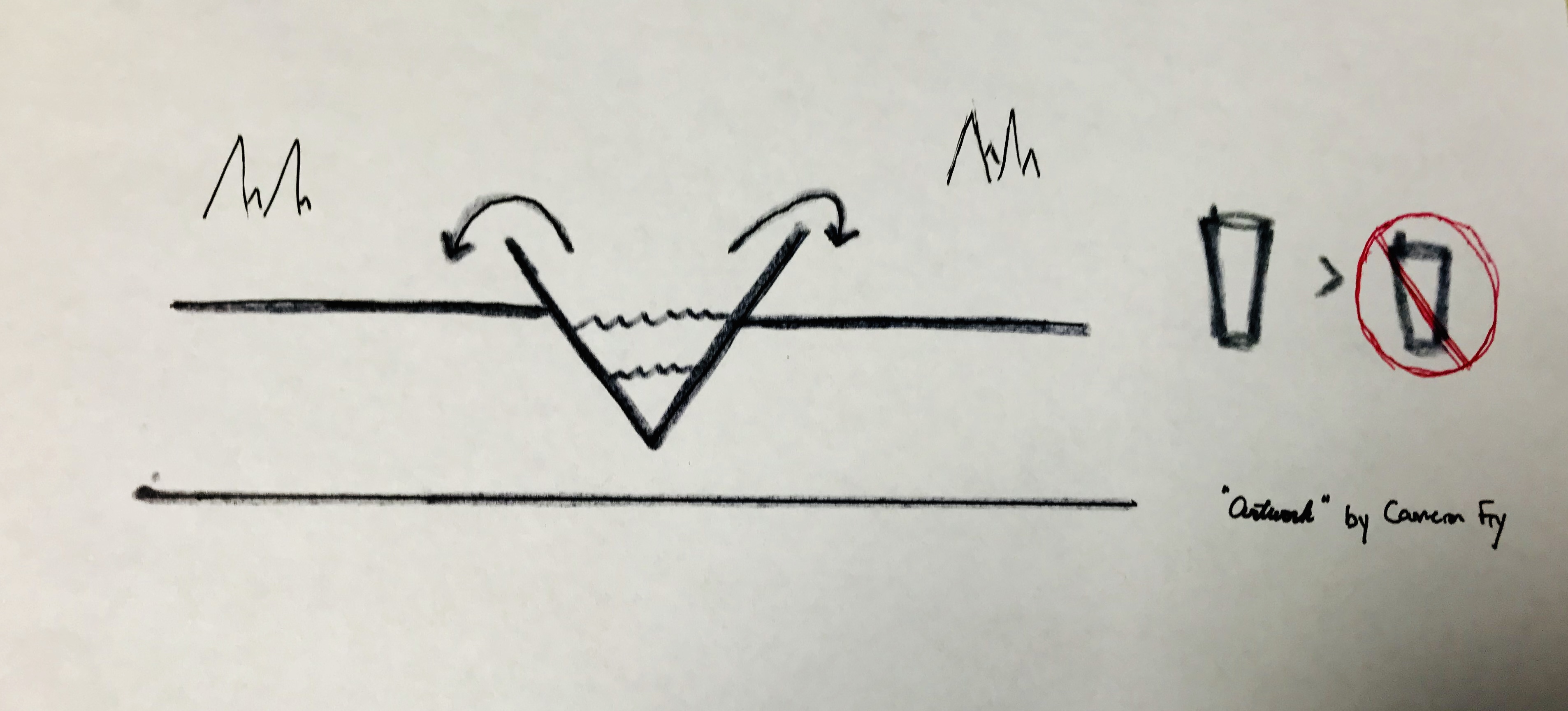
Think of it this way: In this life, on this side of heaven, there are many people living apart from God. To them, fear in the face of chaos makes perfect sense. After all, they have nothing to rely on other than themselves, their hope a mere flatline on the cardiogram of circumstance. But to those who trust in God, they can fear² Him in disarray knowing the chasms created in trial also create the heart space we need to receive those aforementioned love reminders³. As I told a colleague at work today, an empty container is better than no container at all since only the former can be opened and poured into.

IMG_8091

Bottom line:  Whatever you did…whatever you’re going through…those experiences are never worth the fear we preserve keeping them close at heart. Remember your battle scars are more than checkpoints signifying where you got it right; they are altars pointing people in the direction of wonder and reference…the veins by which people can know God longs to commune with them. Ultimately, our voids help us adore God, abide in gratitude, and die to our need to make sense of it all.

Selah.

Footnotes

  1. The sum of self-reliance/independence (i.e. prioritizing reason over faith); sentence shout-out to Jamie George and his Awakening series
  2. Fear as in awe/adoration
  3. See Psalm 23:1-4
Cover photo creds: medium.com