Faith at Work: The Trinity as Structure (Part 1)

So lately, I’ve been thinking about church and marketplace leadership.

Contrasts and comparisons, how the Kingdom applies to governance, management, and authority, things like that. Yeah, yeah, I know this isn’t a new trail of thought. If you’re a regular on here, you know these ideas define a deep-rooted passion within. Still, I can’t help but return to this well especially in a time when there’s so much disruption and disorientation.

In days like these, knowing the grassroots of our identity and calling is critical. As mentioned in past posts, we are all designed as Kingdom agents with appointed influence and spiritual gifts. From the beginning of time, we had a name and a purpose – a destiny to abide through, a God to abide in. The question is: How do we model the everlasting within the expirations of this life? How do we reflect and capture the Trinity in our way of conducting everything from behavior to business? 

While the answers are many, I figure for today we can assess some new angles and later on address how these issues might be changing in the years ahead.

As always, let’s dive in…

Grandpa-diving-board-fail

To understand the Kingdom is to see the Trinity wherever there is appointed structure. This not only includes what God has established for our good but also ‘original intent’ when structures stray from this good.

A classic example of this is the principle we’re all created diverse in function, co-equal in value. While many accept this truth in theory, few default to and apply it due to cultural programming and our quest for meaning. To be fair, this shouldn’t surprise us. After all, in today’s world, we’re told if we want to make a difference, we have to make something of our lives; if we want to change the world, we need to attract attention to what we have to offer. Unfortunately, this not only inflates a sense of survivalism but hinders how we trust in communal contexts. With a societal rise in cynicism as self-preservation, no wonder so many struggle to define servant-based leadership given serving, leading, and relationships are regarded as mutually exclusive.

giphy

Wherever we find ourselves concerning this, we must be unified in our aim to lean on Jesus. By leaning I mean trusting God in what He has modeled and shared from the very beginning – from His love, delight, and compassion to His heart for community and habitation. Remember before there was a creation, there was a culture of safety enjoyed by a Godhead who foreknew the Cross and the ministry of reconciliation to come. By proxy, we can know the Trinity was identifying with our uniqueness long before it existed. As the Psalmist and prophets declared, we were searched and consecrated before our birth (Psalm 139:16, Jeremiah 1:5, Romans 8:29); hence, why we can rest knowing God was engaging relationship with us before we could reciprocate.

Applied to leadership in marketplace and ministry, we can champion these Kingdom grids knowing serving is the leading and the way we approach worship and prayer as a lifestyle. In essence, leading by serving is not only the ‘radical middle’ (i.e. the Spirit/Truth life) at work but also an affirmation of prayer and worship as the core to vocational ministry. Locked into this belief, we can better discern the difference between our aims and what we experience as overflows.

For instance, one of the signs of a healthy church and/or work environment is a culture of humility. To facilitate a culture of humility, one must first trust God to inspire a culture before sowing prophetic encouragement into it. This makes sense given to facilitate at all, there must be people to facilitate to. As the Trinity implies, before anything can be created and developed, there must be time and space granted in the context of rest and relationship. This is why in any setting, people must come before process and procedures.

tumblr_1457319aeb7022cfec0943dfe4666fe9_95364bb7_2048

In business, we see this practically in formation phases: People create the program, not the other way around. If you want to accomplish ground-breaking initiatives, don’t just seize the opportunity to serve, but pour into connectedness and maximize your availability. Don’t simply seek to learn, but seek to burn for what motivates your team. Whatever you do, do until the glory of God knowing you can cultivate community through prayer and worship…even if you can’t always pray and worship together. Remember as servant-leaders, the greatest impacts start by perceiving each function, each engagement as an expression of praise to God. From there, the Spirit/Truth life at work becomes clear, which in summary, is as follows:

  1. Value comes before function.
  2. People come before program. 
  3. Safety comes before creation.

A few words to the wise: Don’t ever use programs to manufacture safety and or emotional margin as leverage for productivity. While dependency keeps us accountable to community, this dependency must always be anchored in Christ alone; otherwise, whatever expression of fearless love we convey will be contained or misleading. Also, comparisons based in insecurity can be just as lethal as untimely agenda. If you ever need a litmus test to gauge the purity of your relational intentions, ask yourself, “Am I resting in my faith? Am I giving God room to invade? Am I helping others taste and see that God is good?’ In doing this, you calibrate to God’s faithfulness operating within you and are rest assured any effort rooted in striving will ultimately not succeed.

Selah.

Cover photo creds: https://www.forbes.com

Kingdom Agents: The Difference Between Gifts, Functions and Vocations (Part 1)

When I say ‘vocation’, what immediately comes to mind?

The 9-5 grind, the hustle and bustle, doing anything and everything to make ends meet?

If so, you’re not alone. After all, the world loves to condition us to view work as a ‘got to’, not a ‘get to’.

Yet, as I was reminded over the weekend, our marketplace vocation goes far beyond immediacy, intellect, and [our sense of] importance. Even though the nature of our jobs may require these elements, the aim of our jobs…the aim of our calling…is to serve as a royal priesthood, as Kingdom agents functioning in personal commission.

The question is: What does this look like and how does this happen?

tenor

For starters, it’s imperative we understand the difference not only between call and vocation but gifts and function.

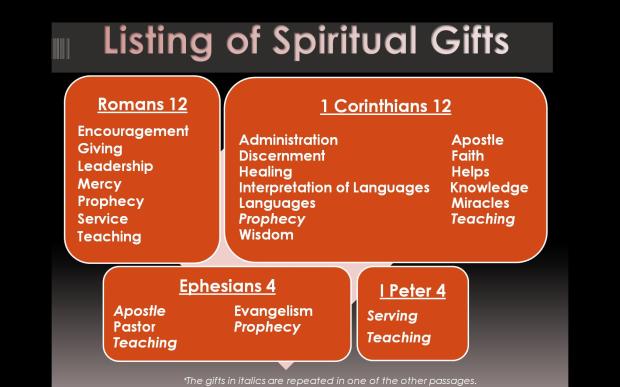
To do this, let’s recap the spiritual gifts as outlined in the New Testament:

*Jesus gifts (Ephesians 4:1-3) – These are part of our vocation and include ascension and equipping gifts as well as the fivefold spiritual gifts (i.e. apostle, pastor, teacher, evangelist, prophet).

Note: While all are wired to shape influence, not all are wired to employ these gifts in the church/in these specific occupations. More on this in a sec.

*Spirit’s gifts (1 Corinthians 12) – These belong to the Spirit and are gifts in a gathering. Some examples include administration, discernment, wisdom, healing, and miracles.

* Community gifts (Romans 4:4, 12:4-8) – These help us function in a local body. Some examples including leadership, encouragement, service, and mercy.

list-of-spiritual-gifts

Due to word count, I’ll link these passages rather than copy/paste; however, after you read them, consider their Greek roots:

1. Romans 12:4-5 – The word for function is the Greek word ‘praxis’ meaning “practice function” and signifies continual activity.

2. Romans 12:6-8 – The word for gifts is the Greek word ‘charismata’ meaning “grace function” and signifies communal activity. In the workplace, we can know these functions as influencing functions.

In both these cases, it’s important to note the origin of gifts point to corporate functions created for unity, not individual skills and talents.

3. Ephesians 4:1-3 – The word for vocation is the Greek word ‘klesis’ meaning “calling function” and signifies the work in which a person is employed. This not only references our occupation but our acceptance of it as a divine call to a particular pathway/course of action.

In this case, it’s critical we know how vocation and calling work together. As Martin Luther once said, “Every person is capable of having a vocation”; however, our universal calling is to be a royal priesthood.

Accordingly, we can break this down as follows:

Our universal calling: Priest (1 Peter 2:9)
Our gifts and functions: Romans 12:4-8
Our vocation: Romans 12 filtered through Ephesians 4


I like how Timothy Williams, author of The Spiritual Gifts, captures the vocational aspect of our spiritual gifts: While we know there are 5 ascension gifts and 7 community gifts,  it’s important to note “each ascension gift has a corresponding functional gift.” For instance, a certain accountant may not be called to serve as a prophet in a ministry setting (i.e. a liturgically designed ascension gift); however, he can still employ prophetic insight through encouragement and counsel in financial arenas (i.e. a vocationally designed ascension gift with specific communal functions). Of course, there may be times the accountant imparts guidance for church staff in critical situations. But the bottom line is: The man of God is at peace serving the body as a financial advisor with a prophetic anointing as opposed to a prophet with financial skills. 

Before I continue, I want to share a couple quick points on ‘vocation’ and how we’re to perceive it in light of our identity:

1. Gifts and vocations are NOT meant to soothe your ego or confirm your identity. If you base ‘who you are’ by ‘what you’ve been given’, you’ll reinforce territorialism in place of influence. Don’t do it!

2. Gifts and vocations are meant to enhance a sense of intimacy. If you base ‘what you’ve been given’ by ‘who you are’, you’ll reinforce a radical dependence on God and radical equality in how you view authority and hierarchy.

3. If we see ourselves as ‘Kingdom agents’, then we’ll a) desire to use our vocation to emphasize the work cultures that already point to Jesus (i.e. redeem our work environment) and b) seek to give clients and colleagues a taste of God by ‘calling forth their destinies’ (i.e. restore people).

4. If we don’t see ourselves as ‘Kingdom agents’, not only will we risk compartmentalizing our sacred and secular lives, but we will also miss opportunities to help people discern spiritual things with their natural minds.

5. Remember we’re all co-equal in value, diverse in function. Therefore, let’s engage our vocation as a holy partnership in influencing people to discover the fruit of their work/organization and in speaking restoration to people without agenda.

Looking ahead to ‘part 2’, I want to revisit William’s quote to help bridge the gap between Ephesians 4 and Romans 12.

‘Cause truth is: If we’re to better understand the relationship between gift and function within our vocation, we’ll need to apply additional grids and principles.

*Cough, Jethro. Cough, perichoresis. Cough*

Additionally, we’ll also need to add ‘elders’ and ‘deacons’ to the pastoral cluster so we can match 7 gifts with 7 functions. But I’m getting ahead of myself.

For now, I hope you were able to glean something out of this introduction. If you have any thoughts or questions, please don’t hesitate to leave a comment or contact me at your convenience.

Until then, God speed on your week. May His sweet presence be fresh wind in your sails as you press into His goodness.

You got this!

Selah.

Cover photo creds: Fast Company; body graphic creds: Msinop; content written by Cameron & Steve Fry; audio voiced by Steve Fry at the 2020 Commission U Leadership Retreat on February 29, 2020