When we talk about leaders doing ‘leader’ things, it makes sense those things remain above reproach. I think we can all agree there.
However, given leaders are people too, one must remember their mistakes are just as inevitable. Thus, how leaders handle adversity, setbacks, and errors in judgment is worth discussion.
For instance, in my ministerial role, there are times a protective heart can become overprotective if offense (real or perceived) compromises trust. Knowing my weakness, there are moments when I start to feel anxious and troubleshoot a problem before praying into it.
In these moments, I find the best way to realign and reset is humility.
Now, humility is one of my favorite topics, in part, since Jesus sets the ultimate example, not to mention, when I’m healthy, the trait isn’t difficult to employ. Growing up, I wasn’t always teachable, but once I started integrating humility into relational troubleshooting, maturing in meekness became more seamless, clicking into gear the more I realized I needed forgiveness on a daily basis.
In the case of this post’s inspiration, I overstepped a boundary in my attempt to establish one. Despite good intention, the execution was marred by impulse and entitlement. After processing my lapse in judgment, I realized…
To receive grace, one must first accept mercy.
The best way to do this is to yield our humanity to humility.
Applying these two steps, it wasn’t long before I went to my pastor and set up a meeting to apologize to those I offended. The process was exhausting yet liberating to the extent I allowed myself to be a grace filter. The more humility flowed through transparency, the more offense evolved into peace and understanding.
All that said, my point in sharing this story is:
1. Humility is a precious gift but also a powerful weapon and an exit strategy for those tempted to take reconciliation into their own hands. If pride (or any derivative) is like being locked out of your car, humility is the wire hanger that breaks the jam and gets you back to where you need to be.
2. There will be times when we think we’ve got it, only to find we’ve lost it. Thankfully, when we receive grace and apply humility, we become more concerned about what is right than who is wrong. By dying to our right to be right, we essentially find the right way to the right path. That’s the power of humility in action.
As for the month ahead, stay tuned as I plan to revisit my toxic workplace series and unveil some traits of healthy/non-toxic work cultures.
‘Til then, stay humble, my friends, and consider praying in the Bible verses below.
Pushed to the wall, I called to God; from the wide open spaces, he answered. God’s now at my side and I’m not afraid; who would dare lay a hand on me? God’s my strong champion; I flick off my enemies like flies. Far better to take refuge in God than trust in people; Far better to take refuge in God than trust in celebrities. Hemmed in by barbarians, in God’s name I rubbed their faces in the dirt; Hemmed in and with no way out, in God’s name I rubbed their faces in the dirt; Like swarming bees, like wild prairie fire, they hemmed me in; in God’s name I rubbed their faces in the dirt. I was right on the cliff-edge, ready to fall, when God grabbed and held me. God’s my strength, he’s also my song, and now he’s my salvation. Hear the shouts, hear the triumph songs in the camp of the saved? “The hand of God has turned the tide! The hand of God is raised in victory! The hand of God has turned the tide!”
Favorite sayings. We all have them.
Epic battlecries, movie references, whispered words of wisdom…there are many phrases we hold dear when chaos is near.
For instance, whenever I’m struggling and need a spark, one of my go-to sayings is “turn the tide”. I don’t know where it comes from, who said it first or its historical origin; all I know is I’m an avid fan of what it represents, the idea you can alter course and be the change you crave even when you feel you can’t stand.
Knowing this, perhaps it’s not too surprising this idiom would resurface during last night’s workout during which I felt the Lord tell me there are many people currently caught in riptides. Riptides of pride. Riptides of anxiety. Riptides of ungodly belief. Riptides of soul/spirit hurt. Riptides of shame. Riptides of discouragement.
You get the picture.
He then said, ‘Cameron, how do you get out of a riptide?‘
I answered, ‘You just wait it out, right?‘
‘That’s one way. What’s the other?‘
I paused.
Then it hit me: The best way to survive a riptide is to swim parallel to the shore.
So I pressed in some more: ‘Lord, what’s your point?‘
He then said my point is…
…I’ve given you a way out when the waves of strife seek to wipe out my waves of life. For my shore is the truth…my shore is the Word…my shore is my unchanging, constant will.
All you got to do is let my shore be your anchor and your horizon. My shore is always your perspective. Why not swim alongside it? No need to overreact. No need to panic. No need to about-face. Just adjust to the shoreline, keep track of it, and eventually, you will swim out of the tide. For tides constantly come and go, but my shore will always be there.
Now, for some of you, this may sound like a glorified remix of another spiritual colloquialism – “If you’re walking through hell, don’t stop“. But to be fair, there’s more under the hood here. For in this word is a secondary reality – the fact there is not only a time for everything but also a tide for anything under the sun (Ecclesiastes 3:1-8). While many understand the value of trusting God to supply needs and/or making a moment count, not nearly as many have a gameplan when undertows strike.
My advice? If life’s a beach, have a guide to survive before you arrive. For what we can’t control is eventual, but what we can is effectual as long as we commit our ways to God James 5:8/2 Corinthians 13:5-style.
You too, be patient; strengthen your hearts [keep them energized and firmly committed to God], because the coming of the Lord is near. Test and evaluate yourselves to see whether you are in the faith and living your lives as [committed] believers. Examine yourselves…and recognize this about yourselves [by an ongoing experience] that Jesus Christ is in you.
Selah.
As for today, if you feel weary, broken, unable to stand, remember while storms come and go, God’s heart is to strengthen your character so His love can be known. Even when you feel discouraged by undertows of stress and fear pulling you down, remember the way out is where He is, the way to the shore! As our ultimate direction, as one who is mighty to save and strong to deliver, He will never abandon or forsake us since His nature is constant. Accordingly, we can navigate the choppy waters of life knowing we have what we need to sail and swim to Jesus.
When I say ‘Acts’, what immediately comes to mind?
Early church? Paul’s conversion? Pentecost? Speaking in tongues?
Perhaps you’re like me in thinking ‘Holy Spirit’, ‘encounter’ or some variation. To be fair, all these are great answers; however, they also occur during the first half of Acts. And as vocationals, I believe it’s important we examine Paul’s ministry in the latter half to understand modern-day application as Kingdom influencers in the marketplace.
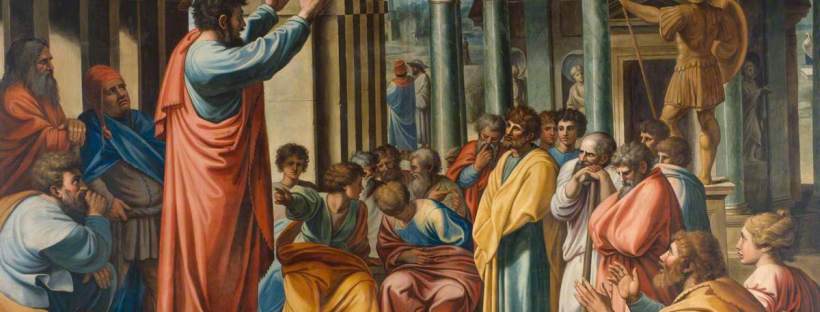
Relative to prior pitstops, the setup to Paul’s Areopagus address is fascinating. After mixed receptions in Thessalonica and Berea, Paul lands in Athens, a densely paganized hub drenched in idolatry (v. 16). Weary from travel, it’s fair to say Paul could have withdrawn or charged the scene in an abuse of confidence; however, as v. 17 states, Paul not only turned the other cheek, but reasoned in the synagogue with the Jews, city officials, and…[wait for it]…marketplace leaders “every day with those who happened to be there“.
This tells me three things off the bat:
Paul knew his audience, intentionally seeking it out realizing where the influence was coming from.
Paul was persistent, persuasive, and patient in his dealings with people from the get-go. As we’ll later see, how else could Epicurean and Stoic philosophers go from “What does this babbler wish to say?” to “May we know what this new teaching is that you are presenting?” in one verse?
Paul understood the seeds of truth he needed to sow, but also the soil he needed to cultivate for those seeds to take root.
Some of the Epicurean and Stoic philosophers also conversed with him. And some said, “What does this babbler wish to say?” Others said, “He seems to be a preacher of foreign divinities”—because he was preaching Jesus and the resurrection.19 And they took him and brought him to the Areopagus, saying, “May we know what this new teaching is that you are presenting?20 For you bring some strange things to our ears. We wish to know therefore what these things mean.”21 Now all the Athenians and the foreigners who lived there would spend their time in nothing except telling or hearing something new.
So Paul, standing in the midst of the Areopagus, said: “Men of Athens, I perceive that in every way you are very religious.23 For as I passed along and observed the objects of your worship, I found also an altar with this inscription: ‘To the unknown god.’ What therefore you worship as unknown, this I proclaim to you.24 The God who made the world and everything in it, being Lord of heaven and earth, does not live in temples made by man,25 nor is he served by human hands, as though he needed anything, since he himself gives to all mankind life and breath and everything.26 And he made from one man every nation of mankind to live on all the face of the earth, having determined allotted periods and the boundaries of their dwelling place,27 that they should seek God, and perhaps feel their way toward him and find him. Yet he is actually not far from each one of us,28 for “‘In him we live and move and have our being’ as even some of your own poets have said,‘For we are indeed his offspring.’”
From here a couple more points stand out…
1. Paul, knowing his audience, not only adapted his language in preaching the Gospel but included secular references in verifying the Scriptures. Note how in v. 28 he cites Epimenides of Crete and Aratus’s poem “Phainomena” to prove the invalidity of temples gods.
I love how Cameron McAllister, a speaker with RZIM, captures this as “cultural apologetics”…
2. Paul, up until now, has not introduced the concept of repentance. This is because he was more concerned about connecting God’s love to creation than freedom from sin – which they lacked context for anyway.
3. Like today’s world, 1st century Athens valued diversity, connectedness, and were open-minded towards many philosophies (v. 21). This is likely why Paul prioritized a) singularity and relationship when explaining God’s absolute nature and b) centralization metaphors/analogies that made sense to them. In other words, Paul knew to capture the sovereignty of God, he had to first emphasize what they inherently knew about Him whether they recognized it or not.
4. As we find in v. 32-34, Paul saw few people converted in Athens on behalf of his presence; however, the lasting influence of his ministry is evident in that today the text of his speeches is still engraved on a bronze plaque at the ascent to the Areopagus.
Applications:
As Paul portrays, relating to the Athens of life is one of the most significant choices we can make as marketplace leaders. Like some of our working environments, Athens was a junkyard of idols, a toxic wasteland where intellect trumped truth. But amidst the funk, there were still people, blind as they were, who were open enough to listen – to give an open space as the Message translates. Thus, it could be said the greatest weakness of the Athenians was also their greatest strength given their misplaced devotion ultimately gave Paul the opportunity to testify.
As for us, there’s something to behold about this moment, especially as it pertains to our vocational environments. For one thing, I believe there are more people with receptible bandwidths in our midst than we think. Like Paul among the Athenians, we are often surrounded by colleagues, co-workers, and supervisors – many of them with a story, a set of ears, and a desire to be heard. Why then do we assume these people wouldn’t want to hear what we have to say? Is it because we’re afraid our vulnerability will not be received? Because we fear the truth will fall on deaf ears? Or are we so insecure, we evade judgment before it’s even cast? Not to downplay the discouragement Christian workers face operating in worldly systems of enterprise. I get how tough it can be when twenty seconds of insane courage become twenty minutes of painful rejection. I’m just sayin’ like Paul, we don’t have to resent the lost for being lost or the hurt for being hurt. Rather, we can sit down, invite them into our confident zones¹, and peacefully present the good news by which we live our lives.
Furthermore, I believe the power in our testimony is enhanced when we choose to speak the language of those we’re witnessing to. Remember everyone has skills and abilities, but very few know where they come from. As such, it’s imperative we acknowledge and affirm the areas God is manifesting through, whether or not they’re immediately recognized. After all, we’re all created by a master Creator with breath to take in the evidence of His presence. Hence, why it makes sense to incorporate the simple things we share in common into the unique ways we capture God’s love.
Selah.
Prayer:
“Lord, we thank you for being our source and our rock. We thank you for going before us to make a way when none seem possible. Day in and day out, you are our sovereign sustenance. What can we do but declare gratitude and victory in your name? But Lord, we also realize as vocationals, as marketplace leaders, as Kingdom influencers…we are not immune to daily alignment. Every day we’re exposed to idolatry, deception…worldly systems of tolerance and reciprocity disguised as love and compassion. We confess there’s much to be frustrated and angry about; however, we also confess your will in us, your Holy Spirit burning within, we have everything we need to counter culture with goodness, godliness, and the love you’re constantly perfecting inside our deep (Psalm 42:7). Give us the strength and discernment, Lord, to use your words in a language those around us can understand. Help us not be closed off to the raw giftings you’ve planted inside those who are far from you. If anything, help us know how to steward those divinely sown seeds so one day those carrying them will know without a day who they come from and why they are there. We choose you and accept the paths you’re establishing even now as we speak. May this all be so in your precious name. Amen.”
Question: What are some of the ways we can approach work as worship?
v 7 – Behave wisely – take life seriously
v 8 – Sound and beyond reproach in instruction
v 9 – Subject in everything, pleasing and not talk back so that in every respect they will adorn and do credit to the teaching of God our Savior
What does ‘adorn’ mean?
Adorn – Implies advancement, a passing on of something; not just something you put on (Proverbs 25:20)
Adorn – An active/direct extension of majesty (God’s sovereignty)
Adorn – Transitive property applied, adorn is all about sharing good news with people. But to share good news with people, it has to be evident in our lives as well.
v.10 – Proving themselves trustworthy*
*Note: ‘Work as worship’ doesn’t mean you effort to prove your maturity. You don’t effort to live above reproach. Without Jesus, you have to rely on yourself. But with Jesus, this becomes an overflow of daily submitting yourself to Christ and His lordship (i.e. ‘not my will, but your will be done’). There’s an investment in doing this, but it’s a joyful one if our heart is to give God all glory.
v 11 – Scriptural evidence that points to God’s grace finding a way to all men
v 12 – Sensible repeated for the fourth time; this is significant.
What does ‘sensible’ mean?
Sensible – Acting within God’s definition of balance; receiving God’s discernment made practical through the Spirit.
Sensible – Spiritual moderation exemplified by “a man who does not command himself, but rather is commanded by God‘” (K. Wuest, Word Studies, 2, 46).
Sensible – The marking of a decision that contributes to the regulation of life; self-control aids this process since the virtue helps us mature as a safe place (evidence) to people and as workers with reliable attitudes and behaviors (manifestation).
Root origins: The root (phrēn) is the root of “diaphram,” the inner organ (muscle) that regulates physical life, controlling breathing and heartbeat.
Example: A good opera singer controls the length and quality of their tones by their diaphragm. This also controls their ability to breathe and moderate heartbeat; hence, why the disaphragm is so valuable as it regulates (“brings safety to”) the body, keeping it properly controlled.
v 13-14 – ‘Work as worship’ means we do good with a good attitude to bring others the good news/into God’s presence. This point only is why we should see self-control as surrendering our control in terms of relationships. Remember God will take care of the possession (making His nature/will known to those around us) as long as we don’t make entering God’s presence all about us.
v 15 – “Tell them these things” – This implies instruction is being modeled with the authority we’ve been given from Christ. Active encouragement and constructive criticism working in tandem. If we do this right, our colleagues and co-workers will be regularly edified.
Thoughts on etymology influenced by Strong’s Concordance; cover photo creds – Logosphere
Scratch notes/commentary from my latest run through Ephesians 2…
1. v. 1-4 – We have every reason to be humble given we’re all blind/once blind as students of worldly systems (hence, ‘course’ in v. 2). As Paul suggests in Colossians 2, these systems operate out of fear and independence, not disobedience. Therefore, it’s worth noting many who are lost won’t immediately see the rebellion of what they’re doing. For those who are saved and now see, we need to focus on what the lost may be able to see first and fears are things all of us can relate to.
2. v. 5 – We’ve been made alive together with Christ so we could ultimately experience life in Christ. We should want to be like Christ not only to model our faith, but so those around us can get as close to a ‘with Christ‘ experience as possible. Our job isn’t to get people in Christ; rather, as we’ll see later in this passage, we’ve been saved by grace to be Christ to people. The joys of fellowship, intimacy, stewardship, compassion we experience in community…this is part of the ‘with Christ’ experience we’re to engage. Put another way, our part in making Christ’s nature known is to be alive with the Christ in each other. In this way, the spirit of authentic community and non-worldly systems can be mutually embraced.
3. v. 10 – For we are His workmanship, created in Christ Jesus for good works…that we should walk in them. It’s not by good works, but for good works. By grace, we have been redeemed not only from desires of the flesh, but also to reveal why good works exist to those who do them.
4. v. 13 – Those who are in nearness with Christ should bridge nearness for others. Not only does this reference the Cross, but it’s also another way of rethinking the ministry of reconciliation (see 2 Corinthians 5).
5. v. 14-15 – Are we breaking down hostilities in our peace-making efforts? Are we allowing Christ to be our peace in the first place? If not, our desire to see unity in community will be hindered. Sometimes, to be a peacemaker we have to focus not only on the internal compromises (i.e. the excuses we make for not doing good), but also the things that keep us from being consistent…from being courageous…from walking in victory in uncharted territory. As Paul often notes in his letters, the law/ordinances not only represented an old way of doing things, but epitomized religion in a new age. Applied to our present, it’s worth asking, ‘Are we tolerating old ways in our life, even if they were once good, by resisting the new way…the new thing…the new work God wants to do?” Post Cross, Christ’s ministry of reconciliation manifests when community intersects sanctification (becoming more like Christ, walking in greater righteousness, holiness made contagious and experienced in koinonia, etc.). As such, both elements should be constantly maturing in our lives.
6. v. 19 – As saints, let the rights of our citizenship not only be self-evident, but contagious and attractive to others. By rights, I’m not suggesting we be entitled, but that we realize we’re no longer foreigners. We are all designed to be a part of God’s family. Accordingly, we should see all people as potential family members in faith.
7. v. 20-22 – It’s easy for those in Christ to accept their corporate identity as the collective body of Christ. But we are also the body in Christ and because of this we shouldn’t see ourselves as individual temples only, but as part of one sacred, sanctified structure coming together, continuing to grow as more come into fellowship…into the presence of God. Put another way, being built up in Christ, with Christ should not be individualized with eternity in mind. Yes, there’s an individual component, but its part in the grand scheme unfolding should not be ignored.
Bottom line: We are made alive in Christ to live life with Christ. His will at the core of our being, let what we believe translate into what we do so the way to God for others can be direct and perceived as good.








 hisgirlfryday.com