Kingdom Aligned: Why the Unshakable Church Starts With Unbreakable Family

Written March 15, 2017; Revised July 12, 2020

Bible verse: Hebrews 12:28-29 (MSG)

“Do you see what we’ve got? An unshakable kingdom! And do you see how thankful we must be? Not only thankful but brimming with worship, deeply reverent before God. For God is not an indifferent bystander. He’s actively cleaning house, torching all that needs to burn, and he won’t quit until it’s all cleansed. God himself is Fire!”

In light of much shaking in the world today, it’s fair to wonder how the church is to become more Kingdom-aligned.

From liturgy to doxology, theology to ecclesiology, there are many topics worth discussing, perhaps more than we like to admit. But before we dive into any ‘ologies’, it’s important we examine the church relative to God’s first command (Genesis 1:28): The family.

As Scripture attests, belonging to a family culture is not only a crucial part of our relational perspective but also our call to engage fellowship and know intimacy. A brief exegesis of Genesis 1 and John 1 confirms this: Before man could exist, there had to be a communal model for him to operate in; however, for this model to also exist, there had to be a holy community sharing everything in common (Acts 1-4) in perfect harmony. Hence, why from the very beginning, the church¹ was a sparkle in the Father’s eye.

Unfortunately, this sparkle is now contending with a culture eager to redefine identity and blur the line between love and tolerance. Stir in a coronavirus, racist divides, and fear propaganda, and there’s even more to distract us from what matters these days. Take it from a brother: If you’re a believer and have struggled lately to combat new deceptions while living your faith, my heart goes out to you. You’re certainly not alone.

Still, despite the challenges, we can’t let temporary headlines shield us from important questions worth asking. In this case…

1. While the church may be conveying truth, is she allowing it to be tasted and seen? Is the church delighting in what she’s demonstrating?

2. If not, how can we expect those outside the church to do the same?

While most would cite an answer between leadership and service, I submit part of the solution to both questions concerns how the church develops and facilities discipleship within the family dynamic.

For instance, in most structures, discipleship is perceived as in-house mentoring with evangelism serving as the primary faith vehicle into the ‘real’ world; however, if the church desires to be more Kingdom-aligned, it should further seek to prioritize these elements in the home. Yes, small groups are essential, but then again, so are Zoom calls, spontaneous texts of encouragement, one-on-one coffees, even charitable support. Like any family, tending community involves systematic and impromptu engagement. And if the church is to be the church today, we must realize this can’t happen without interactive/virtual collaboration on curriculums, events, and leadership/volunteer development.

But reeling it back to 2020: While the COVID-19 epidemic has been discouraging, the evolution of church into the home has been a significant silver lining. While not every experience has been the same, many congregations are discovering new ways to be salt and light in a crooked and twisted time. Accordingly, it’s my hope the church will continue to be Spirit-led as…

1. Her boundaries adapt
2. Her creativity sharpens
3. Her definition of evangelism expands remotely
4. Her definition of discipleship expands virtually 

Assuming all four mature in rhythm, no question, believers will be more equipped to walk in authenticity, confidence, and love (1 Peter 3:15) as immediate and church family relationships strengthen.

Bottom line: If the church wants to mature in her ‘unshakability’. she must also extend her ‘open door’ policy to the home and places of influence. After all, before the church can model grace and love to a deceived generation, she must already be doing so to the next generation. Given we want our church families to be more effective in culture and at work, let’s remember to the extent we desire the unshakable Kingdom, to that extent we must pour into unbreakable family.

Selah.

1556980705

Stay tuned next time when I’ll explore how faith in the marketplace can help bridge family dynamics at work and home. I must admit I’m excited about this new series as it seems largely unchartered.

‘Til then, have a great week, everyone.

Rootin’ for ya as always,

~ Cameron

Footnotes

  1. Not to mention her approach to family discipleship and co-equal in value, diverse in function theology

Cover photo creds: Life Pointe Church

The Trail We Blaze: 4 Convictions for 2020 (Part 2)

After unlocking my first two convictions in ‘part 1‘, I want to conclude this mini-series with two more (despite the fact they are three months overdue – my apologies).

In the spirit of ‘better now than never’…let’s dive in!

6NA

  1. Know you are known.

One of my biggest vices is wanting to be understood…

…the thought that if people just gave me time, be it quality time, time to speak or time to adjust, they’d like what’d they see.

However, as I’ve recently rediscovered: The problem with this mindset is it sets unfair expectations, fuels ego, and fixes identity on satisfied love languages. 

As Scripture attests, a pure desire to be known strays once it seeks to self-satisfy (Romans 8:5-8; Galatians 5-6 MSG). Like a stealthy narcissism, a warped desire to be known is not only egocentric but often can’t function without pride or manipulation. Even if the pride is silent, it can still hinder relationships through the anticipation of self-preservation and withdrawal. Consequently, if we cater to this type of insecurity, it shouldn’t surprise us to find ourselves sealed in cynicism and complacency.

As for the corollary, one of the best ways we invest in others is not preemptively burdening them with a want to be understood. Take it from one who has failed at this time and time again:

If there’s ever a way to trust God as more than enough, it’s through our ‘loved by God’ identity and our ‘love one another’ commission.

Don’t ever put yourself behind the ‘8 ball’ in fear others will set you there first. Instead, cast all fears and anxieties (Psalm 55:22, 1 Peter 5:7 ESV) before they take root knowing God gets you, what you’re going through, and what’s best for you. Trust the Lord will provide the social desires of your heart and focus your mind on loving Christ through serving His people. Surely the arm of the Lord will be with you and enlighten the right minds at the right time along the way.

Bottom line: The human heart wasn’t just made to be known and loved; it was made known and already loved.¹

After all, we were known before we were formed (Jeremiah 1:5, Psalm 139:13-16 ESV) and created for intimacy in a way only God could understand (1 Corinthians 14:2 MSG). ²

As the Psalmist declares…

For you created my inmost being; you knit me together in my mother’s womb.” Yet, even there, “you desired faithfulness…and taught me wisdom in that secret place.” ~ Psalm 139:13, Psalm 51:6 (ESV)

source

  1. Discern the Why’s and the Ways of God

Whoever said Stephen King has been writing ‘2020’ couldn’t have been more accurate.

In a year featuring a global epidemic, killer tornadoes, police brutality riots, and economic recessions, the narrative has been turbulent to say the least.

Yet, despite the political and social unrest, there have been silver linings: Families coming together, spouses maturing in awareness, enterprise and liturgy finding new creative ways to connect and serve. Honestly, the list is longer than you think.

Hence, I’ve been wondering if part of God’s plan for 2020 is to start healing our land from the inside-out. Yeah, yeah, I get why some might think God is wanting to make us more uncomfortable. Like many, I’ve heard the ‘shake, not break’ sermons. But the way I see it, to stop there would be deceiving.

‘Cause truth is: While God may be exposing our privileged mentalities and independencies, His end goal is to perfect our hearts in the abidings of His love and draw us closer to glory. Accordingly, if you’ve felt the divine pruning or sensed the Spirit shaping your reliance, by all means, rejoice and receive God’s work in your life. Don’t waste time focusing on what you lack, but rather in faith, inquire without expectation the ways and why’s of God.

As John 14-16 reminds us…

…to ask of Him is not to be entitled, but to know you’re entrusted.

Even though you may feel pigeon-holed in this time, remember whenever you’re stuck in the corners of life, the only way to go – the only place to look – is up. In every journey, there are fires, conflicts, and forks in the road. But ultimately, the same God who fashioned you is the same God in the thick of your tribulations and decision-making. All the more reason to cherish 2020 knowing God as author, answer, and strength is in it.

Bottom line(s): 1) Know where your help and healing come from. 2) Pursue the bonus opportunities God is directing you to. 3) Embrace the burn as you yearn, the unseen in quarantine. 4) Remember that “God entrusts [you] with a bit of His extraordinary.” ~ Lana Christian

“When the Spirit of truth comes, he will guide you into all the truth, for he will not speak on his own authority, but whatever he hears he will speak, and he will declare to you the things that are to come. He will glorify me, for he will take what is mine and declare it to you. All that the Father has is mine; therefore I said that he will take what is mine and declare it to you.” ~ John 16:13-15 (ESV)

“‘This is what I covenanted with you when you came out of Egypt. And my Spirit remains among you. Do not fear. This is what the Lord Almighty says: ‘In a little while I will once more shake the heavens and the earth, the sea and the dry land. I will shake all nations, and what is desired by all nations will come, and I will fill this house with glory,’ says the Lord Almighty.” ~ Haggai 2:5-7 (ESV)

Selah.

Footnotes

  1. Per David, it’s interesting to note how godly sorrow and godly happiness points back to our ‘loved by God’ identity. If we’re to learn anything about the man after God’s own heart, it’s how to center faith, hope, and love through the emotion of our worship.
  2. Put another way, we were made by love with love for love.
Cover photo creds: DesiringGod.com

The Water Bowl: Why Pilate Washed His Hands

Written on 4/16/2017; revised 4/25/2020

Bible Passage: Matthew 27:11-26

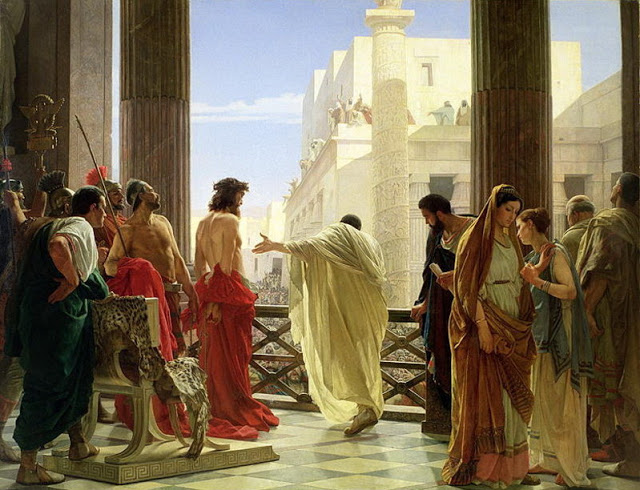
Imagine being Pontius Pilate torn between conviction and affliction, the weight of the world in human flesh standing before you (Matthew 27:23).

No question, it’s a compelling scene: A headstrong Roman official desperate to spare a man he deemed innocent versus a bloodthirsty mob ignorant to Jesus’ Messiahship.

Ecce_homo_by_Antonio_Ciseri_(1)

Who knows what Pilate must have been thinking? What convictions were racing through his mind as he procrastinated the inevitable? If only we could jump inside his head into the tug-of-war, perhaps we could make better sense of such pivotal pressure.

For now, what we can discern is realizing the mob was threatening to riot…

“…he took water and washed his hands before the crowd…” ~ Matthew 27:24 (ESV)

Now, if you think is verse is random, I get it. Without context, this is simply an anecdotal observation; however, in context, this moment carries powerful significance.

For starters, the washing of Pilate’s hands not only symbolized his personal verdict but embodied what Jesus came to do in the first place – to cleanse us from sin (1 John 1:7) and free mankind from captivity (Luke 4:18). In addition, it gave future humanity the opportunity to identify with Barrabas. Like the notorious prisoner, we who deserve death have been given a second chance at life to know what real death is. Accordingly, the prisoner exchange (Luke 4:15-23) can be seen not only as foreshadowing but also as a microcosm of the Cross: Jesus, the son of God, taking the punishment that Barabbas, the anonymous everyman, rightfully deserved – a man guilty of murderous rebellion offset by the one murdered for every rebellion.

Reading on, note the verbal exchange between Pilate and the crowd (v. 24-25):

I am innocent of this man’s blood¹; see to it yourselves. 

His blood be on us and on our children!”

Again, it’s hard to ignore the irony of the situation considering these people, only a week removed from waving palm branches, were declaring judgment on the one who would soon take away their judgment. In a sense, those who knew not what they did were prophecying into those who know not what they do. Though the condemners didn’t understand the power in the blood at the time, they were essentially declaring what we understand today…

Christ’s blood is sufficient to cover the sins of mankind.

I don’t know about you, but I can’t help but marvel at this passage’s symmetry.

‘Cause truth is: While Pilate would ultimately relent to the unrelenting on the ground (v. 26), it was God’s unrelenting from on high that used all things to fulfill the completion of his Word.

And it’s here I want to zero in on since it’s this truth, this past/present/future reality that exemplifies why we celebrate Easter.

For God so loved the world, He had the Cross in mind before he created it. For God so loved us, he was making a way before we even needed it. How sweet it is to know the same God is still unrelentingly reconciling us to himself!

My prayer for you is that as you meditate on Christ’s death and resurrection, you come into a fresh understanding not only of what Christ came to do but what he wants to do in you.

Since therefore Christ suffered in the flesh, arm yourselves with the same way of thinking, for whoever has suffered in the flesh has ceased from sin, so as to live for the rest of the time in the flesh no longer for human passions but for the will of God.” ~ 1 Peter 4:1-2 (ESV)

Rejoice always, pray without ceasing, give thanks in all circumstances; for this is the will of God in Christ Jesus for you. ~ 1 Thessalonians 5:16-18 (ESV)

“He has told you, O man, what is good; and what does the Lord require of you
but to do justice, and to love kindness, and to walk humbly with your God?” ~ Micah 6:8 (ESV)

“And it is my prayer that your love may abound more and more, with knowledge and all discernment, so that you may approve what is excellent, and so be pure and blameless for the day of Christ, filled with the fruit of righteousness that comes through Jesus Christ, to the glory and praise of God.” ~ Philippians 1:9-11 (ESV)

And as you seek Him, I encourage you to pray the blood over your house and the generations to come knowing you can now receive it in joy. Unlike those pleading, ‘Give us Barrabas‘, we can now cry, ‘Give me Jesus‘.

What a way to live the new life we have.

Selah.

Until next time, I wish you all a wonderful Easter full of peace, rest, and grace.

He is Risen…

untitled2

Footnotes 

1) Some manuscripts say ‘righteous blood’

Photo creds: Pinterest, Ecce homo by Antonio Ciseri & jasongoronocy.com

Jethro Principles: Structures for Organized Relationship (Part 1)

Central Thought: The Lord provides a structure in which intimacy with God is nurtured through a system of organized relationships.

Central Theme: The practice of multiple shepherds; the concept of communal shepherding.

Central Culture: A sense of ‘connection’ among members of the Body.
———————————————————————————————————————————————-
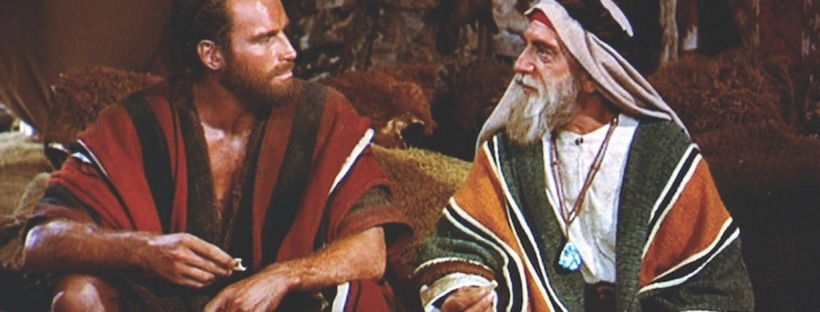
When I say ‘Jethro’ what immediately comes to mind? A husky high priest embracing Moses, guiding him from fugitive to family? A fatherly shepherd in the middle of nowhere?

Perhaps you recall that ‘Prince of Egypt‘ scene when a jovial Jethro leads the Midianites in a festive (“you must learn to join the”) dance around the campfire.

To be honest, I imagine most first impressions of Jethro involves at least one of these things.

But what if I told you Jethro wasn’t just a hospitable father-in-law but a strategic advisor with a depth of business savvy? Would the idea of him being more than a pastoral shepherd cross your mind?

If not, dare to consider Exodus 18 where Jethro advises Moses how to manage two million people, essentially giving him a promised way to the Promised Land.

Let’s set the stage:

After wondering to the wilderness, Jethro finds a swamped Moses settling disputes among the thousands of freshly delivered Israelites. Cloaked in experience, Jethro asks Moses what he’s doing knowing full well what is going on. Moses then replies he’s judging the people as they come to him inquiring God’s will. Immediately, Jethro responds by giving Moses a system and structure for accountable relationship:

Look for able men…who fear God, who are trustworthy…and place them over the people as chiefs of thousands, of hundreds, of fifties, and of tens. And let them judge the people at all times. Every great matter they shall bring to you, but any small matter they shall decide themselves. So, it will be easier for you, and they will bear the burden with you.” ~ Exodus 18:21-22 (ESV)

Heeding Jethro’s advice, Moses appoints a team of elders for each group size in v. 24-26. From there, a relieved Moses finds the flexibility and mobility he needs to meet God on Mount Sinai (Exodus 19) and receive the Ten Commandments (Exodus 20).

Now, I know what you’re thinking: But Cam, I’m low on the totem pole in my not-so-large company. How can this possibly apply to me?

Good news! These Jethro principles, while ancient, are timelessly paramount to the foundations of leadership and character. For starters, not only do they serve as a template for stewarding organized relationships, but also reveal how we, as Kingdom influencers, are to preserve our margins to experience and facilitate intimacy with God. In Moses’ case, he knew God was with him; he just didn’t know how this intimacy needed to be fostered. And I think for many of us, that’s the hardest part: While we may have the discernment, we can’t steer into the unforced rhythms of grace until we embrace our limitations (Matthew 11:20-24) and trust God’s entrusted.

As for Jethro, it’s interesting to note how his counsel reflects the Trinity in an organized relational context where each role is co-equal in value, diverse in function. One could say because of the Godhead, there’s always been a template on how responsibility, accountability, and stewardship operate since one can’t exist without the other. Either way…

…for God so loved the world, He gave us communal systems to be institutionalized so His mission could be realized.

Knowing this, we can see the heart of Jethro more clearly. While delegating authority was crucial in the moment, the intent of his objective wasn’t to establish hierarchy, but to help people discover God and to…

dcc837f9649315879703367e9cb3a17d

Selah.

Study Questions

  1. As Jethro modeled, we serve community as we provide others what they need to receive life and godliness. While the church is a primary outlet, for most, our jobs are the hubs for our social interaction. That said, do you see Jethro principles at work? If so, how are they succeeding and/or where can they improve?
  2. How can one’s concept of authority benefit from the Jethro principles? How can one’s concept of hierarchy benefit from the Jethro principles?
  3. How to Jethro principles help us deal with conflict management and resolution?
Cover photos creds: Simplify the Message; written as mini-devotional for The Gate Community Church (request at or under 500 words)

A New Thing: 4 Easter Insights You May Have Forgotten

So recently I was thinking…

For the past two Easters, I’ve taken an exegetical approach to my content, dissecting familiar topics from unfamiliar angles.

Why the Torn Veil and Split Rocks Matter: https://hisgirlfryday.com/2019/04/19/rolling-stones-why-the-torn-veil-split-rocks-matter/

Saturday Night Lifehttps://hisgirlfryday.com/2018/03/31/saturday-night-life/

However, this year, I’d like to take a different approach. Rather than forge a new facet, I want to read the Easter story from the Message translation for each Gospel…and from there, reveal four underrated Easter passages before lending my commentary.

Sound good?

200

All right! Let’s go…

1. “When it was time, he sat down, all the apostles with him, and said, “You’ve no idea how much I have looked forward to eating this Passover meal with you before I enter my time of suffering. It’s the last one I’ll eat until we all eat it together in the kingdom of God.” ~ Luke 22:14-16

It’s interesting to note Jesus’ demeanor here. In past readings, I’ve often assumed Jesus’ mien at Gethansemne as the same during the Good Supper. But to consider the magnitude of His such enthusiasm, His anticipation…it adds a new dimension to the Passover passage. From the beginning, Christ never lost sight of this moment, but He also never lost the desire to be in community. And now here He was…the Son of Man pouring into man in the most literal way with the Cross, the climax of His mission, in clear view. I don’t know about you, but to know the gladness of Jesus never detached from the glory of His Father is truly inspiring…not to mention one of the more underrated parts of the Easter story. Despite the pain and betrayal before Him, the Cross was all the more. Even in the pre-Passover hour, the tone of Jesus’ final breathes was being set.

As for us, a body of vocationals, let’s remember the model behind this historic screenshot. If Jesus can joyfully partake in a preview of His own death, then we, with Christ in us, can do the same regardless of cost and circumstance. However, in the crossing of troubled waters, remember the bridges involved are not only paved in delight but with people in proximity. Accordingly, let’s not neglect community in our communion with God. Instead, trust God to anchor your relational intentionality within the context of sharing goodness and Good news.

2. “Jesus told them, “You’re all going to feel that your world is falling apart and that it’s my fault. There’s a Scripture that says, ‘I will strike the shepherd; The sheep will go helter-skelter.’ But after I am raised up, I will go ahead of you…” ~ Mark 14:27-28

Here’s a reason why reading the Minor Prophets can prove fruitful during Easter. Remember in Zechariah 13 when Zechariah prophecies about a fountain opening for the house of David to cleanse them from sin and uncleanness? And then in v. 7, he mentions, “‘Awake, O sword, against my shepherd, against the man who stands next to me,’ declares the Lord of hosts. ‘Strike the shepherd, and the sheep will be scattered; I will turn my hand against the little ones‘”?

If not, don’t worry. I had to look it up to be reminded as well. The key takeaway here is the alpha and omega of the passage itself. Having been buried and resurrected with Christ (Colossians 2:12; Romans 6:4), we can know full well any time our world seems to crumble and crack, Jesus is there because He has gone before us. Even when we feel like the one sheep going helter-skelter, astray within our own vanity, we can know Christ will go after us. He took the nails to set us free, but also to pursue us by His Spirit and assure us of His continual Immanuel presence.

BONUS: The last ten seconds of this clip give me goosebumps. Not only did Jesus prophesy Peter’s denial but also his recovery into restoration. No question, the Cross was at the core of everything He spoke into existence.

3. “If people do these things to a live, green tree, can you imagine what they’ll do with deadwood?” ~ Luke 23:31

If you’ve ever had to recite the Easter story, chances are you didn’t quote this line. After all, it’s a tough verse to understand without context. Yes, we can deduce Jesus is the green tree and the deadwood as the ‘builders rejected’ (Psalm 118:22, Acts 4:11), but why would He bring this up in the midst of a death march? As research has shown, there’s plenty of room for debate; however, while some suggest Jesus was hinting at a specific eschatological event (i.e. the destruction of Jerusalem in 70 A.D.), I’m just impressed He was prophesying at all at this point. Even with Simon of Cyrene carrying the Cross, Jesus still had enough selfless awareness to redirect sorrow to its proper source and purify emotions in the light of His suffering. In a sense, not only was Jesus foreshadowing His request for God to forgive the ‘deadwood’, but also sowing truth (John 14:6) in His final moments.

4. “Then he opened their minds to understand the Scriptures.” ~ Luke 24:45

After Jesus’ resurrection, we tend to paraphrase the pre-ascension as ‘Christ making himself known’. And by all accounts, this is true. Before Jesus could ascend, he first needed to ‘show and tell’ before Operation: Great Commission (Matthew 28:18) could begin. However, to stop here would be to stop short. For if we look at this verse in context, we find Jesus was active in awakening faith in the faint of heart. From Mary Magdalene, Joanna and Mary (v. 10) to Cleopas, his wife (v. 31) and the 11…clearly, Jesus had more instruction and blessing to impart. But what ultimately makes these nine words stand out is the demographics behind them. In a poetic and somewhat symmetrical way, Jesus was tying a bow on what He started and cutting a ribbon on what He was about to start. At last the era of the synagogue was transitioning into the dawn of His bride, the church. And who would be in the middle of it but Jesus, the peace-making bridge-builder Himself? I know when we think Jesus as Savior, we think pre-Cross, but the post-Cross sequence, to me, is just as significant in affirming the nature of His love.

Selah.

So there you have it, my friends: Four insights among the thousands currently illuminating around the world.

As you approach tomorrow, my prayer for you is that as you come into a fresh understanding not only of what Christ came to do, but what He longs to do in and through you in the days to come.

Until then, I wish you all a wonderful Easter weekend full of peace and rest as you reflect on the ultimate sacrifice.

~ Cameron Fry

46790

Cover photo creds: Unsplash