
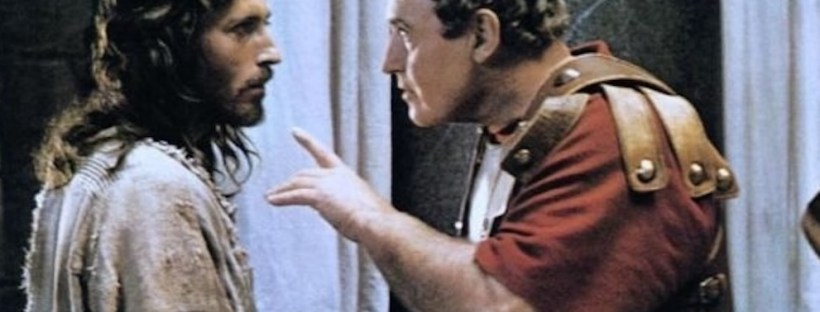
Imagine being Pontius Pilate. A man of high esteem among the Romans but despised by the people of Israel. A leader marked by confidence and chaos, peace and provocations. An ambassador puppet to a foreign land where conflict comes with the territory, where everything you stand for promotes a visceral, divisive reaction.
For a while, things are status quo with the occasional shaking here and there. But then, without warning, in walks a king, the Son of God, a man whose very name was questioned, whose presence would foreshadow the greatest kingdom collapses in history. Who could have known outside the divine? How epic a decision, how dramatic the plate in your lap?
Yet, that’s exactly what you have in John 18-19, a chapter duo ridden with deep denial, betrayal, and surprise confessions.
For many, the chapters read as a prelude to the greatest account of eternal measure, and rightfully so; however, what if I told you the books are more than just a literary overture? What if I told you the exchange between Pilate and Jesus would preview the kind of perspective and contrast we dare embrace today? Where naivety begets a redemptive recognition of truth. Would your mind not be changed or at least freshened to reconsider?
Either way, my curiosity is compelled to Pilate and his part in the resurrection narrative. As always, let’s drill down and dive in…
In the first half of John 18, the Sanhedrin, a council of priestly and lay elders, arrests Jesus during the Jewish festival of Passover, threatened by his teachings and kingdom assertions. After Annas and Caiaphas determine Jesus guilty of blasphemy, he’s brought before Pontius Pilate for judgment in v. 28. At the time, Jewish law prohibited killing one of their own. With Pilate being the only one with power to impose a death sentence, the elders pressure him to crucify Jesus. Amidst the commotion, Peter denies Jesus three times before the rooster’s crow as was foretold.
Seeking to understand the danger behind Jesus’ condemnation, Pilate probes his origin and lordship, stepping in and out of his governor’s headquarters to appease the council. After Pilate asks, “Are you King of the Jews”, Jesus answers, “You say that I am a king. For this purpose, I was born and for this purpose I have come into the world—to bear witness to the truth. Everyone who is of the truth listens to my voice.” Hearing more than he likely anticipated, Pilate poses a fair follow-up, “What is truth?“
While a response isn’t recorded, Pilate’s initial verdict is clear. Without criminal proof, Pilate declares Christ’s Innocence to the Sanhedrin: “I find no guilt in him” (v. 38) and encourages his release again before being met with resistance. Stuck in a stall pattern, Pilate orders Jesus to be flogged and beaten, hoping to satisfy the elders. After applying a crown of thorns into Jesus’ head, the soldiers bring him back to Pilate where again, he proclaims Christ’s blamelessness: “Take him yourselves and crucify him, for I find no guilt in him.” Desperate for control, the elders double-down and ‘double-mind’ their earlier statement (18:31): “We have a law, and according to that law he ought to die because he has made himself the Son of God.” Fearful of a riot, Pilate makes one last attempt to gain clarity from Jesus in a classic ‘help me help you’ moment.
Starting in John 19:9: “He entered his headquarters again and said to Jesus, “Where are you from?” But Jesus gave him no answer. So, Pilate said to him, ‘You will not speak to me? Do you not know that I have authority to release you and authority to crucify you?’ Jesus answered him, ‘You would have no authority over me at all unless it had been given you from above. Therefore, he who delivered me over to you has the greater sin.’ From then on Pilate sought to release him, but the Jews cried out, ‘If you release this man, you are not Caesar’s friend. Everyone who makes himself a king opposes Caesar.” So, when Pilate heard these words, he brought Jesus out and sat down on the judgment seat at a place called The Stone Pavement, and in Aramaic Gabbatha. Now it was the day of Preparation of the Passover. It was about the sixth hour. He said to the Jews, “Behold your King!”
In re-examining this passage, several insights stand out. For starters, the irony of these chapters is largely filtered through its symmetry and the awkwardness of Pilate’s position. The in-and-out of governor’s headquarters, the tug-of-war wavering between two parties keen on not defiling themselves, the contrast between Peter, a disciple, denying Jesus three times and Pilate, an alien, edifying His nature three times. The content and its layout is undoubtedly rich.
But to me, what resonates the most is how this piece of the narrative ends. Say what you want about Pilate’s predicament and decision-making. When we connect the dots within this exchange, we see nothing but truth (and truth seeking) from one who could relate to being despised by Jews, who communicated from authority to authority, who defended the guiltlessness of what he couldn’t understand even when it stood before him.
Make no mistake: Pilate isn’t a hero in the Passion narrative given his indecisive moments and people-pleasing tendencies; however, he is a worthy case study in the sense he sought to circumvent envy and relate to Christ’s innocence not only from what he boldly promulgated but his washing of hands post-sentence (Matthew 27:24). In essence, Pilate was given a tight-rope over shaky ground yet still pursued due diligence to free a righteous man hell-bent on freeing the world from sin. At the very least, we owe Pilate some props in pursuing truth. After all, if we want to point people to Jesus, we must be willing to discover who He is and from there, allow ourselves to be convinced He is set apart as our Messiah.
As for all of us this Easter season, I submit we re-receive the truth about our identity in light of the Cross. For Pilate, he made every attempt to be made innocent of Christ’s blood. But thanks to God’s master plan and Jesus’ sacrifice, we can walk in innocence because of Christ’s blood. No need to wash our hands as long we intend to wash others’ feet. Forward and onward. It’s all up front from here.
Selah. Ecce homo.
Photo creds: pshir.com


 hisgirlfryday.com