
When the world is at war—especially during a conflict you disagree with—it can leave you feeling conflicted about how to even approach God. Do you pray for peace? For justice? For protection?
What if you are no longer entirely sure what the “right” outcome is supposed to look like?
And perhaps even more unsettling: What happens when you are no longer fully confident your own perspective is entirely right either?
If that is where you find yourself, you are not alone.
One of the comforting realities of Scripture is that the Bible makes room for this kind of tension. It gives language to grief, uncertainty, confusion, and even disagreement while still drawing us toward prayer instead of away from it.
So, what does it look like to process war faithfully?
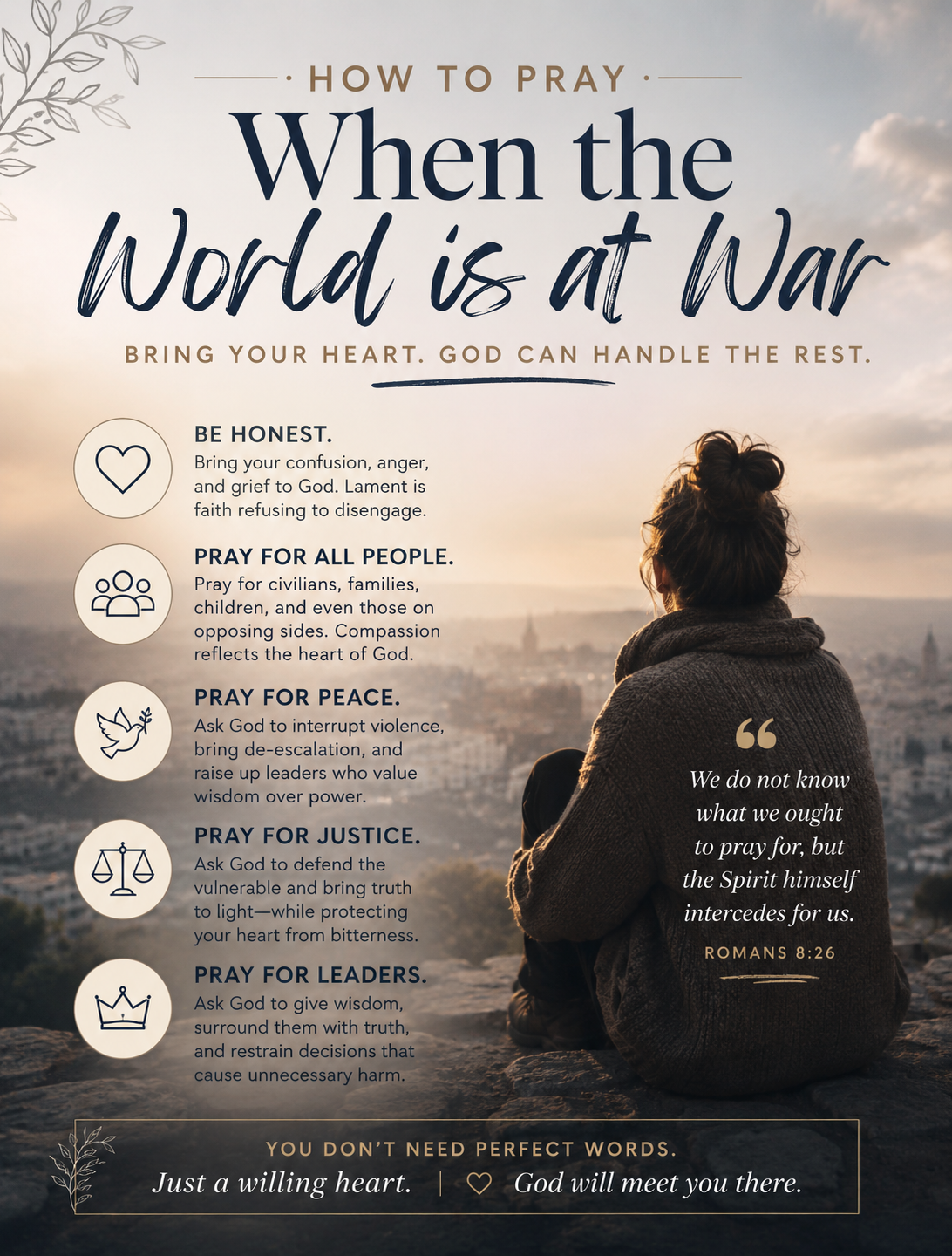
First, it starts with honesty, raw as it may be.
One of the greatest misconceptions about prayer is that we are supposed to sound composed and certain before approaching God. Yet throughout Scripture, we see the opposite. The Psalms are filled with unresolved prayers from people who were hurting, confused, and desperate for understanding:
“How long, Lord? Will you forget me forever?” (Psalm 13:1)
There is nothing polished about that prayer. It is emotional. Unfiltered. Human. And maybe that is the point.
When violence unfolds across the world and everything feels heavy or deeply wrong, we do not have to sanitize those emotions before bringing them to God. We can pray honestly:
- “God, this does not make sense.”
- “I do not understand why this is happening.”
- “This feels heartbreaking.”
Lament is not the absence of faith; it is faith refusing to disengage. At the same time, Scripture continually redirects our attention away from political positions and back toward people—an increasingly difficult thing in an age where outrage spreads faster than empathy.
In 1 Timothy 2:1, Paul urges believers to pray “for all people.” Not merely the people we agree with. All people.
That includes civilians caught in the middle of conflict, families grieving unimaginable loss, children living in fear, and even soldiers on opposing sides of war.
It is possible to care deeply about human suffering without endorsing every action tied to it. Prayer allows us to hold that tension without surrendering compassion. And perhaps that matters more than we realize because prolonged conflict has a way of hardening people if they are not careful.
Jesus said, “Blessed are the peacemakers, for they will be called children of God” (Matthew 5:9). Peace in Scripture is not passive sentimentality. It is something God values deeply.
Praying for peace may feel unrealistic in the middle of war, but it is not naive. If anything, it is resistance against the belief that destruction and violence are inevitable.
Sometimes our prayers are simple:
- “God, interrupt cycles of violence.”
- “Bring de-escalation where tensions are rising.”
- “Raise up leaders who value wisdom over power.”
Even when we cannot envision peace ourselves, prayer aligns our hearts with the heart of God.
But Scripture also makes clear that justice matters deeply to Him.
Micah 6:8 reminds us to “act justly, love mercy, and walk humbly with your God.” I think it is significant that mercy and humility remain attached to justice in that verse because, especially during war, the desire for justice can slowly transform into bitterness, vengeance, or hatred if we are not careful.
Prayer has a way of exposing that shift before it consumes us.
We can ask God to defend the vulnerable, bring truth into the light, and hold powerful people accountable while simultaneously asking Him to protect our hearts from becoming hardened in the process.
Because if we are not careful, we can become so consumed with winning arguments that we forget the humanity of the people suffering underneath them.
Which brings me to arguably one of the hardest parts of all: praying for leaders.
Scripture instructs believers to pray “for kings and all those in authority” (1 Timothy 2:2), even when we strongly disagree with them.
That does not mean endorsing every decision they make. It means recognizing that no earthly authority exists outside God’s awareness and asking Him to intervene where human wisdom falls short.
Sometimes those prayers sound like:
- “Give them wisdom they do not currently have.”
- “Surround them with truth instead of ego.”
- “Restrain decisions that would bring unnecessary harm.”
Other times, all we can bring before God is confusion.
Romans 8:26 says, “We do not know what we ought to pray for, but the Spirit himself intercedes for us.” I love that verse because it reminds us that prayer does not require perfect clarity.
Sometimes faithfulness simply sounds like:
- “God, I feel torn.”
- “I do not know what the right outcome is.”
- “Help me not grow numb to suffering.”
God is not waiting for us to say everything perfectly before He listens. He meets us honestly in uncertainty.
And maybe that is one of the hidden invitations within prayer itself: not merely to ask God to change the world around us, but to let Him change what is happening within us too.
Because over time, prayer has a way of softening us instead of hardening us. It makes us more compassionate instead of more reactive, more humble instead of more certain.
As James 3:17 describes wisdom from heaven is “peace-loving, considerate, full of mercy.”
You do not have to solve the world’s problems to pray faithfully in the middle of them. You simply have to show up honestly and trust that God meets you there.
Graphic generated through ChatGPT
 hisgirlfryday.com