Nothin’ ‘Bout The Blood

So last week I’m on a Messenger Zoom call discussing Triune worldviews when a chilling question is raised:

Are we, as rising, maturing believers valuing the bloodand living in light of that ‘precious flow [making us] white as snow’?

Certainly, it’s easy to think we are given Christ’s death and resurrection is the cornerstone of Christianity.

But what if I told you to the extent we detach God’s communal nature as a foundation of love from our corporate theological foundation, to that extent we reduce the blood as nothing more than a sacrament. Would you agree?

If not, permit me to connect some dots after laying some groundwork…

1. To construct a worldview from the core of God’s nature, we must accept the fact God is a Communion of Three Persons in perfect love.

2. From there, we can establish and grow Biblical community in the same way God does His work: by multiplying what He is as a communion of love.

3. Only then can we value the Gospel and consequentially, understand the destructiveness of sin.

Unfortunately, as we progress in this post-Millennial age, the more young believers are distancing themselves from the saviorhood of Jesus2. As a former student pastor, I can attest to this. For many youth, believing the universal lordship of Jesus having once saved is far less challenging than accepting their current need for a sovereign Redeemer who continues to save.

Granted, our culture’s emphasis of reason over revelation and self-autonomy allots sense to the trend. That said, one must wonder how a world system based on deficiency is affecting the church’s thirst for relevancy.

Take ‘mission’ for example. For most, mission is seen as a journey, an assignment or a means to an end; however, when we note the Godhead, we find ‘mission’ to be an overflow of an established nature.

You see, before love could be extended, there had to be an identity with the ability to love; hence, why so many feel the weight of performance given they’re trying to abide in love not knowing who they really are and as such, forget the key to anything starts and ends with being loved by God.

The question is…

Are we abiding in love…or are we searching in love to find ourselves? Are we trusting God to fill our needs or filling our needs to trust in God? Are we forgiving having received grace or seeking grace in order to forgive?

Either way, it’s worth reminding ourselves…

  1. There’s no depravity God can’t redeem.
  2. Abiding in who we are in Christ is the blueprint to Holy Spirit dependence.
  3. The bedrock of truth, especially as revealed in revelation, is cemented when we allow God to reveal Himself in all circumstances.

giphy-1.gif

As for the blood’s depreciation among ‘next gen’ believers, it’s important we, as the body, perceive the issue as a conflict between identity and performance. For as long as Western individualism exists, so will the temptation to approach mission as drive, fellowship as metric, sin as shame…and thus, the blood as obsolete.

Yet, when we remember we were bought with a price (1 Corinthians 6:20), when we accept Christ’s atonement as the security of our freedom, only then will we understand the blood’s purpose in all things.

For instance…

The blood is central to our community:

Take care and be on guard for yourselves and for the whole flock over which the Holy Spirit has appointed you as overseers, to shepherd (tend, feed, guide) the church of God which He bought with His own blood.” ~ Acts 20:28 (AMP)

The blood is central to reconciliation:

…and through [the intervention of] the Son to reconcile all things to Himself, making peace through the blood of His cross; through Him, [I say,] whether things on earth or things in heaven.” ~ Colossians 1:20 (AMP)

The blood is central to redemption:

In Him we have redemption [that is, our deliverance and salvation] through His blood, [which paid the penalty for our sin and resulted in] the forgiveness and complete pardon of our sin, in accordance with the riches of His grace.” ~ Ephesians 1:7 (AMP)

The blood is central to cleansing:

But when Christ appeared as a High Priest of the good things to come…He went once for all into the Holy Place [the Holy of Holies of heaven, into the presence of God], not through the blood of goats and calves, but through His own blood, having obtained and secured eternal redemption. For if the sprinkling of defiled persons with the blood of goats and bulls and the ashes of a heifer is sufficient for the cleansing of the body, how much more will the blood of Christ, who through the eternal [Holy] Spirit willingly offered Himself unblemished  to God, cleanse your conscience from dead works and lifeless observances to serve the ever living God?”~ Hebrews 9:11-14 (AMP)

Let us approach [God] with a true and sincere heart in unqualified assurance of faith, having had our hearts sprinkled clean from an evil conscience and our bodies washed with pure water.” ~ Hebrews 10:22 (AMP)

Get the picture?

My final thoughts are:

1. To minimize the blood is to minimize our freedom in Christ as it stresses our fear of deficiency over God’s sufficiency (2 Corinthians 12:9).

2. Instead of wanting to be relevant, why make the Good Newsprevalent? After all, the presence of goodwillis a testament to the Good News of the Gospel – the fact Jesus continues to heal the oppressed and set captives free having reconciled us to God through…(wait for it)… His shed blood.

3. Accordingly, by downplaying Christ’s sacrifice, we risk performance systems bridging the gap not only between identity and sin, but also church and mission (more on this in a future post).

I don’t know about you, but give me Jesus and the power of the cross as the divide between those medians.

giphy.gif

Looking ahead, stay tuned for a sequel post where I’ll dive into more detail on how we can better educate young people on how to live in God’s present ministry of reconciliation5.

‘Til then, peace be the journey

~ Cameron

Selah.

Footnotes

  1. Of Jesus
  2. This coming an observation from multiple pastoral colleagues across the country
  3. Which can’t be separated from Christ’s ultimate sacrifice
  4. And our call to extend it
  5. An active reality, not a past occurrence
Cover photo creds: Mudpreacher.org

Begin Again

I’m feeling dry in mid-July as I take to a familiar scene…

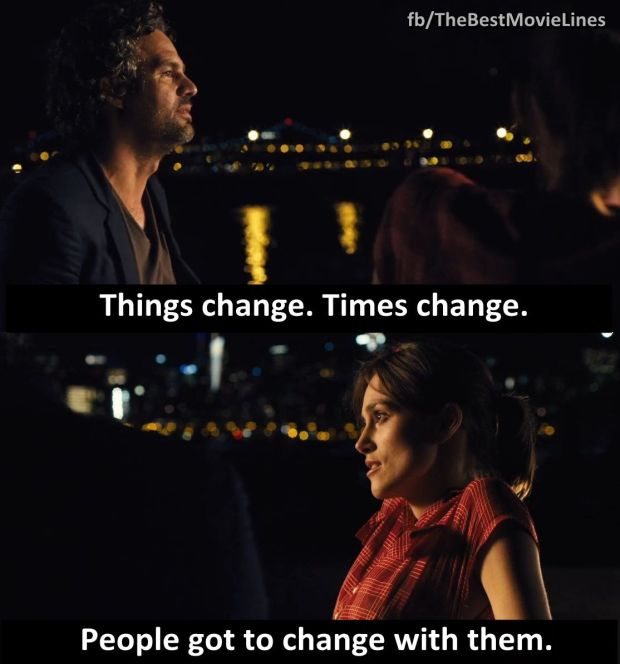
…where Keira Knightley and Mark Ruffalo are, once again…

…deep in nightscape dialogue.

Like them, it’s been a year where nocturnal serenity has frequented my cul-de-sac of vulnerability.

Perhaps this is why I’m watching this, I think to myself.

After all, it’s not every day you catch a cinematic glimpse of what you and God do once the kids go down.

Walk and talk.

Walk and talk.

The perfect end to an imperfect day.

But this time…things are different. For once, I’m inside and idle, content in a still of a different kind.

Riding the rarity, I dive in, the laughs and prose all working towards this one moment…

cba0e11cb0003455e897dafca7344ad6

…sealed by a mic drop for the soul.

And yet, this story, in more ways than one, is just beginning.

For as credits roll, I approach the screen…

…to shelve a case of what was seen…

…only to balk and wonder why.

Why don’t I want to leave this moment, I wonder.

Perhaps it’s a sequence, a song, an emotional call. Perhaps the answer is ‘none at all’.

Either way, I’m at peace. Let it go, let it rest. Sometimes, walking away is best.

Flash-forward to mid-August and I’m cleaning again…the aura of Pledge, a fitting calm.

Then suddenly, it hits me

…what struck me that night was not the scene, but the title itself

…slowly marinating into the stubborn caverns of my disbelief.

Two words…we need, but take for granted; two words…preached, yet breached and slanted.

Two words…an answer once hoped for; two words…a truth igniting my core.

Two words for two months…and likely beyond. Now comes the part I ‘yes’ and respond.

And so it goes…there’s nothing God can’t use to find us and whisper the sweet reminder…

…that sometimes, to go forward, we must go back and…

begin again.

Roll credits.

Photo creds: 7-Themes, Pinterest


Kingdom Carriers: The Reason We Exist (Part 2)

Part 1: Kingdom Agents: The Reason We Exist

So a few weeks back, I’m chillin’ in my humble abode, perusing a couple bivocational pastoral forums when I notice an intriguing update…

I work for UPS and have not taken a salary in the year and a half since I’ve been at my current church. They do provide a parsonage though. I have really been struggling with being bivo[cational]. Outside of my secular job I never feel I’m able to give enough or do enough for my ministry or my family. My job doesn’t build relationships because I’m all way in a different office and on different routes with no real interactions. It really is money only and I hate that. My dream would be to have a job [where] I can truly make money, not a get rich quick gimmick, and that gives flexibility when needed. Actually I’ve always dreamed of opening a coffee and sandwich shop. I have a dream to write but can never get enough time to make much progress. I just have been dealing a lot lately with not being enough, or not achieving enough, in any part of my life. It feels like the duck floating in the water. Things look smooth on the surface but underneath I’m fight what seems to be a losing fight right now. And I don’t know how to fix it or what to do.”

Now, before I continue, understand I’m normally not one to share anonymous posts; however, with this one, I can’t help but resonate given there are people like this all around us…

…questioning their purpose…

…making ends meet…

…all the while desperate to dream in light of their surroundings.

Accordingly, how we engage the chaos in a way that merges ‘hope of glory‘ and ‘hope of freedom‘ within our influence is worth discussion.

My thought is: whether you consider yourself vocational, bivocational, or multi-occupational, regardless of what you’re sacrificing, you desire to lay a foundation of life that pierces the mundane doldrums of an ego-driven culture.

Unfortunately, our desire to build upon this foundation is often offset by discouragement and disorientation. For example, some people know their identity as ‘loved by God’, but feel rudderless in a dead-end situation while for others, they have the ideal situation, but have no idea of who they are and what they’re truly called to.

hsy5VW5

To compound matters, there is dissonance as people who see themselves as a collection of acquired skills and experiences collide with those who view their passions and assignments as functions of their uniqueness. Granted, we live in a fallen world of mixed perspectives where you are what you do outside of what you believe; hence, the tension many believers encounter when they take a servant mentality into the marketplace.

But for the dire dreamer determined to stay up on the down side of life, sometimes acknowledging the fact it’s not supposed to be easy isn’t enough. At some point, we must accept the fact people are not only looking for momentary motivation, but long-term resources and willing availability.

Not to suggest we downplay our readiness in giving answers for the hope we have. I’m just sayin’ if all we’re doing is pointing people, like the UPS man, in the right direction, can we honestly say we’re doing all we can to help? In counseling them to find the tools and direction they’re looking for?

And hear me: I’m not sayin’ we fix all the peoples…all the situations…and make floating ducks feel like power trucks.  I get there are times when all we can do is stand and point people in the way they’re to go.

However, if we see ourselves as Kingdom agents/ambassadors, then we should expect to receive appointed assignments where the only way to reach out is to create room…

…which leads me to why I’m writing this…

…so that we all can be more attuned in extending Jehovah-Jireh hope to the UPS man’s of the world…

…in conveying the promises of God who will not only provide, but get us to the other side…both in trust and in faith.

Perhaps you’re not a fan of who you are or where you’re at right now. Maybe you feel an awkward divide between you and who you wish to pour into1.

If so, I encourage you: stand strong, know you’re loved2, and invite God into the voids you sense. Remember you have what it takes to fight the good fight (1 Timothy 6:11-16)…and by not quitting, you ultimately help others do the same.

As to how we do that?

Well, let’s just say…

that is why we exist.

tenor

Selah.

Footnotes

  1. Or who you wish could pour into you
  2. And never alone
Cover photo creds: benzinga.com


Bearing Forbearance: A SOAP Study on Philippians 4:4-5

Scripture: Phil. 4:4-5

Rejoice in the Lord always; again I will say, rejoice. Let your reasonableness[d] be known to everyone. The Lord is at hand.” (ESV)

d – or gentleness (NIV) or graciousness (HCSB) or considerate (NLT)

Celebrate God all day, every day. I mean, revel in him! Make it as clear as you can to all you meet that you’re on their side, working with them and not against them. Help them see that the Master is about to arrive. He could show up any minute!” (MSG)

Rejoice in the Lord always [delight, take pleasure in Him]; again I will say, rejoice! Let your gentle spirit [your graciousness, unselfishness, mercy, tolerance, and patience] be known to all people. The Lord is near. ” (AMP)

Rejoice in the Lord always: again I will say, Rejoice. Let your [b]forbearance be known unto all men. The Lord is at hand.” (ASV)

Other mentions of forbearance…

✓ O Lord, you know; remember me and visit me, and take vengeance for me on my persecutors. In your forbearance take me not away; know that for your sake I bear reproach.” ~ Jeremiah 15:15

✓ Or do you presume on the riches of his kindness and forbearance and patience, not knowing that God’s kindness is meant to lead you to repentance?” ~ Romans 2:4

✓ Whom God put forward as a propitiation by his blood, to be received by faith. This was to show God’s righteousness, because in his divine forbearance he had passed over former sins.” ~ Romans 3:25

✓ Where your fathers tried Me by testing [My forbearance and tolerance], And saw My works for forty years [And found I stood their test].” ~ Hebrews 3:9

✓ Put on therefore, as the elect of God, holy and beloved, bowels of mercies, kindness, humbleness of mind, meekness, longsuffering; Forbearing one another, and forgiving one another.” ~ Colossians 3:12–13 1

Observations:

1. Forbearance, a word generally found in the King James Version, has two meanings: One is to delay repayment of a debt and the second is an attribute of God’s nature, specifically holding back rightful judgment in favor of patience, mercy, and kindness.

2. Forbearance’s short-term benefit is repentance and its long-term benefit is freedom.

Or do you show contempt for the riches of his kindness, forbearance, and patience, not realizing that God’s kindness is intended to lead you to repentance?” (Romans 2:4, KJV).

In this instance, Paul is warning us not to confuse a delay in discipline/judgment as disinterest or a lack of grace. Instead, Paul is emphasizing the fact we should forbear to judge others given God is constantly forbearing in judging the world.

3. Forbearance is a versatile quality God highly esteems. In fact, several of its facets connect to the fruit of the Spirit in Galatians 5:22. Whether manifest as patience, endurance or gentleness, forbearance is woven throughout the Bible (Proverbs 25:15Ephesians 4:2).

Applications:

1. We live in a world where much comes down to bandwidth and margin. Whether in business, law, or real estate, we tend to think of forbearance has a negative term as it implies the inevitability of a negative outcome…a turning over the keys, if you will. And I think for many of us this results in seeing forbearance as a surrender of control when it reality it’s a surrender of immediate judgment.

Conviction: We talk about making room for Jesus (“prepare Him room” – a popular phrase in worship circles), but often we don’t emphasize making room for forgiveness. Forbearance, while a present action, invests in the future and says when someone wrongs me…when someone offends me…I’m going to be ready. Not for retaliation, not for revenge or manipulation, but for patient grace, for meekness as the model of humility. Hence, why forbearance is an extension of 1 Peter 3:15: “Always be prepared to give an answer to everyone who asks you to give the reason for the hope that you have. But do this with gentleness and respect.” Forbearance has been said to be a honorary fruit of the Spirit; however, the more I think about it, forbearance is perhaps better described as a fruit basket of the Spirit.

2. A repeated command in Scripture is “wait on the Lord” (Psalm 27:14Proverbs 20:221 Corinthians 4:5Isaiah 40:31). Thus, it could be said…

God requires us to wait upon Him in order to help us develop forbearance.

For when we wait upon the Lord, we ultimately increase our capacity to forbear with those around us (1 Peter 3:8).

giphy

Furthermore, sometimes the best place/time to wait on the Lord is when we’re working. As a finance employee, being single-focused on a particular task can come in handy, not only for the job at hand, but in my aim to hear God. Sure, there may be days I feel I’m sinking in the mud of mundanity; however, if I choose to see my effort as an opportunity to listen to my Creator, not only will I develop a more sensitive ear, but a more forbearing heart in the sense I’m cultivating yieldedness as opposed to self-sufficient tolerance.

3. If we’re meant to bear fruit, each others burdens, and with each other in love with all humility and patience forsaking self-righteousness, then forbearance helps get us there. It’s embracing the fact we can reflect the very nature of God without using it our advantage (Phil 2:6-8) as we make every effort to keep the oneness of the Spirit in the bond of peace (Eph. 4:3). It’s a remarkable tool in our spiritual arsenal as it flips the legal IOU mentality for a selfless IOU reality that says. ‘I owe you nothing more than what God shows me every day.’

4. Unfortunately, for many of us, it’s easy to ‘conditional-ize’ forbearance among those we’re comfortable with. We compartmentalize and ration it as we please…as we see fit. I’m sure many of us have seen this demonstrated in secular settings…in the workplace…in the field and beyond. And part of this ties to the obvious…not all are saved, following the Lord, or aiming to be like him so we can’t expect to be on the receiving end of what, rather who, we’re trying to emulate.

At the same time, we can’t give up in being the change we crave, specifically respect to forbearance, being an agent of unbiased unity. When we zoom at Philippians 4 as a whole, note how Paul structures the chapter. Before he talks about how to think and act purely, how he’s learned to be content in all things…how he can do all things through Christ who strengthens him, he first talks about being united. He’s taking vacuum out of the equation.

Forbearance isn’t an exclusive right or privilege, it’s part of a corporate calling that goes beyond the bandwidths and margins we so often quantify. If we truly want to lead a full life, we must be open to full kindness as it’s part of how God leads us to repentance. And shouldn’t we ultimately want this for everyone?

Bottom line: The bridge between being ‘slow to anger’ and ‘abounding in love’ (Psalm 86:15) is forbearance.

Prayer: (see 20:51-22:19)

Footnotes

  1. The New Living Translation words it this way: Make allowance for each other’s faults, and forgive anyone who offends you.
Photo creds: Wallpaper Studio 10

Visions of Vocation (Part 1)

So lately, I’ve been thinking…

…in my quest to resource the church on marketplace ministry, have I been wrong in using the term, ‘bivocational’?

Have I been misleading people through a lack of definition, context…

…or even worse, discouraging people implying the expression as elite?

If so, please know…

  1. My intent is to encourage people where they’re at as opposed to elevating where I’m at.
  2. My goal is to inspire anyone and everyone to run their race to the fullest.
  3. If I’ve given any evidence to the contrary, I sincerely apologize.

Having said that, permit me to press the ‘reset’ button and clean house…

DD4 reset button image2

Going back to our founding in 2014, no question, Lyssah and I were stirred by lessons learned as we balanced jobs in church and out. A quick jaunt to our ‘about’ page confirms this as its composition datestamps a time when our vision, mission, and target audience were finding their niche.

But somewhere during the writing of, ‘The Bottom Line’ in 2016, the tent pegs of what I had thought about ‘bivocational ministry’ began to expand. Suddenly, I saw how ‘bivocational’ in a bifunctional and spiritual gifting context could apply to anyone. As such, by the time I completed the e-book, my thinking had changed so dramatically, what started as a tool for a minority was now a resource for a majority.

Flash-forward to today and the evolution of thought, heart, and content change is still tough to gauge on the outside looking in; hence, why I wanted to take this minute to inform you while we believe occupation and vocation are related, they are not the same thing.

For example, as a youth pastor, what came first: my job or my calling?

If you answered the latter, you’d be correct.

Before I was alive to have an occupation1, God had a specific vocation or klḗsisover my life the same way he had a vocation (i.e. calling) over your life.

2 Timothy 1:8-9 (ESV) confirms this…

Therefore do not be ashamed of the testimony about our Lord, nor of me his prisoner, but share in suffering for the gospel by the power of God, who saved us and called us to a holy calling, not because of our works but because of his own purpose and grace, which he gave us in Christ Jesus before the ages began.

The problem is we often think of ‘calling’ as this one great thing we’re supposed to do whether it’s writing a New York best seller or rising as a top executive at a fortune 500 company; however, when we consider how “in all things God works for the good of those who love him, who have been called according to his purpose” (Romans 8:38), we find God gives us more than one calling.

Take Jesus for example: as a child, he was a faithful student; as a teenager, he was a faithful carpenter (with special guest temple cameos); and by thirty, he was a faithful minister.

Now, we can nit-pick whether ‘student’ and ‘carpenter’ are vocations or occupations. Personally, if you used this model to suggest God designated various occupations to prepare His Son for his ultimate vocation (i.e. Matthew 28:19) – “Go therefore and make disciples of all the nations, baptizing them in the name of the Father and the Son and the Holy Spirit“), I wouldn’t disagree.

jesus-nazareth-110-730x480

Whatever the case, my thoughts are…

  1. At each season in Jesus’ life, God was preparing him for his rabbinical destiny.
  2. While there may be seasons we don’t like what we do, God is always preparing us for what we’re meant to do (a truth that exists today just as much as it exists tomorrow).
  3. Therefore, even if our occupations (what we do) and vocations (what we’re meant to do) don’t seem to line up, we can rest in the common denominator of reflecting Jesus.

In essence, while pastors and ministers are multi-occupational in the sense their time is occupied with multiple responsibilities, given we’re all called to ordained vocations3, it makes no sense to promote one “ational” above the other and accordingly, be offended, trip over semantics, or fear political incorrectness.

After all, if we see “bivocational” as God giving us multiple skills and avenues to be salt and light, then divisive misinterpretations (i.e. clergy is on one level, laity is on another) waste away.

As a wise man recently told me…

Every believer has several vocations (rooted in bearing and restoring the image of God) and many occupations. A pastor or minister working 2-3 jobs is no less ordained than one fully supported.”

To this, I 100% agree.

Bottom line: Whether you refer yourself as bivocational and/or multi-occupational, at the end of the day, a) one is not better than the other and b) on a lifetime scale, we are all bivocational and multi-occupational. Remember being bivocational isn’t about having an occupational ministry outlet, but understanding what you’re meant to do (and more importantly, meant to be) regardless of what you do/want to do. It’s knowing no matter how you’re getting paid, the hope of glory (Colossians 1:27) always resides in you.

Selah.

Stay tuned next time when I’ll dive into a recent forum post from a bivocational colleague that testifies to why His Girl Fryday exists.

In the meantime, in all you say and do, remember what and who you’re meant for.

Peace…

~ Cameron

Footnotes

  1. Hebrew translation – Avodah
  2. Vocation in Greek: klḗsis– “to call, summon”) – a calling or invitation into something, specifically receiving God’s gift of salvation – with all His blessings that go with it (Romans 11:29; Ephesians 4:4; 2 Peter 1:10).
  3. And all bear multiple responsibilities

Ephesians 4:1 conveys this…

* NAS: in a manner worthy of the calling with which
* KJV: worthy of the vocation wherewith
* INT: to walk of the calling in which you were called

Cover photo creds: Medium