Kingdom Agents: The Difference Between Gifts, Functions and Vocations (Part 1)

When I say ‘vocation’, what immediately comes to mind?

The 9-5 grind, the hustle and bustle, doing anything and everything to make ends meet?

If so, you’re not alone. After all, the world loves to condition us to view work as a ‘got to’, not a ‘get to’.

Yet, as I was reminded over the weekend, our marketplace vocation goes far beyond immediacy, intellect, and [our sense of] importance. Even though the nature of our jobs may require these elements, the aim of our jobs…the aim of our calling…is to serve as a royal priesthood, as Kingdom agents functioning in personal commission.

The question is: What does this look like and how does this happen?

tenor

For starters, it’s imperative we understand the difference not only between call and vocation but gifts and function.

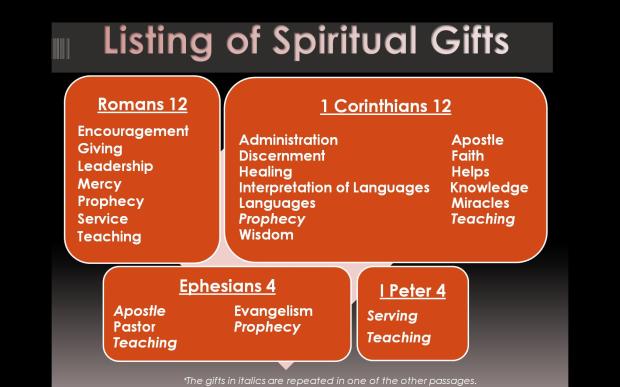
To do this, let’s recap the spiritual gifts as outlined in the New Testament:

*Jesus gifts (Ephesians 4:1-3) – These are part of our vocation and include ascension and equipping gifts as well as the fivefold spiritual gifts (i.e. apostle, pastor, teacher, evangelist, prophet).

Note: While all are wired to shape influence, not all are wired to employ these gifts in the church/in these specific occupations. More on this in a sec.

*Spirit’s gifts (1 Corinthians 12) – These belong to the Spirit and are gifts in a gathering. Some examples include administration, discernment, wisdom, healing, and miracles.

* Community gifts (Romans 4:4, 12:4-8) – These help us function in a local body. Some examples including leadership, encouragement, service, and mercy.

list-of-spiritual-gifts

Due to word count, I’ll link these passages rather than copy/paste; however, after you read them, consider their Greek roots:

1. Romans 12:4-5 – The word for function is the Greek word ‘praxis’ meaning “practice function” and signifies continual activity.

2. Romans 12:6-8 – The word for gifts is the Greek word ‘charismata’ meaning “grace function” and signifies communal activity. In the workplace, we can know these functions as influencing functions.

In both these cases, it’s important to note the origin of gifts point to corporate functions created for unity, not individual skills and talents.

3. Ephesians 4:1-3 – The word for vocation is the Greek word ‘klesis’ meaning “calling function” and signifies the work in which a person is employed. This not only references our occupation but our acceptance of it as a divine call to a particular pathway/course of action.

In this case, it’s critical we know how vocation and calling work together. As Martin Luther once said, “Every person is capable of having a vocation”; however, our universal calling is to be a royal priesthood.

Accordingly, we can break this down as follows:

Our universal calling: Priest (1 Peter 2:9)
Our gifts and functions: Romans 12:4-8
Our vocation: Romans 12 filtered through Ephesians 4


I like how Timothy Williams, author of The Spiritual Gifts, captures the vocational aspect of our spiritual gifts: While we know there are 5 ascension gifts and 7 community gifts,  it’s important to note “each ascension gift has a corresponding functional gift.” For instance, a certain accountant may not be called to serve as a prophet in a ministry setting (i.e. a liturgically designed ascension gift); however, he can still employ prophetic insight through encouragement and counsel in financial arenas (i.e. a vocationally designed ascension gift with specific communal functions). Of course, there may be times the accountant imparts guidance for church staff in critical situations. But the bottom line is: The man of God is at peace serving the body as a financial advisor with a prophetic anointing as opposed to a prophet with financial skills. 

Before I continue, I want to share a couple quick points on ‘vocation’ and how we’re to perceive it in light of our identity:

1. Gifts and vocations are NOT meant to soothe your ego or confirm your identity. If you base ‘who you are’ by ‘what you’ve been given’, you’ll reinforce territorialism in place of influence. Don’t do it!

2. Gifts and vocations are meant to enhance a sense of intimacy. If you base ‘what you’ve been given’ by ‘who you are’, you’ll reinforce a radical dependence on God and radical equality in how you view authority and hierarchy.

3. If we see ourselves as ‘Kingdom agents’, then we’ll a) desire to use our vocation to emphasize the work cultures that already point to Jesus (i.e. redeem our work environment) and b) seek to give clients and colleagues a taste of God by ‘calling forth their destinies’ (i.e. restore people).

4. If we don’t see ourselves as ‘Kingdom agents’, not only will we risk compartmentalizing our sacred and secular lives, but we will also miss opportunities to help people discern spiritual things with their natural minds.

5. Remember we’re all co-equal in value, diverse in function. Therefore, let’s engage our vocation as a holy partnership in influencing people to discover the fruit of their work/organization and in speaking restoration to people without agenda.

Looking ahead to ‘part 2’, I want to revisit William’s quote to help bridge the gap between Ephesians 4 and Romans 12.

‘Cause truth is: If we’re to better understand the relationship between gift and function within our vocation, we’ll need to apply additional grids and principles.

*Cough, Jethro. Cough, perichoresis. Cough*

Additionally, we’ll also need to add ‘elders’ and ‘deacons’ to the pastoral cluster so we can match 7 gifts with 7 functions. But I’m getting ahead of myself.

For now, I hope you were able to glean something out of this introduction. If you have any thoughts or questions, please don’t hesitate to leave a comment or contact me at your convenience.

Until then, God speed on your week. May His sweet presence be fresh wind in your sails as you press into His goodness.

You got this!

Selah.

Cover photo creds: Fast Company; body graphic creds: Msinop; content written by Cameron & Steve Fry; audio voiced by Steve Fry at the 2020 Commission U Leadership Retreat on February 29, 2020

Year in Review: A Look Back at 2019

**Scroll down for our HGF 2019 reflection pod**

When you think back on 2019, what immediately comes to mind?

CF: There are three answers to this question: The first and most obvious is Milo. His arrival into the world, no question, was the highlight of the year. The second and not as obvious is the phrase, “finished strong“. Granted, this was part of my 2017 answer, but it’s arguably been more applicable this year. Last but not least is the phrase, “hope realized“. As my next post will attest, I can’t recall a year where I felt so spiritually buoyant amidst great uncertainty.

LF: On the surface, one would think everything that happened this year involved situations I’d already experienced. But under the surface, everything that could wrong did go wrong, be it pregnancy, work, ministry, etc. That’s just how the year feels at first glance. Glass-half full, I’d say everything that could be different was different in 2019. The need for grace and deeper trust has rarely been so high from what I can recall.

What were some of the highlights/defining moments?

CF: Apart from Milo, I’d say our anniversary/missions trip to France, starting a TDOT Bible study, getting ordained with Messenger Fellowship, and the transition to Foundation Group round up the top four. Come to think of it, it’s crazy how my former employer fits into half these spots, but this only testifies to God’s brilliant and timely plan. Also, while this fall featured one of the more turbulent stretches we’ve known, the way we came out of it…I’d say was defining for our family as a whole.

LF: France, definitely. Losing two clients due to their need for in-house support. A very challenging pregnancy that impacted every area of life. Frankly, there were many defining moments this year, but most of them were taxing, testing, or both. Quite the opposite from last year.

How would you compare this year of marriage to years prior?

CF: From the onset, I sensed a leap not only in my understanding of intimacy but my appreciation of the little things. Call it a serendipitous surge, I feel 2019 has been our best start-to-finish year from what we were able to grow and persevere through. Obviously, as a newly crowned family of five, quality time and discussion are limited so expectations have to adjust. But this is offset knowing we’re pouring more into our co-workers, clients, and the kids under our care.

LF: This year had some of its sweetest moments for sure, some hard, some adventurous. Really a little bit of everything. All in all, the more life has put on us, the more refreshing the teaming has been despite its twists and turns. Blows my mind we’re almost to seven years already!

What lesson from 2019 are you eager to apply in 2020?

CF: God not only gives us everything we need for goodness and godliness but faith and fearlessness. As I used to tell LEGACYouth, when you abide in Christ, the way to ‘yes’ becomes clear even if the way out isn’t. This is especially true in the midst of great pain or confusion. We may be blindsided by disappointment, but trusting God books our next appointment.

Also, this is more awareness than lesson, but 2019 really exposed the fact I’d rather serve God than be close to Him. My halftime reflection piece unpacks some of this further…

LF: Resting in my weakness and learning not to strive. I had to learn these lessons the hard way this year, but I’m excited to build off them next year. I guess anytime you find yourself wanting to acknowledge weakness in a ‘You got this, God, I don’t‘ sort of way, good things will happen. One more reason to be flex and flow when things don’t go how you want them to go.

savingPNG

What has surprised you the most?

CF: In few words, the setting of adversity. While it’s no surprise the year had its ups and downs, the places we found support and the places we didn’t were far and away the biggest shock to me. We’ll see how much shaking we experience as a family in 2020. For now, it’s nice to know the two places I spend the most time are places I love to be.

LF: In general, I agree. Perhaps not to that extent, but I see where you’re coming from. I’d also add there were many answered prayers this year, but it’s hard to classify them as surprises when all is said and done.

What do you hope you’ll be saying at this time next year?

CF: “Hello, Davidson county!“, “You have questions about the Charleston Principles? Yes, I can help with that!“, “Welcome, Cameron and Lyssah. We’ve been expecting you.”
Continue reading

High Priest in a Manger: The Nativity As Seen Through Hebrews 4

‘Tis the season to be jolly…

…or so they say.

To exalt why we exist, to know freedom abundantly…

…yeah, yeah, I’ve heard it all before.

But if you’re like me these days…drained, disoriented…wondering when and where you are…unsure of most things status and standing…lend an ear.

‘Cause while I don’t have all the answers, I’m also not one to hide what I find. Even if it means going back to certain wells time and time again.

That said, a few weeks ago, I was glancing through Hebrews 4 when it hit me: While verses 14-16 are often attributed to genealogy and lordship, they also hold value in light of Christmas.

Don’t believe me? Well, let’s read together…

Since then we have a great high priest who has passed through the heavens, Jesus, the Son of God, let us hold fast our confession. For we do not have a high priest who is unable to sympathize with our weaknesses, but one who in every respect has been tempted as we are, yet without sin. Let us then with confidence draw near to the throne of grace, that we may receive mercy and find grace to help in time of need.”

Upon first look, it’s fair to say there’s not much Bethlehem and Messianic prophesy referenced in this passage. Granted, one could say the “great high priest” achieves the latter, but either way, odds are you’re not thinking Luke 2 when reading Hebrews 4.

However, when we take a deeper dive, we begin to see the significance of what “great high priest” means for us today. For instance, after emphasizing Christ as Word and the trust/rest dynamic in v. 14, note the critical turn in v. 15. As the Message translates, “We don’t have a priest who is out of touch with our reality.” Rather, He is able to understand our weaknesses and temptations because He not only conquered them but experienced them!

giphy

From here, we begin to see how this passage pertains to Christmas. Before the Son of God could bear our sin in His body, the Son of Man had to be born into it. Before He could redeem us from the curse of the law, He had to establish His plan of grace. Before He could save us through the Cross, He had to love us through the manger. You get the picture.

Yet, even before the manger, Christ had to be our high priest relating to us before the beginning of time. In this way, His sovereign authority could craft a divine pathway for our eternal relationship and our fearless approach beforehand. After all, nothing takes God by surprise.

Of course, the theological layers run deeper, but for now, consider this. When we celebrate Christmas each year, we’re essentially saying…

… “Lord, I’m taking hold of your mercy, I’m entering your rest, I’m accepting your help, I’m renewing my mind…all because you loved us to know our flesh as flesh. And from that relatability, I can receive you in confidence as the center of my ability, humility, stability, tranquility, etc.

I love how the Amplified breaks this down…

Therefore, let us with privilege approach the throne of God’s gracious favor with confidence and without fear, so that we may receive mercy AND find His amazing grace to help in time of need…an appropriate blessing, coming just at the right moment.”

Ahhh, at the right moment. Isn’t that what we’re always searching for? The right time, a right moment, the right one, even? And yet, so often we miss the fact Jesus is all these things. A perpetual reality punctuated by the incarnation, Jesus was our hope as a high priest before He became hope as a baby. Now we can live with Him in heaven forever all because once upon a time, a hope once deferred became the hope we cling to today.

Accordingly, for all you in despair, in a rut…a funk, whatever it may be, know this: Jesus came at the right moment so He could intervene for you at the right moments. Past, present, future…He never stops being a shining light of David directing our hearts to where His rest lies. As Paul states in Ephesians 2:14, “He Himself is our peace, who has made us both one and has broken down in His flesh the dividing wall of hostility.” All the more so, His light could enter, penetrate the darkness, and shatter the mold.

And so…as we wrap up another year, my prayer is that you’ll embrace this season and boldly enter into God’s best, His rest, and His next. For when you see the Cross behind the manger, you understand Christmas; however, when you see the priest in the manger, you’ll know the courage that can be yours as you invite into your weakness. How awesome it is to know Christ made Himself vulnerable so we could be vulnerable back? Not to mention with each other as we share the good news of His love in all we say and do.

Selah.

‘Til next time, may you know the hope that is yours and the breakthrough that will be yours this Christmas season.

Love you guys…

~ Cameron

79347731_10101376553512862_7564821732050075648_n

CourageousHarmlessCollardlizard-size_restricted.gif
Cover photo creds: Renovare


Staying Strong in the Void of Calm (October Recap Ed.)

I admit: I have not been in a writing mood this month.

Baby Milo, new job prospects, freelancing gigs, totaled car, family health issues…no question, there’s been much to handle in recent weeks. But amidst the turbulence, there have been silver linings – rays of strength in voids of calm. And while there’s much I don’t know in this state of processing, what I do know is we often discover new levels of courage during life’s greatest challenges.

So for today, I want to get real, raw, and a little freestyled about what the past month has been for me and family.

‘Cause truth is: Our response to crisis and unforeseen trauma is crucial; yet, it’s our heart towards God in the midst of chaos that defines whether we see Him as a momentary provider or persistent sustainer.

Real quick, before I forget: If you’re reading this and feel outside your comfort zone, rejoice! You’re probably doing something right or better put, right where you need to be. Be at peace, receive the calming of the seas within, and don’t look back.

That said, let’s dig in…

tenor

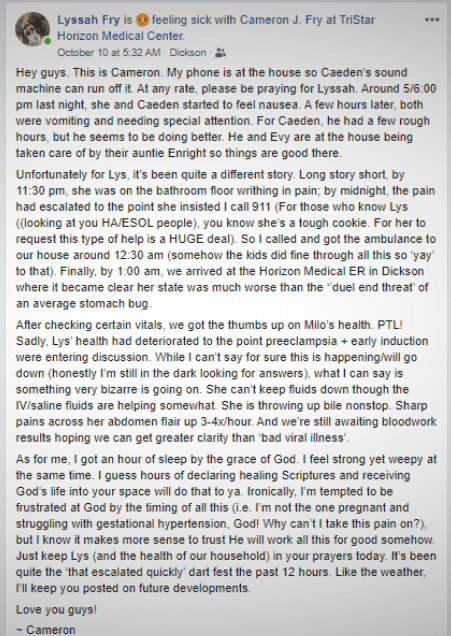
As mentioned, October was a roller coaster month with memorable highs and freaky lows. The fun and games started back on October 7 when Lyssah was diagnosed with gestational hypertension. Coming off this appointment, we were only mildly concerned knowing we were close to Milo’s due date, not to mention we now had a valid reason to designate ministerial assignments. What we weren’t ready for was the nasty stomach virus spreading through our family starting with Everly then me, Caeden, and Lyssah respectively. While the bug left me quickly and unscathed, the same could not be said for Lyssah.

I’ll let my October 10th post do the talking…

FBP

As you can see, the episode ran a gauntlet of fear, mainly preeclampsia and early induction. Thankfully, while our collective nerves had been rattled, none of these issues verified. Despite the modest scare, the event was now mellowing to background prologue. Surely Milo’s labor and delivery would be uphill in comparison…

Birth story recap: https://hisgirlfryday.com/2019/10/25/birth-story-staying-strong-in-the-void-of-calm/

Long story short, strength had gained momentum heading into Milo’s birth weekend thanks, in large part, to our surprise emergency excursion; however, this impetus could not have happened without deferred fear and supernatural strength adrenaline. For instance, throughout the Dickson Tristar ordeal, I’d often catch myself wondering, “How am I doing so well amidst this turmoil? I should be freakin’ out right now. This is unchartered territory. I don’t how to handle all this!” Yet, time and time again, I’d land on a familiar tune, beating into heart as if it had been on loop for days…

Don’t just ‘not stop’ and keep going, but stop making sense of my strength…and just receive it.

Ahhh, just receive it. Sounds easier said than done, right? Like fortune-cookie wisdom disguised as solicited sarcasm or oversimplified commentary on complex theology. But as the ‘tune’ advised, when ‘try’ and ‘do’ become excluded, the right option becomes an effortless decision, and perseverance is made practical, who’s to say receiving divine strength has to be challenging?

As Lys and I discussed with our doula, sometimes abiding in Christ is simply allowing God to prop us up when falling seems like the only option. Even as waves of crap are hitting the fan, by recognizing the proximity and sovereignty of God, we can experience a higher confidence never thought possible. Granted, it may seem counter-intuitive at first; however, as embracing God’s strength in weakness becomes rhythm, it’s not long until we find rest and rise to our aim.

For example, when I crashed my car in a four-vehicle accident a few Friday’s ago, I could have easily catered to disappointment wondering ‘why me‘ or ‘why God‘; however, having exercised my focus to ‘help me‘ and ‘help God‘ in prior troubles, my dependence was locked into gratitude.

Screen Shot 2019-11-11 at 8.25.48 AM.png

Of course, sitting in a totaled car on an interstate median is never fun. But again, as the Spirit reminded me, it can be when you count your blessings and declare praise knowing you and God’s best are still alive. Come to think of it, I wonder why we often say, ‘it could have been worse‘ when to use it implies a contrast of an inferior outcome to the worst possible one. Shouldn’t we go the other way and gauge reality through the ‘new’ that is to come?

GargantuanDisguisedCowrie-size_restricted.gif

Whatever the case, whether you’re walking through hell or a level of purgatory, what ultimately matters is knowing a) you’re perpetually loved by One who has your front and your back and b) even in your darkest hours, you can worship through staccato cries for help.

As for how one stays strong in the void of calm? Frankly, there are many ways, but perhaps the shortest and sweetest one is this: Draw near, surrender fear, pray on the fly, don’t wonder why…just rely. Again, this takes years to learn and is handily theorized outside moments of stress; however, by committing to these steps ahead of the heat, you’ll be primed for God’s power during it. Like conquering any temptation, the winning move doesn’t start at the point of testing, but well before it (more on this in a later post).

For now, I’ll conclude with this: Though this breakthrough may sound basic to some, for the first time in forever, I’m pressing through pain without making sense of it, content in knowing what I don’t immediately understand will eventually be understood. And while I get the value in devotionals and specialized guides on handling conflict, there’s something to be said when God shows up in a fresh way, does an expanding work in your heart, and it’s not contingent on whether or not you ask for it.

He just shows up and pours in…because that’s who He is.

Selah.

As mentioned in my last pod, Lys and I will try (key word) to air a new pod on all this before 2020. Until then, feast on these verses (ESV/AMV), receive them whether or not you’re in a storm, and know if all you got is, ‘Help me, God‘, ‘Hallelujah‘ or ‘I need you, Jesus‘, God considers it a fragrant offering.

2 Timothy 1:7 – “For God has not given us a spirit of timidity, but of power and love and discipline.”

Psalm 107:29-30 – “He caused the storm to be still so that the waves of the sea were hushed. Then they were glad because they were quiet, So He guided them to their desired haven.”

John 14:27Peace I leave with you; My peace I give to you; not as the world gives do I give to you Do not let your heart be troubled, nor let it be fearful.”

Psalm 37:7-9 – “Rest in the LORD and wait patiently for Him; Do not fret because of him who prospers in his way, Because of the man who carries out wicked schemes. Cease from anger and forsake wrath; Do not fret; it leads only to evildoing. For evildoers will be cut off, But those who wait for the LORD, they will inherit the land.

Psalm 46:10 – Cease striving and know that I am God; I will be exalted among the nations, I will be exalted in the earth.”

Isaiah 43:2 – When you pass through the waters, I will be with you; and through the rivers, they shall not overwhelm you; when you walk through fire you shall not be burned and the flame shall not consume you.

Woke Faith: A SOAP Study on Luke 7:1-10

Remember the centurion at Capernaum, the one who wows Jesus with his ‘woke’ faith?

If so, I want to take a brief minute to talk about him.

‘Cause truth is: While most read this story as faith leading to healing, we often overlook the context behind the dialogue. For instance, what led to the centurion feeling unworthy? Did he actually meet Jesus1? And what about the servant/centurion relationship? Is their bond in light of the social scene a big deal? Or is there a bigger reason Matthew and Luke included this account in their Gospels?

To be fair, we could be here all day unraveling these mysteries; for now, let’s focus our discussion on why the centurion built the Jewish synagogue and why it’s significant for marketplace leaders today.

Scripture

First, let’s dig in starting with Luke 7:1-10 (ESV)

SmallWelllitJellyfish-size_restricted

 “After he had finished all his sayings in the hearing of the people, he entered Capernaum. Now a centurion had a servant who was sick and at the point of death, who was highly valued by him. When the centurion heard about Jesus, he sent to him elders of the Jews, asking him to come and heal his servant. And when they came to Jesus, they pleaded with him earnestly, saying, “He is worthy to have you do this for him, for he loves our nation, and he is the one who built us our synagogue.” And Jesus went with them. When he was not far from the house, the centurion sent friends, saying to him, “Lord, do not trouble yourself, for I am not worthy to have you come under my roof. Therefore, I did not presume to come to you. But say the word, and let my servant be healed. For I too am a man set under authority, with soldiers under me: and I say to one, ‘Go,’ and he goes; and to another, ‘Come,’ and he comes; and to my servant, ‘Do this,’ and he does it.” When Jesus heard these things, he marveled at him, and turning to the crowd that followed him, said, “I tell you, not even in Israel have I found such faith.” And when those who had been sent returned to the house, they found the servant well.”

Observations

There are several directions we can go from here, but to me, it’s hard to ignore the overarching contrast between Jewish faith and the Roman world. Like the Hebrews and Egyptians, the Jews and Romans were oil and water linked by oppression, an expiring dictatorship, and a deliverer in waiting; however, they were also similar in demographic disparity and the need for legislation. Perhaps this is why Herod Antipas assigned centurions as royal troops exempt from army duty – to balance the frontline action with local jurisdiction.

Either way, centurions were widely regarded as the real professionals of the Roman army. As Helen Bond states in Bible Odyssey...

Most owed their position not to family connections but to their military prowess. Besides a level of command on the battlefield, they engaged in a wide range of other activities: general policing (see Acts 27:1-3, Acts 27:43), customs work, and the supervision of capital penalties (Mark 15:39). The troops of Antipas seem to have been garrisoned within towns. Although centurions are presented positively in the New Testament, contemporary scholarship makes it clear that most were disliked by ordinary folk, who regarded them as cruel, violent, and self-serving.”

However, this was not the case with the centurion at Capernaum. As v. 4-5 confirm, the centurion not only oversaw the construction of the Jewish synagogue but served as a benefactor to the community at large. This seemingly small detail carries radical significance as it proves the centurion’s goodwill was rooted in empathy and unity as well as diligence.

V. 4-5 in the Amplified drives this home…

When they reached Jesus, they pleaded with Him earnestly [to come], saying, “He is worthy for You to do this for him, because he loves our nation and he built us our synagogue [at his own expense].”

A couple of things stand out here:

  1. Note how ‘loves our nation‘ precedes ‘built us our synagogue‘. Based on this order alone, one can assume the centurion’s love was not only contagious before it was constructive but inspired the elders to represent him (v. 3).
  2. Note how the centurion personally funded this operation! This tells me the synagogue was not only a social sacrifice but a financial and likely physical one as well. No wonder the elders pleaded earnestly with Jesus given the centurion was actively entering into their suffering.
  3. While off-script, it’s probable Jesus carried this example into Nain (v. 11) as news of His miracles spread through all of Judea.

Application

The centurion template is a fascinating one to discuss. Whether you analyze it through an exegetical or historical lens, the story reminds us what the power of breaking walls through selfless service can do.

Consider this excerpt from Jon Bloom, Executive Director of Desiring God:

“The centurion is a reminder to us that ‘man looks on the outward appearance, but the Lord looks on the heart’ (1 Samuel 16:7). I think we will be surprised someday when Jesus doles out rewards. Most of the great ones among us will probably have lived in obscurity. Jesus is not as impressed with titles, degrees, and achievements as we are. He is impressed with those who really do humbly believe him. [As Billy Graham once said], ‘God will not reward fruitfulness, he will reward faithfulness.’ The centurion was faith-full. I want to be like him when I grow up.”

As to what we can glean as vocations, starting with the centurion’s rapport with the Jews makes sense. After all, the centurion could have easily constructed a building detached from relational foundation. But as we see, the centurion cared far more about people finding freedom than notoriety and quotas. To him, excellence was not a metric to be measured, but a sacrifice to be invested. Granted, his position offered security, but his heart could not help but share it with those less fortunate.

And it’s here, I submit, we take inventory. Like the centurion, we may struggle to champion the underdog as those in authority. We may wonder if our tasks are being effective or if our bandwidths are hindering our influence; however, as long as we lay down our lives for the sake of another, as long we seek to serve through benevolence and compassion, we will make the difference we crave. For God did not create us to ‘get by’, but to ‘let die’ the reservations and preservations compromising our generosity. Accordingly, we never have to fear the extent of our giving or the bounds of our effort since the Lord will continuously provide outlets for both.

As for our colleagues, no question there will be times of disagreement when organization feels like a lame duck sitting in a sea of chaos. In those moments you feel overwhelmed by what you can’t control, dare to ask God for what you need with a centurion’s heart:

Prayer

Lord, I know by myself I’m not worthy. I don’t ask these things out of entitlement or false expectancy. Rather, I know, as one set under and in authority, you have given me all I need for goodness and godliness at my job. I have the mind of Christ; however, this doesn’t mean I lack weakness. Though you’ve wired me with skill and creativity, I’m not immune to your healing touch… your desire to restore my inner being. Honestly, there’s so much I don’t know or understand. Yet, I know as long as I align to your will, you WILL come through. Though my faith may suffer, I know as long as I say the word, you will be there…and if you say the word, it will be done. With this as my forefront, I make these requests known to you so that your glory be known as faith expresses itself through love. To you and in you I commit the fruit of my labor and the spirit behind it. Amen.

Selah.

Footnotes

  1. Matthew 8:5-13 suggests ‘yes’, Luke 7:1-10 suggests ‘no’