
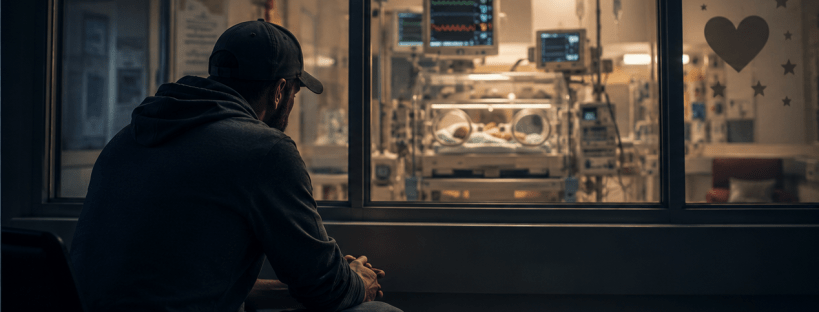
There’s a kind of exhaustion that doesn’t announce itself while you’re in it.
It’s not loud. It doesn’t always look like breaking down in a hallway or sitting in the dark parking lot outside the hospital trying to gather yourself before you go back in. Sometimes it just looks like functioning. Clocking in. Clocking out. Making calls. Answering texts. Sitting beside the hospital bed like you’re holding the whole world together with duct tape and determination.
You do what you have to do.
You become provider, advocate, scheduler, translator of medical jargon, emotional anchor, and sometimes the only stable point in a room full of uncertainty. You learn to live in two worlds at once—one foot in hospital rooms that smell like sanitizer and fear, the other in a life that keeps demanding normalcy from you like nothing has changed.
And somehow, everything has changed.
For a lot of dads, the hardest part isn’t just surviving the NICU or a long hospital season. It’s what comes after.
Because when the alarms stop and the routine of scans, rounds, and consultations fades, there’s this quiet that shows up. And in that quiet, everything you didn’t have space to feel starts asking for attention.
That’s where it gets complicated.
During the crisis, you run on adrenaline and necessity. There’s no room to fall apart, because someone has to keep the wheels turning. But once the urgency lifts, the body finally catches up with what the mind had to postpone.
And sometimes that looks like depression that didn’t have time to introduce itself earlier.
It’s disorienting, because people around you assume the hardest part is over. They’re grateful—and you are too—but they don’t always see that “over” doesn’t mean “undone.” You’re still carrying the weight of decisions, sleepless nights, financial strain, and the quiet fear that lived under every update from a doctor.
“Cast your burden on the Lord, and He will sustain you.” — Psalm 55:2
And if you’re honest, you might not even have the language for what you’re feeling yet. Just heaviness. Irritability. Numbness. A sense that you should be “back to normal” by now, but normal doesn’t quite exist anymore in the same way.
What makes it harder is how isolating it can be.
Not everyone is equipped to hold space for what you’re processing. Some people move on quickly, not out of indifference, but because life keeps moving and they don’t know what to say anymore. Even family, as well-meaning as they are, might be dealing with their own version of grief or fear. So, the support you need doesn’t always show up in the way you need it to show up.
And you can find yourself in this strange place of being surrounded, yet still alone with it.
Then there’s the layer no one talks about enough: your kids still needing care beyond survival. Appointments. Therapies. Counseling. Emotional regulation that requires patience you’re not sure you have left. And you’re trying to be the steady presence for them while quietly wondering who is steady for you.
That tension can feel impossible—like you’re supposed to be both strong and untouched by what you’ve just walked through.
But you’re not untouched. You’re just still standing. And there’s a difference.
If you’re in that in-between space—the season after the season—where everything is quieter but somehow heavier, I want to say this clearly:
What you’re feeling is not a failure of faith, strength, or character. It’s often the delayed impact of prolonged stress and trauma finally finding space to surface.
You were in survival mode. Now you’re in recovery mode, even if it doesn’t feel like recovery yet.
“Come to Me, all who labor and are heavy laden, and I will give you rest.” — Matthew 11:28
And recovery is not linear.
Some days you’ll feel fine. Other days you’ll feel like you’re back in it emotionally, even when nothing is actively wrong. That doesn’t mean you’re going backward. It means your mind and body are processing what they couldn’t process in real time.
You don’t have to rush that.
You also don’t have to do it alone, even if it feels like the support around you is limited. Sometimes the right support isn’t a crowd, it’s one person who can sit with you without trying to fix it.
Sometimes it’s a counselor who understands trauma and transition. Sometimes it’s simply learning to name what’s happening inside you, so it doesn’t stay undefined and heavy.
“Bear one another’s burdens and so fulfill the law of Christ.” — Galatians 6:2
And if you’re struggling to be present the way you want to be, especially for your kids, it doesn’t disqualify you. Conversely, it reflects the reality that you’ve been carrying more than one person is designed to carry for a long time.
Your presence matters more than your perfection.
Even now. Even in the exhaustion. Even in the days when you feel like you’re just getting through.
If no one has told you lately in plain terms: what you carried through that season was significant. What you’re carrying now still matters. And what you need in this season matters just as much as what everyone else needs from you.
There’s no shame in needing time to come back to yourself.
And maybe that starts with letting God meet you honestly instead of trying to meet Him polished.
“The Lord is near to the brokenhearted and saves the crushed in spirit.” — Psalm 34:18
You’re not behind. You’re not broken.
You’re in the aftermath of something heavy—and learning how to breathe again in a different kind of normal.

Cover graphic creds: ChatGPT
 hisgirlfryday.com