Springs Within You: A SOAP Study on Psalm 85-87

Well, folks. The weather outside is finally changing. You know what that means…

  1. Fire up ‘severe weather mode’ on Flash Weather.
  2. De-winterize the house.
  3. Compose another SOAP Bible study!*

*For those who don’t know, Lys and I are huge fans of this practice having implemented it during our youth pastor tenure. While our time in student ministry is long gone, in recent years, we’ve efforted to tailor these studies towards vocationals as part of our His Girl Fryday initiative; hence, why the legacy lives on.

Today, we’ll examine Psalm 85 and Psalm 87 in the context of Israel’s exile. While these selections may seem random at first glance, my hope is you’ll know why I chose these chapters by the end. 

As always…

Observations: If you’ve studied the Psalms in detail, you know the book is composed of 150 chapters broken down into sections. With Book 3 (Psalm 73-89) focusing on the tragedy of Israel’s uprooting and downfall of David’s family, one might think the tenor of Psalm 87 is out of place; however, this is partly due to how the sons of Korah¹ constructed their songs. Anticipating transition, Psalm 87 represents a confident foreshadowing, specifically Israel’s restoration and relationship to other nations.

A precursor to Psalm 87, Psalm 85 establishes the following tropes, all essential to our spiritual walk:

  1. God is faithful to bring a foundation to our footsteps, especially during seasons of adversity (Psalm 85:13).
  2. God draws near to those who fear and revere Him, who anticipate His voice and glory to manifest (Psalm 85:9).
  3. God’s love and faithfulness aren’t mutually exclusive as they’re intertwined within the same flow (Psalm 85:10-11).

These realities set the stage for Psalm 87, in which the privileges of God’s people are recognized and celebrated. Although the chapter is relatively short, the song lacks no exclamation given the holy tribute and 3:1 ‘verse-to-selah’ ratio. The general gist is straightforward and simple: As salvation comes forth from Zion, God takes note to what He can foresee.

But perhaps my favorite part of Psalm 87 is the final verse (v. 7): “All my springs and sources of joy are in you.”

While the ‘you’ is a cite to Jerusalem, given the polysemy of the Psalms, one could deduce this refers to something more than the city itself. Again, we must discern the tone and style of the author. For instance, the sons of Korah tended to ask questions they knew the answers to but framed anyway. 

Will God do ‘x’? Why, God, do you ‘y’? How long, O Lord, will you ‘z’? 

In almost every case, the resolution comes in the conclusion and inspires a modern-day practice. No matter, how dire, how challenging, how impossible a situation might seem, God, in both His Word and Way, is everlasting. Even if we seem far from the promised land we seek, God’s sovereignty is constant and His love is steadfast. Knowing this, the concerns we have should not interrogate God’s nature but inquire how we must journey with Him to see greater character, intimacy, and fruit result.

As for us, there may be an uptick in storms in the weeks and months ahead, literally and figuratively. but spiritually speaking, why not let the word picture of ‘spring’, both the season and water source, refresh our inner man? As Psalm 85:10-11 and Psalm 87:7 encourage us, why not receive the fullness of God’s springs and assess our return flow? After all, every good and perfect gift is from above. All we are or hope to be, all we have or ever hope to have, all we attain or ever hope to attain is from Him. Let the people of God acknowledge this and praise Him for it. 

Application

Prayer: Lord, as the winds of change surround us, we thank you for being at hand. As we worship you in Spirit and Truth today, we’re reminded how grateful we are that you are Lord of all, the God who sustains our help and gives us everything we need for goodness and godliness. No matter what tomorrow holds, we pause now to reflect on your love, your faithfulness, and how we can allow your currents to purify the rhythms in which we believe and operate. To what needs to be surrendered, convict us with grace so we may properly deal with our baggage. To what needs to be received, we ask you to not only revive us to taste you in full but to broaden our capacity to trust your truth in an increasingly compromising world. Help us not be overly discouraged by where abandonments are occurring. Rather scale our faith to see the grander scheme unfolding and how we can partner with you in victory. Give us this day and season as bread so we may feed your sheep as fed. In your holy and precious name. Amen. 

Footnotes:

  1. The sons of Korah were Levites, from the family of Kohath. By David’s time, they served in the musical aspect of the temple worship (2 Chronicles 20:19).

Cover graphic creds: Wallpapers.com

The Adamant Fig Tree: A SOAP Study on Mark 11

Scripture: Mark 11

Question: Why did Jesus curse the fig tree post-triumphal entry in Mark 11?

A few nuggets for thought… 

Observations: Like other instances in the Gospels, the account of Jesus scolding the fig tree appears random at first until we consider the context. Let’s break the chapter’s first segment into three layers:  

  • Layer 1: v. 2-6 – Jesus enters Jerusalem on a virgin colt a week ahead of His death and resurrection.  
  • Layer 2: v. 7-10, Jesus hears ‘Hosannas’ from the crowd, many of who misappropriate His identity. 
  • Layer 3: v. 11, Jesus travels to the temple for His first of two cameos.  

All layers applied, we can see how Christ metaphorically entered the future home of His bride to love and purify her with holy intent.  

Yet, as the scene changes in v. 12, so does the tone. On route to Bethany, Jesus notices a fig tree in leaf and after searching for fruit to no avail, He curses the tree: “May no one ever eat fruit from you again.” 

Again, this seems harsh, albeit justified considering His rumblings. Still, the ‘outburst’ is necessary. Here’s why… 

Jesus, being the Master of big picture symbolism, rebukes the tree, not so much for the lack of fruit, but because His created failed to recognize His identity in the construct of its original design. Although the season isn’t conducive for figs (v. 13), the tree should have produced sustenance for Him prior to His temple return. No wonder Jesus responds in hangry fashion!  

After cleansing the temple (v. 15-19), Jesus and the disciples return to the fig tree where Peter observes the tree has withered to the root. Factoring in the temple’s distance from the tree and the likely duration of their temple stint, one can deduce a 24-hour decay, not as swift as Matthew’s account (21:19b), but impressive nonetheless. 

This miraculous transformation highlights three tactics of Jesus in the moment: 

  1. He empowered the disciples to believe in greater measure, to have faith in anything being possible in His name (v. 23 – “I tell you the truth, if anyone says to this mountain, ‘Go, throw yourself into the sea,’ and does not doubt in his heart but believes that what he says will happen, it will be done for him.”) 
  2. He encouraged the disciples to know the authority they carried within on account of such faith.  
  3. He associated the power of prayer and forgiveness to knowing Him with expectant hope (v. 25 – “And when you stand praying, if you hold anything against anyone, forgive him, so that your Father in heaven may forgive you your sins.”) 

Application: Zooming out, we find some powerful connections. Within the passage, the adamant tree represents the people of Israel, specifically those who cried out “Hosanna” yet failed to recognize His Messiahship; however, closer to home, the fig tree emphasizes the value of staying connected to Jesus as branches to the vine. Without Him, there is no original design or ability to yield fruit. Thus, it does not make sense to live as if Jesus doesn’t exist when the universe’s pulse is to the contrary.

The cautionary tale of Mark 11 is simple: If we live a life cut off from the root of faith, the cornerstone Himself, we will deprive ourselves of bearing fruit and witness alike. May we be a body who not only discovers and references God in all seasons, but stays in position to give what He asks us so the world may be blessed by the fullness of life we carry.

Selah.  

Prayer:

Cover photo creds: Heartlight.org

West Side Story: A SOAP Study on Mark 5

Written 11/1/2016; revised 4/28/2024

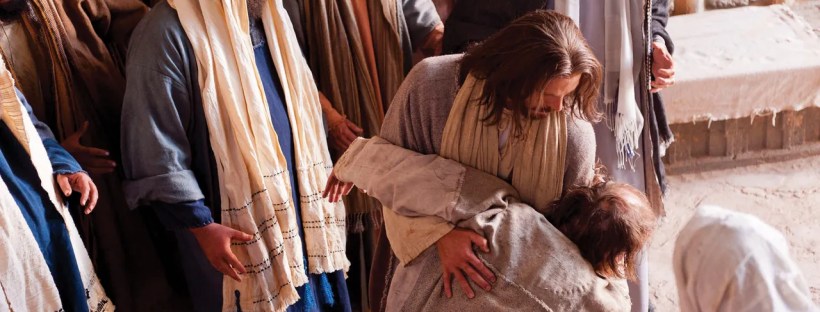
So yesterday I’m reading Mark 5 and it hits me: Why does Jesus tell the once demon-possessed man to go home to his people and tell them how much the Lord has done for him (v. 19), but gives strict orders to the sleeping girl’s family not to let anyone know about her miraculous healing (v. 43)?

At first glance, Jesus seems inconsistent. Why tell one party one thing and contradict it with another?

I mean…yeah, Jesus was always yielded to the Father following the Spirit’s lead. Fair enough. Still, I can’t help but dive a little deeper. As always, let’s grab a shovel and dig in.

Scripture/Observations

In Mark 5:1, we find Jesus, fresh off of calming a tempest (4:35-41), crossing the lake to Garasenes, a country region lying on the east side of the Sea of Galilee. Upon arrival, a demon-possessed man decked with torn chains coming out from the tombs approaches Jesus (Spooky, right? Talk about the ultimate Halloween Bible read). Once within range, the demon reveals itself as Legion (“for we are many” – v. 9) and begs to be cast into swine. From there, Jesus grants the request and inspires the man to proclaim the good news of what He had done John 4 style.

Now, check out v. 21: “When Jesus had again crossed over by boat to the other side of the lake, a large crowd gathered around Him while He was by the lake.”

Like similar encounters, we see life flocking to Jesus upon arrival, perhaps more causal than coincidence given the west side was more populated, not to mention Jesus’ reputation had established momentum. Yet, it’s here I want to pause to highlight a key contrast.

When Jesus arrives at Gerasenes, how many people come to him? At least one that we know of, right? How about the flip side? If you said ‘large crowd’, you’d be correct. Granted, the population difference may seem like a subtle detail; however, when we stack it against proceeding context, we see its connection to part of the answer.

That answer, you ask?

I’ll get to that shortly. For now, we must understand the correlation between Jesus’ intimacy with the Father and how this enabled Him to know the best way to unleash the truth. In the case of Mark 5, Jesus, having already revealed His nature on the west side, knew the best way for the good news to spread at Gerasesnes was for the ex-possessed man to ‘go tell it on the mountain’. After all, what occurred at the Decapolis post-healing centered, in part, on Jesus’ identity being made known to the masses.

Yet, as I teased earlier, the truth of Jesus’ identity was already spreading on the west side. Therefore,  it’s fair to say Jesus’ cross-country trek was just as much about manifesting love through power as it was confirming the truth of who He was (see v. 25-34).

Quick side note: I find it amusing how ‘crowd’ is mentioned not once, not twice, but five times between v. 21-31. If in fact the author intended the reader to grasp the chaotic backdrop, mission accomplished. The point here, I submit, is less about Jesus having to endure uncomfortable circumstances than it is Him loving in spite of them. Imagine having zero personal space, teaching to the culprits responsible, and being interrupted mid-sermon setting commotions between people crying and wailing loudly (v. 27). I’d probably lose my mind and grey my hair all at once!

But not Jesus. Instead, look at how unruffled he is, first in v. 36 when he says, ‘Don’t be afraid; just believe’ in response to the disciples telling Jairus’ people, ‘Why bother the teacher anymore?’ and second in v. 39 when he says, ‘The child is not dead but asleep’ after the entire house thought Jairus’ daughter was dead.

Seriously, it’s like Jesus is calming a second storm here. 

Now, for most, the story ends here, but the truth is Jesus had one more thing to say before peacing out, which in my paraphrasing, goes something like ‘Shhh! What happens here, stays here.

But again, why would Jesus demand this? Well, go back to v. 36: ‘Don’t be afraid; just believe.’

Throughout this whole chapter, we’ve seen three miracles, three transfers of power; however, this doesn’t mean Jesus was on the ‘power play’. Rather, Jesus was on a mission to inspire belief in people’s hearts. Accordingly, we can assume what mattered most to Jesus more than signs, more than miracles was the truth of His Word.

In this context, Jesus knew if He allowed the news to break in synagogue central, it would lead to a major distraction. Remember there was enough pandemonium leading up to Jesus’ encounter with the little girl. Any more attention would likely have caused an uproar and reduce Jesus to the role of ringmaster. How fascinating it is to see how timely silence was sometimes part of Jesus’ strategy to further the Gospel!

Bottom line: While Jesus was Spirit led in all He said and did, He also discerned the theology of the land and time He was in as He constantly yielded to the Father.  As a result, Jesus was able to reach more people through love and teach them with the truth and power of his Word.

Application/Prayer

Cover photo creds: JW Org

Marketplace Ministry Origins: A SOAP Study on Mark 6

If you’re a longtime follower, you know it’s been a while since my last vocational post. Thus, I figured for today we’d travel back in time to 2016 when I first started to explore Jesus’ cleansing of the temple (Luke 19:45-48). To guide our discussion, I’ll once again we taking a SOAP Bible study approach to help us synchronize revelation. 

Get ready, set…

Scripture: “When they had crossed over, they came to land at Gennesaret and moored to the shore. And when they got out of the boat, the people immediately recognized him and ran about the whole region and began to bring the sick people on their beds to wherever they heard he was. And wherever he came, in villages, cities, or countryside, they laid the sick in the marketplaces and implored him that they might touch even the fringe of his garment. And as many as touched it were made well.” 

Observations: Taking a bird’s eye view at Mark 6, we soon realize there’s much going on in this passage. While author ‘Q’ is renowned for his truncated style, this doesn’t undermine the literal and figurative ground covered in this chapter.  

After Jesus’ rejection at Nazareth, we note he is intentionally mobile starting in v. 7 where we find a Great Commission preview in the sending out of the 12 disciples. Verses later, we find a surprisingly long account of John the Baptist’s death (No offense, John, I think your 16 verses could have been cut in half and we would have been fine) followed by the feeding of the 5,000 and walking on water accounts (v. 30-52). Honestly, it’s almost like author ‘Q’ is creating this Gospel popery, an EP of Jesus’ greatest hits for future generations to share.  For most, the chapter concludes in v. 52 once Jesus has calmed the storm; however, in terms of time lapse, there’s still over half the book to go. 

Enter v. 53, where we find Jesus passing over into Gennesaret* and setting the stage for one of the most overlooked segments in Scripture (I.e. v. 54-56). To best understand the significance of this excerpt, we must first take note of the setting. Having crossed the Sea of Galilee from Bethsaida, we find our Ocean’s 13 crew in an exhausted state, more from past pitstops than the 9.8 km sail. Upon porting, we note the crowd instantly recognized him, which may be a subtle detail to some but bears emphasis when we zoom out.

For before Jesus’ presence could be seen, it was often first felt.  

Even when oral tradition and word of mouth were the only vehicles, the awareness of Christ’s authority kept increasing. Just imagine if social media existed 2,000 years ago. Jesus would have needed 12 bodyguards in addition to the 12 disciples!  

Either way, with corporate cognizance ignited, the hustle put into rounding the sick and afflicted makes sense. After all, the Isaiah 53 prophecies were compelled to verify in light of the Messiah. No wonder there was such an initial reaction considering the anticipation was manifesting off the heels of past divinations.

Contrasting the comps of this passage, I can appreciate the conclusion in Matthew’s account: 

…and implored him that they might only touch the fringe of his garment. And as many as touched it were made well.” (v. 36

A safe and sound finale, it’s no surprise author ‘Q’ takes a similar approach lacing the climax and resolution with one swoop; however, while he maintains the same canon, we’re gifted a slight wrinkle in v. 56. See if you can find it…

“...And wherever he came, in villages, cities, or countryside, they laid the sick in the marketplaces and implored him that they might touch even the fringe of his garment. And as many as touched it were made well.” 

Pause. Did you catch that? Where did they lay the sick again? The marketplace, you say?

Indeed, from city to country, the social fulcrum was corporate Israel! 

Ya’ll, that is crazy and completely mind-boggling. Just think if that were to happen today, how much culture shock this would cause on social and vocational levels. As much as the church would be expected to help in these situations, would it yield some responsibilities to non-religious epicenters?

While the answer there is a blog for another day, when we consider the ending of Mark 6, we must understand the temple and outer peripheries where marketplace extended were social hotspots. In fact, if you analyze the places Jesus roamed during His ministry, the temple/marketplace tandem topped the chart! As we transition into potential applications, one must wonder what today’s “marketplace” looks like…

Application: Outside the sanctuary, where would Jesus be hanging out if he came back today? Bars, clubs, cafes, and transport hubs come to mind. Per your comment adds below, I’m sure there are many others. Regardless, I can’t help but marvel knowing the workplace was at one point in history the nerve center for where Jesus did ‘business’. Put another way…

The brunt of Jesus’ labor occurred not in the synagogue, but in the highest concentrations of people and their transactions.  

This speaks to me on several fronts. For starters, the modern tendency is to endure work, be it a basic necessity or worse, a necessary evil, on route to finding Jesus anywhere else. We may reference Christ a few times throughout the day, mostly internal. But for the most part, we’re pressing through the office part of our day to get to the good stuff.

However, in Jesus’ time, the black and white lines of today didn’t apply as He constantly referenced the Father within His itinerary. In past posts, I’ve talked about the intentionality of Christ and how it manifests administratively, to planning, leadership development, and time management among other criteria. Interestingly, when you layer Mark 6 with Matthew 14 and Luke 9, we find the Spirit-yielding logistics of Jesus’ mission as the backbone of His greatest works. As much as we tout the miraculously, we must also acknowledge the leadership of His lordship from delegation to per diem.

Secondly, Jesus never advised His disciples outside of what He’d already established as best practice. Whatever He asked the disciples to do, He had already done and was doing alongside them. Could one argue Jesus was the great middle-manager in history? Absolutely. However, unlike some we may know in real life, Jesus did not direct apart from His directive. To that which Jesus was on mission, so were His disciples on co-mission. And the encouragement for us is two-fold:  

  1. Just as Jesus established the marketplace as a place of freedom where teachings and miracles occurred, so, too, did He empower His disciples to do the same in rural areas. 
  2. Just as Jesus intended the marketplace to serve as an apostolic arm, so, too, must we embrace this corporate call in current times.  

Granted, I understand how thousands of years have made certain external factors a case of apples and oranges. Still, I can only imagine what could happen if more marketplace ministers today served as compassionate conduits of Christ’s desire to heal, as ambassadors reconciling others through the ministry of prayer and availability! Whatever changes in our midst starts from within and I implore you, my friends, to not segregate the sacred from secular at work but live your faith transparently. Do not literally hide God’s Word in your heart in so masking the evidence of sanctification. Rather, love on purpose so others may find your company as an extension of safety to where requests are exchanged and prayer has more runway.

I’m telling you, even a few mindful tweaks can have deep, far-reaching impact. Follow the Gospel model set forth by Jesus and His Spirit will awaken you as you yield and abide. 

Prayer:

Footnotes

*The name Gennesaret is associated with the area mentioned in two NT references (Matthew 14:22; Mark 6:45). After feeding the 5,000, Jesus’ disciples crossed over the Sea of Galilee to Bethsaida (6:45), then crossed back again (6:53) and came to land at Gennesaret. Sometimes, however, the name is not restricted to the district, for Luke speaks of the lake of Gennesaret (Luke 5:1), referring to the Sea of Galilee 

Graphic creds: Tenor

Rock Solid: A SOAP Bible Study on Psalm 18

Written: July 4, 2022

Scripture: Psalm 18 (A Psalm of David)

I’m not going to lie: I’m not in the mood to write right now. So much going on; so little time to pause and ponder. 

However, on this Fourth of July, I’m kicking chaos (and the temptation for complacency) to the curb. For the first time in [almost] forever, it’s time for a SOAP Bible study. 

As for today’s Scripture, I call Psalm 18 to the stand. For without question, the passage has been a lampstand of late casting illuminance onto present day shadows. Hopefully, for you as the reader, you find similar vibes as we explore some of the most powerful poetic imagery in the Bible. 

So without further ado, let’s dive into Psalm 18 as we probe the stabilizing presence of the Almighty…

Observations/Applications:

Right off the bat, it’s interesting to note the double rock reference in v 2

The Lord is my rock and my fortress and my deliverer, my God, my rock, in whom I take refuge, my shield, and the horn of my salvation, my stronghold.”

Upon first glance, we may not think much of the repetition, if at all; however, as we dig (pun intended) into the metaphor, we find rich soil. Specifically, when ‘rock’ and ‘stone’ are used in Scripture, the surrounding descriptors often point to God’s sovereignty as the anchor to communal, emotional, and spiritual stability. This reference is additionally powerful when we consider God’s steadfastness. Just as the rock conveys unwavering durability, so too is our God during our trials and tribulations. For in this life, everything outside the divine has an expiration date and within the restraint, so great is our need to identify our rock be it of ages, salvation, righteousness or simply Jesus as cornerstone. To me, this is why the narrative of Psalm 18 sounds so extreme:

While the disappointments of life can seem intense, they should never be so great to minimize our view of our Creator nor crippling to the point we resist a call to Him. Again, we’re talking about God as our rock – the source of everlasting love, a stronghold against our strongholds, the refuge of all refuges, and the ultimate constant.

As we progress towards v. 6-7, we not only note a stark contrast between God as rock and the rocks upon which we tread, but also our vertical S.O.S in between.

“In my distress I called upon the Lord; to my God I cried for help. From his temple he heard my voice, and my cry to him reached his ears. Then the earth reeled and rocked; the foundations also of the mountains trembled…”

This compels an ironic dichotomy: As God, in His mercy, answers our plea for intervention, He often allows a shaking of some kind, a holy dislodge in the direction of freedom where He and hope abound. Honestly, what better way to capture the scale of our deliverance request than to consider the physical and spiritual effects of an infinite God engaging our finiteness. Even if such poetic license is taken to its most literal, the sensory saturation is sensible. While God whispers to our hearts in a still voice, this in no way mitigates the seismic repercussions of when He moves, sets a new thing in motion, and ministers to our hearts. As Galatians 5:16 and James 3:17 remind us, to receive from God is to yield to His power and trust His purposes against our perceptions of prosperity and pain. Even when our spiritual appetites are compromised, we should always perceive the potential discomfort of ‘God with us’ as more significant than the false comfort of ego and tolerance. 

Heading into v. 8-9, the Psalmist suggests an angry God true to context, but this doesn’t represent how God tends our brokenness every time. As many a Scripture testifies (see references below), when God addresses our distress, His heart is stirred by love and is executed through justice, compassion, patience, faithfulness, grace, wrath…usually a combo platter of attributes. Yet, though the nature of God’s dealings may vary, the large-scale reality is God never stops pursuing us through them. Given the darkening days and the absolute essence of God, the Psalmist makes a riveting case: Although crises may increase, from personal to global, we have every reason to believe God will in some way, at some point, draw near and provide what we need even if we don’t immediately understand it.

As Psalm 18:31-32 triumphantly declares:

For who is God, but the Lord? And who is a rock, except our God?— the God who equipped me with strength and made my way blameless.”

Shout-out to the hailstone usage in v. 12-13 and the humility/honoring layer in v. 16-30, I can’t help but relish the anti-relative exclamation here. Though Oprah would disagree, the truth is only God can give what we need for goodness and godliness (2 Peter 1:3). Only God can straighten our paths and direct us to walk on them accordingly (Proverbs 4:26; Hebrews 12:13). Only God can shepherd our hearts when we feel lost, when we’re sinking in waters we were never meant to walk on alone.

Only God. Our rock…

I know He’s able

As for you, my friends, in the spirit of v. 2,  I raise you a double portion of rock and encourage you to delight in God as He delights in and rescues you from whatever pit of despair you’re in (v. 19). For it is He, our light and life giver, who brightens our darkness to see what He sees, who not only establishes our steps but also purifies them so we discover Him afresh and anew…each and every day. Blessed be our rock and exalted be the God of my salvation (v. 46)!

Selah. 

Prayer:

Father God,

We praise you for being our rock, our refuge, our fortress, our deliverer. We exalt you as the author of our support system. And we celebrate the fact you take joy in saving us. Truly, there is no one like you! As we digest today’s Word and return to our daily routines, we ask you lock these truths into the tapestry of our understanding. In a culture full of extremes, we remember you are a God who constructed the very things that make them possible. The difference is you intended them for our good, for the best possible outcome and we acknowledge our sin, our strongholds, our self-centered tendencies have collectively interfered with your highest callings on our lives. That said, we also remember the Cross, identify with your heart to reconcile and restore, and lean into you once more as our precious rock. Yes, we ask you protect and cover us, but we also ask you anoint, bless, and cover our steps not to preserve us from darkness but to empower us to live as salt and light in an increasingly fragile and morally decaying world. We choose to live from victory, not for victory today knowing the battle has been won. Accordingly, we choose to take up the Word and put on the armor as we recall our identity as vocational priests and beloved warriors contending for your love to be known. Be with us as we go about our days and ways. May we be catalysts in our surroundings helping others taste and see that you are good. And may you be glorified as we surrender all knowing it’s by your Spirit we can resist fear and humbly call upon you to invade our space.

In this we pray, amen!

References:

Psalm 27:1 – “The Lord is my light and my salvation— whom shall I fear? The Lord is the stronghold of my life— of whom shall I be afraid?” 

Psalm 62:7-8 – “My honor and salvation come from God. He is my mighty rock and my protection. People, trust God all the time. Tell him all your problems, because God is our protection.”

Psalm 144:1-3 – “Of David. Praise be to the LORD my Rock, who trains my hands for war, my fingers for battle. He is my loving God and my fortress, my stronghold and my deliverer, my shield, in whom I take refuge, who subdues peoples under me. LORD, what are human beings that you care for them, mere mortals that you think of them?

Deuteronomy 32:4 – “He is the Rock, his works are perfect, and all his ways are just. A faithful God who does no wrong, upright and just is he.”

Isaiah 2:10 – “Go into the rocks, hide in the ground from the fearful presence of the LORD and the splendor of his majesty!” 

James 1:17 – “Every good gift and every perfect gift is from above, coming down from the Father of lights with whom there is no variation or shadow due to change.”

Cover photo creds: WallpaperBetter