Messiah’s Misfits: Why The Name Says It All

So recently I’m reading 1 Corinthians 4 when suddenly it hits me…

…of all the chapters in all of Paul’s letters, arguably the greatest content on vocational perseverance can be found in v. 9-13 when Paul discusses the nature of true apostleship.

 Let’s check it out…

For I think that God has exhibited us apostles as last of all, like men sentenced to death, because we have become a spectacle to the world, to angels, and to men. We are fools for Christ’s sake, but you are wise in Christ. We are weak, but you are strong. You are held in honor, but we in disrepute. To the present hour we hunger and thirst, we are poorly dressed and buffeted and homeless, and we labor, working with our own hands. When reviled, we bless; when persecuted, we endure; when slandered, we entreat. We have become, and are still, like the scum of the world, the refuse of all things.” (ESV)

It seems to me that God has put us who bear his Message on stage in a theater in which no one wants to buy a ticket. We’re something everyone stands around and stares at, like an accident in the street. We’re the Messiah’s misfits. You might be sure of yourselves, but we live in the midst of frailties and uncertainties. You might be well-thought-of by others, but we’re mostly kicked around. Much of the time we don’t have enough to eat, we wear patched and threadbare clothes, we get doors slammed in our faces, and we pick up odd jobs anywhere we can to eke out a living. When they call us names, we say, “God bless you.” When they spread rumors about us, we put in a good word for them. We’re treated like garbage, potato peelings from the culture’s kitchen. And it’s not getting any better.” (MSG)

For, I think, God has exhibited us apostles at the end of the line, like men sentenced to death [and paraded as prisoners in a procession], because we have become a spectacle to the world [a show in the world’s amphitheater], both to angels and to men. We are [regarded as] fools for Christ, but you are so wise in Christ; we are weak, but you are strong; you are highly esteemed, but we are dishonored. To this present hour we are both hungry and thirsty; we are continually poorly dressed, and we are roughly treated, and wander homeless. We work [for our living], working hard with our own hands. When we are reviled and verbally abused, we bless. When we are persecuted, we take it patiently and endure. When we are slandered, we try to be conciliatory and answer softly. We have become like the scum of the world, the dregs of all things, even until now.” (AMP)

Now, before we dive in, we must understand the broader context.

First, what is the nature of true apostleship? Going back to 4:1, we find the answer: Those who minister Gospel hope as servants/stewards/ambassadors of Christ no matter the cost. The Amplified breaks it down further describing these servants as those who are certain in adoration more than they are uncertain in anything else. Essentially, apostleship goes beyond the office of apostle and involves anyone who is willing to be salt, light, and life in places where there is none. If you are being a faithful steward of God’s call on your life, you’re engaging your apostolic anointing! Whether or not you have a mobile ministry is moot compared to God’s faithfulness being reflected in what you say and do as you draw people to Christ (Colossians 3:17).

Second, how do we abide in the nature of true apostleship? Verses 7-8 give us a hint when paraphrased: We have not only been given everything for goodness and godliness (2 Peter 1:3), but every reason to trust the Lord as our portion (Psalm 73:26)¹. Accordingly, as we reference God in reverence², to live as Christ (Philippians 1:21) becomes the foundation to our perseverance and influence regardless of setting and trial. After all, “there are different kinds of [work], but in all of them and in everyone it is the same God at work (1 Corinthians 12:6).

Finally, we arrive at v. 9 where Paul employs some serious poetic license. Messiah’s misfits (MSG), prisoners of spectacle (AMP, ESV), an accident in the street everyone stands around and stares at…these are all powerful metaphors and similes reminding us there is no earthly honor in apostleship. If, by chance, we are pursuing any glory apart from what is rightfully God’s, our endurance will not stand, but if our satisfaction is rooted in being complete with Christ (Colossians 2:10), if our contentment is secure to His sufficiency, only then will we be victorious as dregs. It’s a paradox to the flesh, but one necessary for our dependence. When we are thirsty, we’ll see the need as being filled as opposed to satisfying a lack. When we are persecuted, we’ll know God is with us as one who relates as opposed to withdrawn as one who can’t. And when we’re struggling to make ends meet, we’ll rest in the mysteries of what God has and hasn’t revealed since our reliance is not contingent on self.

For some of us, it’s hard to accept what doesn’t make sense. It’s like we’re okay being misfits to sin, but not to the minds/culture tolerating it. I know for me, I’d rather be criticized for what I do wrong than be judged for what I do right. At least, with the former I can apply the correction and move on! However, I also know whenever I crave my work to be affirmed and my love to be reciprocated, I can declare God’s grace as sufficient, the fact I can joyfully boast in His power made perfect in my frailty (2 Corinthians 12:9-11). And suddenly those ‘weak as I eke‘ moments fade in something infinitely more…

…the sweet reality that I need JESUS! What a beautiful place to be!

-Jprj2

Bottom line: If you’re a vocational leader, dare to see the identity of what you do through the lens of apostleship, through the lens of being a servant taking light into dark places. And if hard times come, don’t be surprised; rather view them as a sign you’re doing things right³. When you bless others in the face of voids and discouragement, remember the same Christ you ask to bless others is the same Christ who will honor your obedience. If you don’t fit in, remember you were never called to in the first place. Stand out, take what comes, and know the power of you standing through adversity will assuredly have a positive ripple-effect on those around you even if you don’t see it right away.

Selah.

Footnotes

  1. Note how strength in this verse has Hebrew roots to ‘rock’
  2. This form of dependence opens up the Romans 5:1-5 road (more on this in a future post)
  3. Assuming the hard times aren’t consequences of sin, shortcuts, etc.
Cover photo creds: Medium

3 More Things I’m [Really] Sorry For

If you’re like me, you like to reflect.

So much to say, so much to do…how can either happen when there’s so much to think.

Yet, as we journey another January, the heart behind this series, as made known last year, is still the same:

If we want to think right, then we must get right, if we want to get right, then we must get real…and if we want to get real, we must value cleanse before change.

Not to suggest such internal inventory is easy. Certainly putting all things on the table for examination requires courage, humility, vulnerability…among other things; however, since my goal with these posts is to help us embrace God’s ‘next’, it only makes sense to pray into the substitutions¹ God has for us.

That said, here are three things I’m owning as we turn the page to 2019…

1) Making sense of my surroundings

It’s remarkable the ways we justify our surroundings. I know for me, whenever I find myself in what I can’t explain, living in the moment can almost seem secondary to knowing why it has to exist. ‘If only I can solve the mystery, perhaps then I can find the satisfaction and peace I crave,’ I sometimes think.

But as we know, the journey of life is far from cut and dry. As much as we want to reconcile all our relationships and circumstances, we’ll never be able to given sin and free will’s response to it among other things.

Granted, God’s sovereignty isn’t confined by man’s weakness. But it’s also not restricted by our ability to ‘sherlock’ the past. And it’s this temptation I believe trips many of us up. We long to feel affirmed when we’re down. We yearn to feel validated when we smell injustice. We burn to make sense of our surroundings when they don’t make sense. Yet, in our quest to solve our voids, little do we realize the size of our ego and the numbing effect it has on our attitudes and heart postures.

It’s not always fun to accept, but the way I see it: Often the reason we are where we are is because God wants to help us find our kneel…to show us where our independencies have become idolatries…and to learn reliance within the unforced rhythms of grace. Perhaps you’ve struggled to grasp this feeling in seasons of idleness or stress…in settings where you felt more like a fish in an aquatic Pandora’s box.

If so, take a bite of my 2018 testimony. Our free will exists so we can choose Jesus to find freedom. No 12-step program full of striving. Just a simple decision to resist the fear of man and the impulse to make sense of our surroundings.

Accordingly, if you sense the temptation but not the exit, yield to surrender, voice the heartcry, and receive the serenity of stilled waters. God has not abandoned you, so don’t you abandon ship.

giphy

2) The Nazareth complex

I suppose this could be a subset of point #1, but the nature of this conviction alone is worth emphasizing.

As alluded to in my 2018 Year in Review post, when last year started, going back to The Gate was far from an option. Having phased out of LEGACYouth weeks prior, my hope had clung to a sunset narrative where my last days of youth ministry would coincide with where it took place. While there were many reasons I emotionally did not want to return, the core of my withdrawal² centered on what I call the Nazareth complex.

The Nazareth complex is based out of Luke 4:14-30 when Jesus is driven out of his hometown (i.e. Nazareth) after revealing his true identity at the synagogue. While obviously I’m no Jesus, the personal correlation was this: Among whom whose eyes I had been under for years, there was no way for me to be known as God knew me. As such, what Nazareth was to Jesus, The Gate/local church was to me. To move on with my life, I had to leave the church to find anyone who not only would listen, but see me sans past and last name.

Of course, it’s safe to say Jesus never employed such a self-absorbed attitude. Still, it’s not hard to see why my deception took months to dissipate with resentment rooted in deception and victimization fixed in misapplied Scripture. To justify my isolated ego, I had to constantly cite the past, church gossip, unsurrendered soul/spirit hurts…even assumed vain assumptions (sounds confusing, but that’s unholy fear for you).

Yet, as the story goes, I eventually woke up, realizing if I truly wanted to move on and take hold of the new, I couldn’t keep holding on the way I had been. Six months later, the exchange is still ongoing…however, the door to freedom is much wider, in large part, to having repented of this complex.

tumblr_nikl8pxddz1tq4of6o1_5003) Financial fitness

For many couples, one spouse is the buyer, the other is the saver. In my relationship with Lyssah, the contrast is evident. While I’m a buyer who lives well within his means, Lys is much better at budgeting and sticking to it.

Ironically, you would never know by where our financial anxieties lie. As co-bread winners, to make ends meet, we both must work…whatever the cost with whatever time we can give. Unfortunately, the drive for excellence doesn’t always extinguish the entitlements and justifiers we use to buy (or even save for) momentary contentment/peace.

I know for me, I can only afford to invest so much as I near the end of paying off student loans. The white lie, then, is if I can’t currently invest as much as I want for my family, I should be frugal in my giving and employ generosity through alternative means. Yet, as I’ve been convicted, often my lack of giving ties to a lack of trust manifest as leverage against God for not opening certain doors. And I think for some of us, we forget withdrawing doesn’t just apply to our presence and/or banking transactions. It’s applies to trusting God with our finances…our energy…our time…not just what to sow, but where to sow and how much.

All that said, if you feel financial weak starting 2019, you’re not alone. Yeah, I’m an ex-Ramsey spouse. I have content, lessons, and principles I can pass down to future generations. But I also know…

  • If I’m not maturing my stewardship, those values can only go so far.

  • If’ I’m not maturing my stewardship, my intentionality in inviting God into my budget will be compromised.

As for 2019, no longer will I reduce God to an on-call financial counselor and over-rely on my wife’s strengths to make up the difference. Rather, I’m going to pursue financial fitness, embrace frugality under the context of stewardship, and flex into shape accordingly.

Think of it this way: Even though money isn’t the end-all, be-all of extending God’s providence, in no way should we want God’s faithfulness to be restricted by what we’re not trusting Him in.

Besides if you’re reading this, chances are you have enough and know God as more than enough. Not do you have what it takes…but you can do this. Why not do it together?

giphy-1.gif

Selah.

Footnotes

  1. Where I’m letting go of a stronghold, sin, negative thought pattern, etc. to replace it with something better
  2. Albeit an indefinite sabbatical was necessary
Photo creds: https://buzzerg.com

Chosen to Succeed: A Homily for Vocational Ministers

Shared at The Gate Community on 11/18/18

Many times in this sanctuary we have acknowledged pastoral leaders, ministerial entrepreneurs, and trailblazing missionaries, recognizing their call to churches, organizations, and nations. But until last year, seldom have we, as a local body, celebrated the ministry giftings in vocational leaders and those appointed to corporate frontlines.

For many of us in this room, there’s been a convergence of conviction in recent years centered on the idea that fivefold ministry gifts aren’t exclusive to those with fivefold ministry callings. For instance, like vocational ministers, a CPA with God-given financial skills, a physician, and a businessperson known for quality service can function in pastoral, evangelical, and apostolic anointings.

The question is: Are we helping them make connection between original design and occupation…between sacred and secular offices?

While many answers could be said, the truth is we, at The Gate, believe works of the Spirit are manifold and that there are infinite functional ministries saints can be called to. As such, it is also our belief anyone who is saved and aligned with Christ has difference-making, culture shaking potential as part of their appointed skill and spiritual gift mix…

…which brings us to today where it is with great pleasure we celebrate these individuals who have fulfilled their Commission U course requirements as part of Messenger Fellowship’s initiative to equip and empower marketplace ministers.

For those unaware of what Commission U is all about, in short, it’s more than a credentialing course, more than a biweekly small group, more than a quest for frame-able accomplishment; rather, it’s a pathway for disciple-making believers to discover and apply their spiritual gifts in worldly systems…a training ground for men and women of faith to mature their reach in fallen settings.

Scripturally, the word ‘commission’ is used several times. In Genesis, we find Joseph being commissioned by Pharaoh as the vizier of Egypt. In Numbers, we find Eleazar the priest and Joshua being commissioned in front of large assemblies. In Timothy, we find Timothy being commissioned by Paul to commit to his calling. And in the Gospels, the disciples are commissioned by Jesus to make disciples of all nations.

While these cases may seem random, the point is in each of them God appointed his chosen to succeed. And it’s for this reason we are gathered here: to charge these ambassadors not only to go and make disciples of all nations, but occupational arenas as well, baptizing them in the name of the Father, Son, and Holy Spirit, teaching them to obey not only what they’ve chosen to follow, but what they’re continuously choosing to learn and abide in.

So to our graduates, we employ you to build upon the insight you’ve inherited and to see the Scriptures as God-breathed in what you put your hands to.

As 2 Timothy 3:16-172 Timothy 3:16-17 says…

Do your best to present yourself to God as one approved, a worker who has no need to be ashamed, rightly handling the word of truth [knowing] all Scripture is breathed out by God and profitable for teaching, for reproof, for correction, and for training in righteousness, that the man of God may be competent, equipped for every good work.

And to all of us, understand we carry a priestly, Immanuel’ (God with us) identity embodying the incarnate… with ignitable Kingdom influence wherever we walk…wherever we work.

On this note, we consecrate this moment by commissioning our Commission U graduates.

This slideshow requires JavaScript.

For full service, click here

Photo creds: Lydia Ingegneri

Kingdom Carriers: The Reason We Exist (Part 2)

Part 1: Kingdom Agents: The Reason We Exist

So a few weeks back, I’m chillin’ in my humble abode, perusing a couple bivocational pastoral forums when I notice an intriguing update…

I work for UPS and have not taken a salary in the year and a half since I’ve been at my current church. They do provide a parsonage though. I have really been struggling with being bivo[cational]. Outside of my secular job I never feel I’m able to give enough or do enough for my ministry or my family. My job doesn’t build relationships because I’m all way in a different office and on different routes with no real interactions. It really is money only and I hate that. My dream would be to have a job [where] I can truly make money, not a get rich quick gimmick, and that gives flexibility when needed. Actually I’ve always dreamed of opening a coffee and sandwich shop. I have a dream to write but can never get enough time to make much progress. I just have been dealing a lot lately with not being enough, or not achieving enough, in any part of my life. It feels like the duck floating in the water. Things look smooth on the surface but underneath I’m fight what seems to be a losing fight right now. And I don’t know how to fix it or what to do.”

Now, before I continue, understand I’m normally not one to share anonymous posts; however, with this one, I can’t help but resonate given there are people like this all around us…

…questioning their purpose…

…making ends meet…

…all the while desperate to dream in light of their surroundings.

Accordingly, how we engage the chaos in a way that merges ‘hope of glory‘ and ‘hope of freedom‘ within our influence is worth discussion.

My thought is: whether you consider yourself vocational, bivocational, or multi-occupational, regardless of what you’re sacrificing, you desire to lay a foundation of life that pierces the mundane doldrums of an ego-driven culture.

Unfortunately, our desire to build upon this foundation is often offset by discouragement and disorientation. For example, some people know their identity as ‘loved by God’, but feel rudderless in a dead-end situation while for others, they have the ideal situation, but have no idea of who they are and what they’re truly called to.

hsy5VW5

To compound matters, there is dissonance as people who see themselves as a collection of acquired skills and experiences collide with those who view their passions and assignments as functions of their uniqueness. Granted, we live in a fallen world of mixed perspectives where you are what you do outside of what you believe; hence, the tension many believers encounter when they take a servant mentality into the marketplace.

But for the dire dreamer determined to stay up on the down side of life, sometimes acknowledging the fact it’s not supposed to be easy isn’t enough. At some point, we must accept the fact people are not only looking for momentary motivation, but long-term resources and willing availability.

Not to suggest we downplay our readiness in giving answers for the hope we have. I’m just sayin’ if all we’re doing is pointing people, like the UPS man, in the right direction, can we honestly say we’re doing all we can to help? In counseling them to find the tools and direction they’re looking for?

And hear me: I’m not sayin’ we fix all the peoples…all the situations…and make floating ducks feel like power trucks.  I get there are times when all we can do is stand and point people in the way they’re to go.

However, if we see ourselves as Kingdom agents/ambassadors, then we should expect to receive appointed assignments where the only way to reach out is to create room…

…which leads me to why I’m writing this…

…so that we all can be more attuned in extending Jehovah-Jireh hope to the UPS man’s of the world…

…in conveying the promises of God who will not only provide, but get us to the other side…both in trust and in faith.

Perhaps you’re not a fan of who you are or where you’re at right now. Maybe you feel an awkward divide between you and who you wish to pour into1.

If so, I encourage you: stand strong, know you’re loved2, and invite God into the voids you sense. Remember you have what it takes to fight the good fight (1 Timothy 6:11-16)…and by not quitting, you ultimately help others do the same.

As to how we do that?

Well, let’s just say…

that is why we exist.

tenor

Selah.

Footnotes

  1. Or who you wish could pour into you
  2. And never alone
Cover photo creds: benzinga.com


Visions of Vocation (Part 1)

So lately, I’ve been thinking…

…in my quest to resource the church on marketplace ministry, have I been wrong in using the term, ‘bivocational’?

Have I been misleading people through a lack of definition, context…

…or even worse, discouraging people implying the expression as elite?

If so, please know…

  1. My intent is to encourage people where they’re at as opposed to elevating where I’m at.
  2. My goal is to inspire anyone and everyone to run their race to the fullest.
  3. If I’ve given any evidence to the contrary, I sincerely apologize.

Having said that, permit me to press the ‘reset’ button and clean house…

DD4 reset button image2

Going back to our founding in 2014, no question, Lyssah and I were stirred by lessons learned as we balanced jobs in church and out. A quick jaunt to our ‘about’ page confirms this as its composition datestamps a time when our vision, mission, and target audience were finding their niche.

But somewhere during the writing of, ‘The Bottom Line’ in 2016, the tent pegs of what I had thought about ‘bivocational ministry’ began to expand. Suddenly, I saw how ‘bivocational’ in a bifunctional and spiritual gifting context could apply to anyone. As such, by the time I completed the e-book, my thinking had changed so dramatically, what started as a tool for a minority was now a resource for a majority.

Flash-forward to today and the evolution of thought, heart, and content change is still tough to gauge on the outside looking in; hence, why I wanted to take this minute to inform you while we believe occupation and vocation are related, they are not the same thing.

For example, as a youth pastor, what came first: my job or my calling?

If you answered the latter, you’d be correct.

Before I was alive to have an occupation1, God had a specific vocation or klḗsisover my life the same way he had a vocation (i.e. calling) over your life.

2 Timothy 1:8-9 (ESV) confirms this…

Therefore do not be ashamed of the testimony about our Lord, nor of me his prisoner, but share in suffering for the gospel by the power of God, who saved us and called us to a holy calling, not because of our works but because of his own purpose and grace, which he gave us in Christ Jesus before the ages began.

The problem is we often think of ‘calling’ as this one great thing we’re supposed to do whether it’s writing a New York best seller or rising as a top executive at a fortune 500 company; however, when we consider how “in all things God works for the good of those who love him, who have been called according to his purpose” (Romans 8:38), we find God gives us more than one calling.

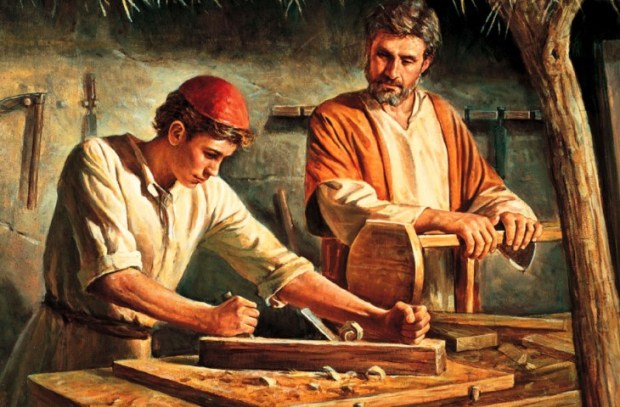
Take Jesus for example: as a child, he was a faithful student; as a teenager, he was a faithful carpenter (with special guest temple cameos); and by thirty, he was a faithful minister.

Now, we can nit-pick whether ‘student’ and ‘carpenter’ are vocations or occupations. Personally, if you used this model to suggest God designated various occupations to prepare His Son for his ultimate vocation (i.e. Matthew 28:19) – “Go therefore and make disciples of all the nations, baptizing them in the name of the Father and the Son and the Holy Spirit“), I wouldn’t disagree.

jesus-nazareth-110-730x480

Whatever the case, my thoughts are…

  1. At each season in Jesus’ life, God was preparing him for his rabbinical destiny.
  2. While there may be seasons we don’t like what we do, God is always preparing us for what we’re meant to do (a truth that exists today just as much as it exists tomorrow).
  3. Therefore, even if our occupations (what we do) and vocations (what we’re meant to do) don’t seem to line up, we can rest in the common denominator of reflecting Jesus.

In essence, while pastors and ministers are multi-occupational in the sense their time is occupied with multiple responsibilities, given we’re all called to ordained vocations3, it makes no sense to promote one “ational” above the other and accordingly, be offended, trip over semantics, or fear political incorrectness.

After all, if we see “bivocational” as God giving us multiple skills and avenues to be salt and light, then divisive misinterpretations (i.e. clergy is on one level, laity is on another) waste away.

As a wise man recently told me…

Every believer has several vocations (rooted in bearing and restoring the image of God) and many occupations. A pastor or minister working 2-3 jobs is no less ordained than one fully supported.”

To this, I 100% agree.

Bottom line: Whether you refer yourself as bivocational and/or multi-occupational, at the end of the day, a) one is not better than the other and b) on a lifetime scale, we are all bivocational and multi-occupational. Remember being bivocational isn’t about having an occupational ministry outlet, but understanding what you’re meant to do (and more importantly, meant to be) regardless of what you do/want to do. It’s knowing no matter how you’re getting paid, the hope of glory (Colossians 1:27) always resides in you.

Selah.

Stay tuned next time when I’ll dive into a recent forum post from a bivocational colleague that testifies to why His Girl Fryday exists.

In the meantime, in all you say and do, remember what and who you’re meant for.

Peace…

~ Cameron

Footnotes

  1. Hebrew translation – Avodah
  2. Vocation in Greek: klḗsis– “to call, summon”) – a calling or invitation into something, specifically receiving God’s gift of salvation – with all His blessings that go with it (Romans 11:29; Ephesians 4:4; 2 Peter 1:10).
  3. And all bear multiple responsibilities

Ephesians 4:1 conveys this…

* NAS: in a manner worthy of the calling with which
* KJV: worthy of the vocation wherewith
* INT: to walk of the calling in which you were called

Cover photo creds: Medium