
Built to Build: The Call of Vocations (Part 1)

After previously discussing 1 Corinthians 4, I want to rewind a chapter and review our vocational identity – what God intends us to be on the clock.

While we will ultimately need guidance from Colossians 2 to unpack this in full, for now let’s start with 1 Corinthians 3:9-11 (ESV):

For we are God’s fellow workers. You are God’s field, God’s building. According to the grace of God given to me, like a skilled master builder I laid a foundation, and someone else is building upon it. Let each one take care how he builds upon it. For no one can lay a foundation other than that which is laid, which is Jesus Christ.

Here, Paul, having emphasized church divisions (v. 1-4), is reminding the Corinthians to see Christ as their cornerstone (Ephesians 2:19-22), as the foundation of life on which new life can be built. Unfortunately, like the Israelites in Judges, the Corinthians are strong in flesh and weak in discernment. A people ravaged by schismatic impulses, they are plagued by paganism and a past rooted in idolatry. Certainly, Paul couldn’t have been too surprised to hear reports of such dissension.
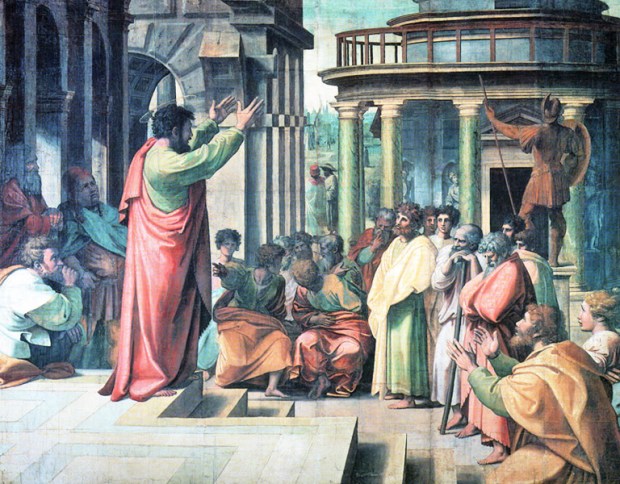
Athena

Yet, what Paul lacks in suspense, he makes up in candidacy, specifically we are servants designed for unity and God is the source and core of it all. What matters is not who gets this task and who gets that task, but rather why the task exists at all. For most of us, this makes sense, but to the Corinthians, a people who saw their value through who they followed, this would have been difficult to accept. Imagine your political preference and/or denomination of choice being your chief designation. “Hi, my name is Cameron and I’m a charismatic Republican.” A bit off-putting, right?­

Conversely, for Paul, affiliations meant nothing compared to eternal intent as evidenced in v. 9 (AMP):  

For we are God’s fellow workers [His servants working together]; you are God’s cultivated field [His garden, His vineyard], God’s building. “ 

Like 1 Corinthians 4:9-13, this is powerful imagery concerning our vocational identity. We aren’t just God’s workers, but fellow workers on mission with Christ doing good works in Gospel partnership (Phil. 1:5-6). Concerning our colleagues and clients, they’re also designed for God’s assignments, but whether they know it or not should not deter us from working peaceably as it depends on us (Romans 12:18). As long as we accept the call to be Christ’s championing companions, we can embrace unity as helpers of joy (2 Corinthians 1:24) while perceiving our cultivation as an overflow of God’s goodness.

After all…

…we don’t work to lay the foundation; we work because Christ is the foundation!

Put another way, as co-laborers and vocational leaders, we’re meant to be laid on, not laid upon; hence, why Jesus says in Mark 3:25, “…a house divided against itself cannot stand.” If we don’t value teamwork apart from personal gain, our operations will be hindered having affirmed our identity as the foundation.

Again, this offers quite the paradox to the natural mind. Are we the foundation Christ, the master builder, lays or are we the slab plan built on Christ the foundation, by Christ the builder? Personally, I side with the latter, especially when I note the Psalmist and weeping prophet (i.e. Jeremiah) who perceived identity as predestined (Psalm 139:13, Jeremiah 1:5), Christ’s work in them1 as destined, and God’s nature as perpetually present. Applying their worldview, we can rest knowing as vocational influencers, we can mature our reach knowing it is Christ in us who does the cultivating through our work.

Screen Shot 2019-03-16 at 1.03.27 PM

In other words…

He is the vine, we are branches…but we are also a part of His vineyard!

Sometimes, we get so discouraged being branches, we forget the beauty of the garden we’ve been planted in. This tells me not only do we need to know Christ as the foundation on which we stand, but also the cultivator who pours out seeing the growth before it happens.

Colossians 1:4 and 2:2 (AMP) captures this process beautifully.

We have heard of your faith in Christ Jesus [how you lean on Him with absolute confidence in His power, wisdom, and goodness], and of the [unselfish] love2 which you have for all the saints (God’s people)…For my hope is that their hearts may be encouraged as they are knit together in [unselfish] love, so that they may have all the riches that come from the full assurance of understanding [the joy of salvation], resulting in a true [and more intimate] knowledge of the mystery of God, that is, Christ…”

Combining these passages, we find the blueprint to living our vocational identity. When we’re overcome by disappointment, we choose gratitude seeking God in confidence. When we’re overwhelmed by hate, prejudice, and indifference we choose love seeking God in faith. And when we’re overpowered by unbelief and unforgiveness, we choose hope seeking God in His grace and power. In this way, we allow the towel (John 13: 1-9) to unfold as our hearts yearn to see others transformed and united by unselfish love. Granted, when we talk being on the job in the midst of funk and discrimination, this is easier said than done.

Then again, the whole point of Paul writing this is to encourage the Gentiles to desire unity with the Jews in hope to see them know Christ. And it’s this heart posture, I submit, we embrace as believing vocations on marketplace frontlines. Remember we are built up to build up, a process that with God knows no bounds.

As far as what we do between being built up in Christ and building up through Christ, Paul does give an additional template on this later in Colossians 2. For now, let’s pause and revisit the topic in next week’s post on how we contend for unity at work.

Selah.

Footnotes

  1. Ministry of reconciliation/sanctification
  2. The key to understanding this and other statements about love is to know that this love (the Greek word agape) is not so much a matter of emotion as it is of doing things for the benefit of another person, that is, having an unselfish concern for another and a willingness to seek the best for another.
Photo creds: FULLER studio

Visions of Vocation (Part 1)

So lately, I’ve been thinking…

…in my quest to resource the church on marketplace ministry, have I been wrong in using the term, ‘bivocational’?

Have I been misleading people through a lack of definition, context…

…or even worse, discouraging people implying the expression as elite?

If so, please know…

  1. My intent is to encourage people where they’re at as opposed to elevating where I’m at.
  2. My goal is to inspire anyone and everyone to run their race to the fullest.
  3. If I’ve given any evidence to the contrary, I sincerely apologize.

Having said that, permit me to press the ‘reset’ button and clean house…

DD4 reset button image2

Going back to our founding in 2014, no question, Lyssah and I were stirred by lessons learned as we balanced jobs in church and out. A quick jaunt to our ‘about’ page confirms this as its composition datestamps a time when our vision, mission, and target audience were finding their niche.

But somewhere during the writing of, ‘The Bottom Line’ in 2016, the tent pegs of what I had thought about ‘bivocational ministry’ began to expand. Suddenly, I saw how ‘bivocational’ in a bifunctional and spiritual gifting context could apply to anyone. As such, by the time I completed the e-book, my thinking had changed so dramatically, what started as a tool for a minority was now a resource for a majority.

Flash-forward to today and the evolution of thought, heart, and content change is still tough to gauge on the outside looking in; hence, why I wanted to take this minute to inform you while we believe occupation and vocation are related, they are not the same thing.

For example, as a youth pastor, what came first: my job or my calling?

If you answered the latter, you’d be correct.

Before I was alive to have an occupation1, God had a specific vocation or klḗsisover my life the same way he had a vocation (i.e. calling) over your life.

2 Timothy 1:8-9 (ESV) confirms this…

Therefore do not be ashamed of the testimony about our Lord, nor of me his prisoner, but share in suffering for the gospel by the power of God, who saved us and called us to a holy calling, not because of our works but because of his own purpose and grace, which he gave us in Christ Jesus before the ages began.

The problem is we often think of ‘calling’ as this one great thing we’re supposed to do whether it’s writing a New York best seller or rising as a top executive at a fortune 500 company; however, when we consider how “in all things God works for the good of those who love him, who have been called according to his purpose” (Romans 8:38), we find God gives us more than one calling.

Take Jesus for example: as a child, he was a faithful student; as a teenager, he was a faithful carpenter (with special guest temple cameos); and by thirty, he was a faithful minister.

Now, we can nit-pick whether ‘student’ and ‘carpenter’ are vocations or occupations. Personally, if you used this model to suggest God designated various occupations to prepare His Son for his ultimate vocation (i.e. Matthew 28:19) – “Go therefore and make disciples of all the nations, baptizing them in the name of the Father and the Son and the Holy Spirit“), I wouldn’t disagree.

jesus-nazareth-110-730x480

Whatever the case, my thoughts are…

  1. At each season in Jesus’ life, God was preparing him for his rabbinical destiny.
  2. While there may be seasons we don’t like what we do, God is always preparing us for what we’re meant to do (a truth that exists today just as much as it exists tomorrow).
  3. Therefore, even if our occupations (what we do) and vocations (what we’re meant to do) don’t seem to line up, we can rest in the common denominator of reflecting Jesus.

In essence, while pastors and ministers are multi-occupational in the sense their time is occupied with multiple responsibilities, given we’re all called to ordained vocations3, it makes no sense to promote one “ational” above the other and accordingly, be offended, trip over semantics, or fear political incorrectness.

After all, if we see “bivocational” as God giving us multiple skills and avenues to be salt and light, then divisive misinterpretations (i.e. clergy is on one level, laity is on another) waste away.

As a wise man recently told me…

Every believer has several vocations (rooted in bearing and restoring the image of God) and many occupations. A pastor or minister working 2-3 jobs is no less ordained than one fully supported.”

To this, I 100% agree.

Bottom line: Whether you refer yourself as bivocational and/or multi-occupational, at the end of the day, a) one is not better than the other and b) on a lifetime scale, we are all bivocational and multi-occupational. Remember being bivocational isn’t about having an occupational ministry outlet, but understanding what you’re meant to do (and more importantly, meant to be) regardless of what you do/want to do. It’s knowing no matter how you’re getting paid, the hope of glory (Colossians 1:27) always resides in you.

Selah.

Stay tuned next time when I’ll dive into a recent forum post from a bivocational colleague that testifies to why His Girl Fryday exists.

In the meantime, in all you say and do, remember what and who you’re meant for.

Peace…

~ Cameron

Footnotes

  1. Hebrew translation – Avodah
  2. Vocation in Greek: klḗsis– “to call, summon”) – a calling or invitation into something, specifically receiving God’s gift of salvation – with all His blessings that go with it (Romans 11:29; Ephesians 4:4; 2 Peter 1:10).
  3. And all bear multiple responsibilities

Ephesians 4:1 conveys this…

* NAS: in a manner worthy of the calling with which
* KJV: worthy of the vocation wherewith
* INT: to walk of the calling in which you were called

Cover photo creds: Medium

3 Ways to Level ↑ Your Teamwork

Have you ever struggled with group participation or felt more productive working independently?

Perhaps you’re a team player at heart, but feel taxed, even lost, when collaborating in a joint setting.

If so, I want to encourage you: a) you’re not alone and b) dare to rethink what you know about teamwork.

For while corporate success often hinges on team dynamic (i.e. how a group behaves and performs in pursuing a particular goal), such cooperation is only possible when each member knows the purpose and direction of their role.

Thus, in the next few posts, I want to discuss how we, as students and employees, can build teamwork through better team dynamic starting with these three points…

giphy

1) Clarify Expectations

It’s been said group morale is a fragile art – a sacred science based on strength integration, maintaining transparency, and trust management.

Yet, of all the bonds that bind, arguably none is more cohesive to team dynamic than clarifying expectations.

To quote Ron Edmondson…

to feel a part of the team, people need to know where the team is going and what their role is. An understanding of the overall goals and objectives fuels energy. When the big picture objective is understood each team member is more willing to pull together to accomplish the mission because they know the ‘why’ and can better understand where they fit on the team.”

In other words, to achieve positive outcomes, each role must be clearly defined in a way direction, unity, and purpose are mutually inclusive. Of course, none of this can happen without accountability, authenticity, and strategy/tactics (as we’ll later discuss); however, as long as expectations are effectively communicated top-to-bottom, the foundation to success is, at least, secured.

Bottom line: The more people perceive core value and expectations1 through vision, the more team dynamic will strengthen.

5QOJguX.gif

2) Don’t Just Direct People, Develop Them

As mentioned in my ‘effective influencer’ post, strong teams form when people are valued over goals and success is celebrated corporately as well as individually.

Unfortunately, not all work cultures are created equal where motivation is shared, let alone contagious. The question is…

How do we inspire unity among our teams regardless of setting, situation, or position?

For starters, we must be willing to connect role to direction and expectation to vision. In my case, having worked in various financial and ministerial arenas, I’ve found the best unity occurs in environments where each member understands their role and how it directly impacts the success of the organization.

Granted, easier said than done for the sanitation engineer and mail deliverer; still, if strong team dynamics are applied, even these employees can be directed to know the company’s core values2 and developed to take ownership of their responsibility.

Ultimately, if team members are empowered to see their skin in the game, camaraderie will flourish in the sense each person is directed, developed, and driven to see his/her work as more than a means to an end.

Bottom line: Intentional leaders not only give their team intentional purpose, but help their teams understand mission while embracing vision.

AlienatedCoordinatedCassowary-max-1mb.gif

3) Get Out of the Office

A great ministry leader once said…

Don’t get so busy doing the work of the Lord that you don’t spend time with the Lord of the work.”

Interestingly, while this truth pertains to spiritual intimacy, the same concept can be applied in collaboration and networking. After all, if project management and people management are best undivided, then the quality of our communication should extend beyond performance into its surrounding context.

For example, as a former LAMPO spouse, sports editor, and youth pastor, no question, the best “silo-busting” moments occurred during retreats, corporate team-building activities, and family outings. In each scenario, not only were tensions lessened, but a sense of esprit de corps developed carrying over into seasons of challenge and discomfort.

Moreover, to the extent creativity and oasis conversations abounded, to that extent priorities were pruned in the wake of internal and external inventory. Ultimately, as awareness within community increased, so did morale and enthusiasm by proxy.

Bottom line: 1) Teamwork is just as much attitude as it is practice. 2) If you want better teamwork, know the context of your team’s performance given team dynamic is influenced just as much outside work as at work.

Selah.

tenor.gif

Looking ahead, I want to talk about how we, as spouses and household heads, can abide by the same teaming principles outside our careers and inside our homes.

In the meantime, be at peace as you better people to better your teams to better your business.

As always, Lys & I are rooting for you.

Here’s to the journey…

~ Cameron

Footnotes

  1. Even compensation
  2. Tip: consider creating a team charter)

Cover photo creds: Australian Institute of Business

One Voice Q&A’s with Cameron & Steve Fry

Cameron & Steve Fry talk Commission U and marketplace/bivocational ministry @ Messenger Fellowship‘s annual summit

Note: Apologies on the audio (especially the first minute); will aim to obtain higher quality when available.

1. Why is focusing on equipping people in the marketplace so vital for the church?

I believe if the church wants to equip people in the marketplace, it must embrace its transitive nature. The marketplace ministry problem, particularly in the western church, isn’t so much a function of not discipling saints to be like Jesus as much as it is not discipling saints to be like Jesus…within their respective spheres of influence. Considering 90-95% of congregations work in secular settings, we must bridge the disconnect and target these settings if we want to better reach the lost.

2. What is ‘bi-vocational’ ministry?

Bivocational ministry is ministry that bridges the sacred and secular. Whether you’re versatile in the marketplace working multiple gigs or have a foot in both church/workplace arenas, bivocational ministry not only empowers people to be like Jesus at their desks, but also teaches them to make the best possible use with the margins and bandwidths they’ve been given.

3. What have you seen in Commission U that is so helpful to marketplace people?

One of the advantages of Commission U (and courses like it) is how it acknowledges the priesthood in all believers while shattering the mold of ‘pastors do this/non-pastors do that‘. There’s a false paradigm that suggests only those with liturgical callings can be ordained, but with Commission U, as we experienced last night…

…we recognize all as partners in God’s ministry of reconciliation…all as effective ministers and child-like ambassadors…co-equal in value and diverse in function with a unique set of spiritual gifts designed for deployment wherever we influence. Ultimately, the heart of Commission U is to decompartmentalize faith and work so it becomes faith at work…at our work.

Graphic per Vicki Wilstermann/Ryan Hall

3 Ways to Mature as an Effective Influencer (Part 1)

If I were to ask what the point of ministry is, what would you say?

Drawing people to Christ? Developing them as disciple-makers? Deploying them into service?

Albeit, these are all fine answers…but what if I told you we can sum up ministry in one word…

…influence.

Would you agree?

Regardless, the Word is clear our ministry emerges from our influence.

Consider 2 Corinthians 5:11

Therefore, knowing the fear of the Lord, we persuade others.”

If you’re like me, you hear ‘persuade’ and immediately think ‘convince’; yet, when we dissect the Hebrew and extend it through v. 21, we find Paul is actually talking about influence.

Applying this filter, we can better understand how influence not only partners in God’s ministry of reconciliation, but matures our effectiveness as marketplace influencers.

Granted, there are many ways to broach the topic. For now, we’ll start with our usual ‘core three’ and work from there…

1. Know who you’re fearing

As mentioned, the bottom line of ministry is reconciliation achieved through influencing; however, to get there it’s important we grasp the fear of the Lord.

For while “the fear of the Lord is the beginning of knowledge” (Proverbs 1:7), it’s also a preserver of our sincerity (Colossians 3:22) and a gateway to comfort in the Holy Spirit (Acts 9:31).

Note the latter reference:

So the church throughout all Judea and Galilee and Samaria had peace and was being built up. And walking in the fear of the Lord and in the comfort of the Holy Spirit, it multiplied.”

This tells me two things:

  1. Godly fear multiplies wisdom and virtue in addition to faith.
  2. The evidence of influence is peace inspired by encouragement.

Therefore, when we talk about influence, we’re not talking as much about personal strength as we are the maturation of corporate morale and pointing people in the direction of Jesus (more on this in future posts).

Contrarily, it’s important we understand what influence isn’t.

‘Cause while the key to influence is the fear of the Lord, the enemy will use the opposite spirit, the fear of man, along with memories of past hurt to contrive a narrative where we’re seeking to overcome what’s already been overcome.

Thankfully, as Kingdom agents…ministers of reconciliation who can persuade through the fear of the Lord…we can rhythmically resist this mindset whiling combating the compromised systems of the world.

For as long as there is sin, enterprise will be governed by hierarchy1 where people are bound by control, manipulation, and intimidation. Yet, as for you, you can see people as God sees them (i.e. forgiven) and help them find purpose through daily influencing where they are.

After all, freedom begets freedom…and He craves it more than you do.

2. Know how you’re leading

As effective influencers2, it’s imperative we not only have the right mindset towards people, but our work as well.

For starters, we must view our work as an opportunity to show people who they are as opposed to a stage to prove our self-worth. In this way, we not only invest trust in God being the one to open eyes, but free ourselves to influence through our wiring and discover new strengths through how God uses their responses.

‘Cause truth is: When we allow God into our realm of influence, we trade the pressure of of accomplishing goals for a humility motivating others to reach them.

But Cam…what if I’m not a team leader or in a place of authority?

Again, to answer this question…we must ask ourselves why we’re asking it.

For instance…

251zgc

If we’re talking about what we’ve been conditioned to believe…then authority is nothing more than the appointed person governing ‘over’ us; however, if we’re talking about absolute authority3, then we can see how a) God alone carries it…and b) what we often associate as ‘authority’ is, in fact, influence manifest through the seven motivational gifts (as outlined in Romans 12).

Again, the system…a real life Matrix if you will…runs by pecking order, production, and the Jerry Maguire mindset of ‘show me the money’, but…

giphy.gif

…as Kingdom influencers, we can approach metrics and outcomes without agenda by combining nurturing with our competence4.

Thus, whether you’re a supervisor in crunch time or a subordinate in training, you can help hold your team accountable to achieve certain goals in your respective roles. Just remember no matter what you do to galvanize effort, make sure it stems from a desire for everyone to succeed given a true influencer always values people over goals and never risks reaching them at the cost of another’s well-being.

For when we value people and decompartmentalize our desire to impact them, we not only influence a place where encouragement and goodness abound, but also where confidence and favor are ultimately shared.

Stay tuned next time when I’m unveil my third and final step to maturing as an effective influencer in the marketplace.

‘Til then if you have any questions, thoughts, concerns, feel free to leave them below in the ‘comments’ section and I’ll return serve as soon as I can.

Peace for your week,

~ Cameron

Footnotes

  1. As well as the idea leadership is greater than serving (contrary to Romans 12 which tells us each gift is equal and carries status and dignity)
  2. All influencers lead, but not all leaders influence
  3. Difference between authority and authorities
  4. A simple formula for adding value to your team members in a way they’ll turn to you for guidance and feedback

Cover photo creds: MikeLavere.com