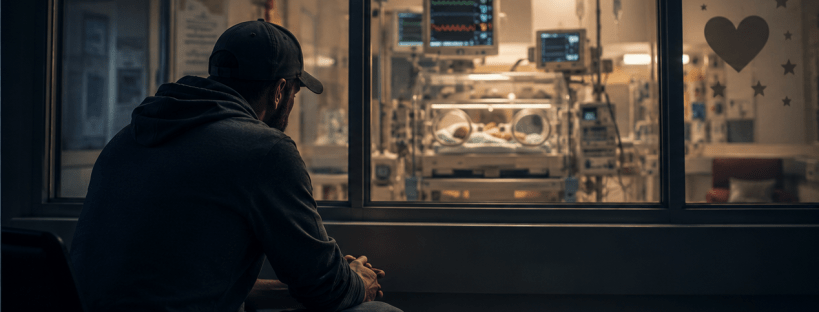
The Part No One Talks About: A Letter to Exhausted NICU Dads

There’s a kind of exhaustion that doesn’t announce itself while you’re in it.

It’s not loud. It doesn’t always look like breaking down in a hallway or sitting in the dark parking lot outside the hospital trying to gather yourself before you go back in. Sometimes it just looks like functioning. Clocking in. Clocking out. Making calls. Answering texts. Sitting beside the hospital bed like you’re holding the whole world together with duct tape and determination.

You do what you have to do.

You become provider, advocate, scheduler, translator of medical jargon, emotional anchor, and sometimes the only stable point in a room full of uncertainty. You learn to live in two worlds at once—one foot in hospital rooms that smell like sanitizer and fear, the other in a life that keeps demanding normalcy from you like nothing has changed.

And somehow, everything has changed.

For a lot of dads, the hardest part isn’t just surviving the NICU or a long hospital season. It’s what comes after.

Because when the alarms stop and the routine of scans, rounds, and consultations fades, there’s this quiet that shows up. And in that quiet, everything you didn’t have space to feel starts asking for attention.

That’s where it gets complicated.

During the crisis, you run on adrenaline and necessity. There’s no room to fall apart, because someone has to keep the wheels turning. But once the urgency lifts, the body finally catches up with what the mind had to postpone.

And sometimes that looks like depression that didn’t have time to introduce itself earlier.

It’s disorienting, because people around you assume the hardest part is over. They’re grateful—and you are too—but they don’t always see that “over” doesn’t mean “undone.” You’re still carrying the weight of decisions, sleepless nights, financial strain, and the quiet fear that lived under every update from a doctor.

Cast your burden on the Lord, and He will sustain you.” — Psalm 55:2

And if you’re honest, you might not even have the language for what you’re feeling yet. Just heaviness. Irritability. Numbness. A sense that you should be “back to normal” by now, but normal doesn’t quite exist anymore in the same way.

What makes it harder is how isolating it can be.

Not everyone is equipped to hold space for what you’re processing. Some people move on quickly, not out of indifference, but because life keeps moving and they don’t know what to say anymore. Even family, as well-meaning as they are, might be dealing with their own version of grief or fear. So, the support you need doesn’t always show up in the way you need it to show up.

And you can find yourself in this strange place of being surrounded, yet still alone with it.

Then there’s the layer no one talks about enough: your kids still needing care beyond survival. Appointments. Therapies. Counseling. Emotional regulation that requires patience you’re not sure you have left. And you’re trying to be the steady presence for them while quietly wondering who is steady for you.

That tension can feel impossible—like you’re supposed to be both strong and untouched by what you’ve just walked through.

But you’re not untouched. You’re just still standing. And there’s a difference.

If you’re in that in-between space—the season after the season—where everything is quieter but somehow heavier, I want to say this clearly:

What you’re feeling is not a failure of faith, strength, or character. It’s often the delayed impact of prolonged stress and trauma finally finding space to surface.

You were in survival mode. Now you’re in recovery mode, even if it doesn’t feel like recovery yet.

Come to Me, all who labor and are heavy laden, and I will give you rest.” — Matthew 11:28

And recovery is not linear.

Some days you’ll feel fine. Other days you’ll feel like you’re back in it emotionally, even when nothing is actively wrong. That doesn’t mean you’re going backward. It means your mind and body are processing what they couldn’t process in real time.

You don’t have to rush that.

You also don’t have to do it alone, even if it feels like the support around you is limited. Sometimes the right support isn’t a crowd, it’s one person who can sit with you without trying to fix it.

Sometimes it’s a counselor who understands trauma and transition. Sometimes it’s simply learning to name what’s happening inside you, so it doesn’t stay undefined and heavy.

Bear one another’s burdens and so fulfill the law of Christ.” — Galatians 6:2

And if you’re struggling to be present the way you want to be, especially for your kids, it doesn’t disqualify you. Conversely, it reflects the reality that you’ve been carrying more than one person is designed to carry for a long time.

Your presence matters more than your perfection.

Even now. Even in the exhaustion. Even in the days when you feel like you’re just getting through.

If no one has told you lately in plain terms: what you carried through that season was significant. What you’re carrying now still matters. And what you need in this season matters just as much as what everyone else needs from you.

There’s no shame in needing time to come back to yourself.

And maybe that starts with letting God meet you honestly instead of trying to meet Him polished.

The Lord is near to the brokenhearted and saves the crushed in spirit.” — Psalm 34:18

You’re not behind. You’re not broken.

You’re in the aftermath of something heavy—and learning how to breathe again in a different kind of normal.

Cover graphic creds: ChatGPT

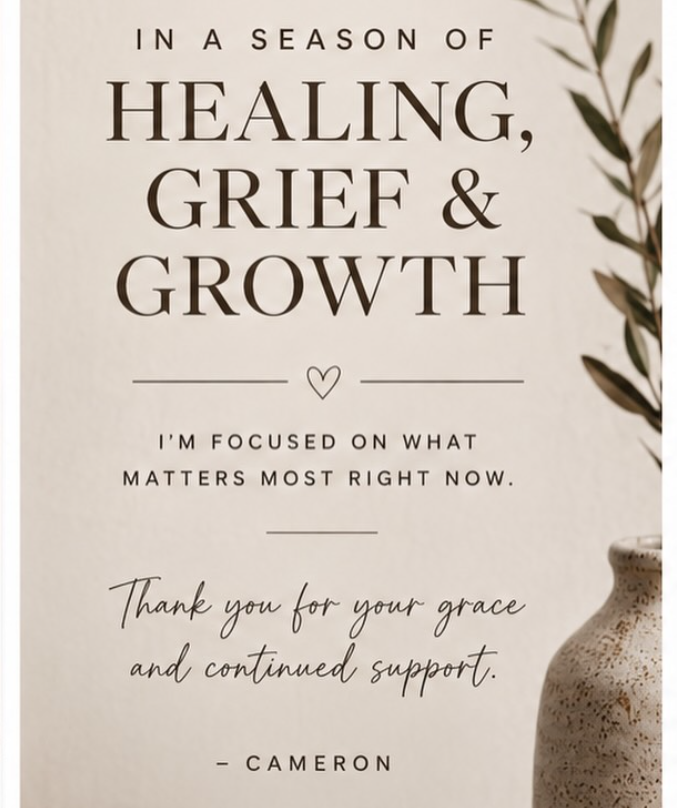
Why I’ve Been So Quiet Lately

There are seasons when words flow freely—and seasons when they don’t.

This is one of those seasons for me.

If you’ve noticed fewer blog posts or podcast episodes, I want to offer a simple and honest update about why. Not as an exhaustive explanation of everything happening in my life, but as a way of being transparent with this community I deeply value.

Since December, I’ve been engaged in counseling and therapy at The Refuge Center. This has been an important part of my ongoing healing journey as I continue to process past trauma and pursue greater wholeness. It is steady, intentional work that requires time, honesty, and emotional presence.

In February, I entered the editing phase of Jubilee’s book while also starting her nonprofit (more details to come). These are sacred responsibilities to me, and they deserve thoughtful attention as these efforts begin to lift off the ground.

In March, I stepped into a new Accounting Manager role with Rural Health Redesign Center. It has been a meaningful professional transition, but also one that requires focus and adjustment as I learn new rhythms and responsibilities. Around the same time, I began a two-month mental health evaluation as part of Vanderbilt’s VUMC Studyfinder program, which confirmed my ASD diagnosis earlier this month.

Alongside these transitions, my roles at The Gate Church and Messenger Fellowship have also shifted. Instead of focusing on admin and tech support, I’m beginning to move more into my wheelhouse—spiritual formation and education. This work has been deeply life-giving, though more inward-facing.

Most importantly, I’m doing my best to be fully present for my kids and support them as they finish their school semesters strong. That responsibility remains one of my highest priorities.

All of these pieces together have created a season in which I simply do not have the same capacity for consistent blogging and podcasting as before.

This is not a step away from this space, but rather a recognition of the season I am currently in.

I still believe in the value of storytelling, reflection, and honest conversation. I still care deeply about this community. And when the time and capacity return, I look forward to engaging more regularly again.

For now, I’m grateful for your patience, your understanding, and your continued presence here.

Thank you for walking with me.

— Cameron

Cover graphic creds: Center for Grief Counseling

Presence With Purpose: What Companies Must Consider about Remote Work

As more companies return to hybrid or fully onsite work, I keep coming back to a simple question: If we’re asking people to be physically present again…what are we actually using that presence for?

We can’t rewind to pre-pandemic. Work changed. People changed. Expectations around flexibility, productivity, and trust changed. And for many employees, performance didn’t drop when they left the office—it actually improved.

So, when organizations decide that onsite time should increase, the “why” matters more than ever. It can’t just be about proximity for proximity’s sake or leaders feeling secure within their control.

If people are commuting in, that time should feel different—not just a change of scenery from remote work. It should be where in-person presence adds something you can’t get through a screen:

  • Faster collaboration and real-time problem solving
  • Deeper mentorship and coaching moments
  • Relationship-building that strengthens trust
  • Decisions that benefit from shared context and energy

Otherwise, employees start asking a fair question: What’s the point of being here?

And honestly, that’s where a lot of friction shows up—not in the requirement itself, but in the lack of clarity and communication. around it.

Most people aren’t anti-office. They’re anti-wasted-office-time.

They don’t mind coming in when it’s useful, engaging, or meaningful. What frustrates them is showing up to sit on video calls all day, doing the exact same work they could have done remotely—just with a commute added on top. That’s not collaboration. That’s relocation.

Thus, if we’re going to bring people back in more consistently, maybe the better conversation isn’t how often, but how intentionally.

Because proximity, when used well, is powerful. It accelerates ideas. It strengthens relationships. It builds momentum. But when used poorly, it just feels like distance with extra steps.

Cover graphic creds: iBelieve.com

Supporting Scriptures: Colossians 3:23, Ephesians 6:6-7, Hebrews 10:24–25

Autside Looking In: 3 Ways to Support Spectrum People at Work

I’m blessed to serve where I work in this season. As my employer‘s name suggests, the extension of opportunity and grace has proven effective in recent years, a corporate Godsend in the sense I’ve discovered what I can offer within a healthy environment. 

That said, I’m also blessed to have worked in places where support and psychological safety were absent. Granted, those shortages came during a period when people weren’t as woke on the subject of neurodiversity as they are today.

Still, given the uptick of autism awareness in recent years, I want to examine ways employers can assist employees who are on the spectrum or struggling beyond their emotional or mental capacity. Too often, businesses will take reactive approaches to painful situations instead of proactively collaborating in humility. For what is working and what isn’t, consider this breakdown an attempt from experience to bridge the divide.

Let’s dive in… 

  1. Make Space, Show Grace

As one who is high functioning autistic, I can attest to the profound challenges—and lost potential—that come from working in environments where neurodiversity is misunderstood or undervalued. According to the Word, our individual design is not separate from our corporate identity given we are diverse in function and co-equal in value (Romans 12:4–8; 1 Corinthians 12:12–27). If we want to see our organizations thrive, we must understand this extends beyond job responsibilities to the very ways we perceive and process information.

For example, in previous roles, I was occasionally criticized for requesting additional technology, explicit communication, and extra time to process information—needs that stem from how I best contribute. At the time, I was embarrassed in the face of pushback; however, in hindsight, I recognize how advocating for these supports is not a weakness, but a strength that benefits the masses. Embracing neurodiversity requires courage from both sides. Leaders and managers have the opportunity—and the responsibility—to create inclusive environments where neurodivergent team members can excel. In turn, spectrum workers can extend patience and understanding to those who may not immediately relate. By fostering mutual respect and open dialogue, organizations can unlock innovation, loyalty, and a deeper sense of belonging for all.

  1. Withhold Premature Character Judgments 

When we examine an autistic colleague, there are certain factors to consider. For starters, many on the spectrum have heightened awareness not only to sensory stimuli but also rejection, exclusion, or just being misunderstood. Conversely, they can display diminished or skewed responses to social cues and nonverbal forms of communication, such as body language, facial expressions, even social media tact. In certain instances, an acute reaction may result when an autistic worker struggles to find words, senses a lack of psychological safety, and/or discerns discrimination. To the allistic eye, an autistic co-worker may be considered immature, irrational, emotional, or even complicated; however, in reality and within our behavior assessment, the truth is often beneath the surface of perception.

Regardless of our role, we must be slow to judge, if at all. While some mannerisms can seem confusing, the best move in general is to merge authority and/or care with curiosity before delegating constructive criticism. Rather than rebuke an accommodation, seek to understand its necessity. Don’t chastise an essential need when it might contradict your desire for conformity. Instead, assess workplace practices that can be unique and specific to each team member. In doing this, you’ll enhance a sense of security within your organization and decrease the odds of false labeling, treatment imbalances, and premature character judgments. 

  1. Nurture Their Strengths

Whatever you make of the spectrum, one thing is for sure: It is significantly broader and more complex than we think. As new information emerges, more people are discovering their place on neurodivergent planes. For those like me who didn’t discover their autism until adulthood, this can be quite the wake-up call. Yet, when we consider the big picture, we can find peace knowing once a diagnosis is confirmed and accepted, one can better understand how the difference between allistic and autistic is not to be compartmentalized but utilized!

For instance, most agree that autistic people tend to exhibit unconventional ways of perceiving instruction and execution. Some take directives down to the letter; others allot for creative interpretation. While understanding the behaviors, patterns, and preferences of autistic workers may be challenging at times, we must remember there’s value in not only acknowledging strengths and accommodations but nurturing them! For those in leadership, know your profiles, validate special needs, and as needed, receive and calibrate them to company policy without bias. Even though your supporting autistic colleague may talk differently and process more visually, you can still reel in their thoughts and fine-tune their priorities with precision. Be empowered, not discouraged in those moments.

Of course, in all this, taking the time to know the person you’re pouring into is key. On some days, you’ll find a ‘hands off’ approach is best; on other days, you’ll note a direct angle into constructive moments is more ideal. Regardless of the situation, bear in mind an autistic person benefits from stimuli conducive to their focus and security. Why not use your voice and support to be part of what they need to find safety and success in their role?

Now, I turn the podium over to you. What do you think about this topic? What other points would you add to this list? Do you have experience on either end of the spectrum? If so, I encourage you to share your thoughts. In the spirit of building one another up (Ephesians 4:11-16), Lys and I are here as always if you need us. 

God speed and as I always say in closing…

Cover graphic creds: Substack

Autside Looking In: Dealing with the Spectrum and Grief at Work

So, this isn’t a newsflash, but I’ll go ahead and say it anyway.

I’m an autistic adult who’s lost a kid yet believes in his story. While there’s a lot I don’t know, I know a lot about things I wouldn’t wish upon anyone, from holding a child taking her last breath to being unfairly labeled in school for lacking social cues, and at past jobs for having neurodivergent tendencies.

Not to suggest I’m a victim or anything. I’m just different, perhaps a little anomalous, and that’s okay. Honestly, the world needs more people who are content and confident in their uniqueness, in how they see and understand the world around them.

Yet, as for why I’m writing this, consider it a call for corporate introspection, from churches and counseling centers to employers across the country. No matter what organizational structure is employed, there must be support for spectrum people as well as those who are struggling with trauma and loss. In our interactions with colleagues, providers, subordinates, and those in our household, we must not only prioritize grace, compassion, and understanding in our dealings but also make additional room for them with certain people in specific situations.

The reason is simple: While every day is a gift, it can also feel like a burden for the one walking through complexities they can’t understand. Are we actively thinking of ways to steward psychological safety in our workplaces, to share requests and concerns? Are we screening people at strategic junctures to know what their accommodations should be? Are we seeking to understand the ‘why’ behind select needs, tools, and outputs? Are we willing to learn more about what doesn’t directly apply to us but applies to those on our team, from the cubicle peer next door to the prospect who could be the missing link to our company’s next big thing?

Again, I’m not looking to force conviction, but stir some questions for thought. Are we, as influencers and leaders with varying degrees of authority, considering ways we can facilitate healthy environments for those who may struggle to regulate on overwhelming, high-pressure days? Are we contributing our availability and wisdom to potentially detrimental dynamics? Are we being bold to sow life while being emotionally sensitive to those who could use a piece of our positivity, perspective, or direction?

Whatever your answers are, I’m not entitled to know, though I will say this in closing. Dare to care enough to know when an unjust tag is applied, when bias is infiltrating a pride-centric culture where hurting and/or neurodiverse people are somehow inferior. In all we say and do, let’s keep our hearts intact, our protocols fine-tuned, and our attitudes open to adjustments.