So, this isn’t a newsflash, but I’ll go ahead and say it anyway.
I’m an autistic adult who’s lost a kid yet believes in his story. While there’s a lot I don’t know, I know a lot about things I wouldn’t wish upon anyone, from holding a child taking her last breath to being unfairly labeled in school for lacking social cues, and at past jobs for having neurodivergent tendencies.
Not to suggest I’m a victim or anything. I’m just different, perhaps a little anomalous, and that’s okay. Honestly, the world needs more people who are content and confident in their uniqueness, in how they see and understand the world around them.
Yet, as for why I’m writing this, consider it a call for corporate introspection, from churches and counseling centers to employers across the country. No matter what organizational structure is employed, there must be support for spectrum people as well as those who are struggling with trauma and loss. In our interactions with colleagues, providers, subordinates, and those in our household, we must not only prioritize grace, compassion, and understanding in our dealings but also make additional room for them with certain people in specific situations.
The reason is simple: While every day is a gift, it can also feel like a burden for the one walking through complexities they can’t understand. Are we actively thinking of ways to steward psychological safety in our workplaces, to share requests and concerns? Are we screening people at strategic junctures to know what their accommodations should be? Are we seeking to understand the ‘why’ behind select needs, tools, and outputs? Are we willing to learn more about what doesn’t directly apply to us but applies to those on our team, from the cubicle peer next door to the prospect who could be the missing link to our company’s next big thing?
Again, I’m not looking to force conviction, but stir some questions for thought. Are we, as influencers and leaders with varying degrees of authority, considering ways we can facilitate healthy environments for those who may struggle to regulate on overwhelming, high-pressure days? Are we contributing our availability and wisdom to potentially detrimental dynamics? Are we being bold to sow life while being emotionally sensitive to those who could use a piece of our positivity, perspective, or direction?
Whatever your answers are, I’m not entitled to know, though I will say this in closing. Dare to care enough to know when an unjust tag is applied, when bias is infiltrating a pride-centric culture where hurting and/or neurodiverse people are somehow inferior. In all we say and do, let’s keep our hearts intact, our protocols fine-tuned, and our attitudes open to adjustments.
The other day, I was catching up with a former colleague when the following topic came up: Why does God lead us to places we don’t belong, places so far out of our giftings and comfort zones, they are practically impossible?
These are fair and popular questions during and after seasons of intense shaking and course-correcting. If we’re to start our exploration on the right foot, we must know who God is and how He journeys us. After all, God’s concern is not so much where we’re going as much as who we’re becoming. While man, in his lust for understanding, craves direction for his gain, be it clarity, validation, or something tangible, God is always after our hearts, relentlessly pursuing us in love (1 John 4:19). True to His Word, He never forsakes us and is always ready to help when we ask for it (Matthew 7:7; John 14:13-14).
So, if God is all this and more, why does He migrate us into deserts and wildernesses? Why does God sometimes open doors to places we’re hard-pressed to thrive, to be most effective?
As Jennie Allen suggests in her book, Untangle Your Emotions, when processing these questions, we must start with the right ‘W’. Often, we wonder why so we ask ‘why’, when really, we should be asking, ‘what’. For example, rather than ask God, ‘Why did you lead me here? Why did you let this happen? Why aren’t you manifesting’, inquire with, ‘God, what do you want me to know? What must I do to help this situation? What is it you want me to receive from you at the moment?’ While these are but a few examples, the mere shift in approach gives us a healthy starting point from which we can troubleshoot internal dissonance.
I believe for many of us, we’re searching not only for answers but stillness with a side of healing. Often, to what we hope for, we’re desperate for an improvement of circumstance, character, even health. The problem is while our reliance in the vertical is perpetually possible, the restoration we crave in the horizontal isn’t always plausible; hence, why we sometimes succumb to a ‘why’ question as we seek to bridge the disconnect. The good news is while this divide may hurt in the short term, it can have long-term, large-scale impacts given it validates our call to rely on God when we’re overwhelmed. Feeling down in your doubt? Cast it on Him! Sensing unfair treatment? Pray for peace-making discernment. Struggling to reconcile the past or advance in your way? Submit your intent to Christ knowing He desires to mature you according to His purposes.
Stumble as we may, our grooming for eternity doesn’t pause in the potholes of life but by His stripes can be enhanced in our weakness.
Accordingly, if you’re questioning God at a crucial intersection, if you’re struggling to arrive at peace, rest, forgiveness, whatever it may be, consider changing your ‘Why God’ into a ‘What God’ and watch what happens. Once your ‘what’ questions are in rhythm, marinate in the sweetness of God’s sanctification and strategize ways in which righteousness and holiness can cover your interactions with other people. Like ‘why’ questions, harboring offense and intentionally withholding good things (i.e. availability, a gentle critique/response, a listening ear, an effort to understand, etc.) will only cloud judgment and cap God’s love from flowing through us. Rather than quench the fires of tension or repair the damages of burnout, inquire what God wants to show you as you walk through it in humility. No need to panic or freak out; just leave it to the wrath and ways of God to straighten and enlighten. From there, all you have to do is breathe, release, and release again.
Ultimately, what compels us to journey through impossible places is God’s love filling in possible spaces – those spaces being our ‘deep’ (Psalm 42:7) desiring to know and grow in God within the world around us. As the Word attests, we were made to discover God; however, this cannot happen without the opportunity to trust Him in the desert, the wilderness, and all points in between. Remember God uses all things for good according to His perfect will purposed for those He loves (Romans 8:28). Core to our maturation as believers, we must learn to align faith and hope during adversity so any wresting against God can turn into wrestling with and for Him. Granted, this isn’t possible in our strength and requires daily sacrifice and surrender. But at the very least, we can respond to God’s pursuance and where He’s leading us, knowing we have nothing to lose and everything to gain in Christ Jesus following in His footsteps.
Imagine being Pontius Pilate. A man of high esteem among the Romans but despised by the people of Israel. A leader marked by confidence and chaos, peace and provocations. An ambassador puppet to a foreign land where conflict comes with the territory, where everything you stand for promotes a visceral, divisive reaction.
For a while, things are status quo with the occasional shaking here and there. But then, without warning, in walks a king, the Son of God, a man whose very name was questioned, whose presence would foreshadow the greatest kingdom collapses in history. Who could have known outside the divine? How epic a decision, how dramatic the plate in your lap?
Yet, that’s exactly what you have in John 18-19, a chapter duo ridden with deep denial, betrayal, and surprise confessions.
For many, the chapters read as a prelude to the greatest account of eternal measure, and rightfully so; however, what if I told you the books are more than just a literary overture? What if I told you the exchange between Pilate and Jesus would preview the kind of perspective and contrast we dare embrace today? Where naivety begets a redemptive recognition of truth. Would your mind not be changed or at least freshened to reconsider?
Either way, my curiosity is compelled to Pilate and his part in the resurrection narrative. As always, let’s drill down and dive in…
In the first half of John 18, the Sanhedrin, a council of priestly and lay elders, arrests Jesus during the Jewish festival of Passover, threatened by his teachings and kingdom assertions. After Annas and Caiaphas determine Jesus guilty of blasphemy, he’s brought before Pontius Pilate for judgment in v. 28. At the time, Jewish law prohibited killing one of their own. With Pilate being the only one with power to impose a death sentence, the elders pressure him to crucify Jesus. Amidst the commotion, Peter denies Jesus three times before the rooster’s crow as was foretold.
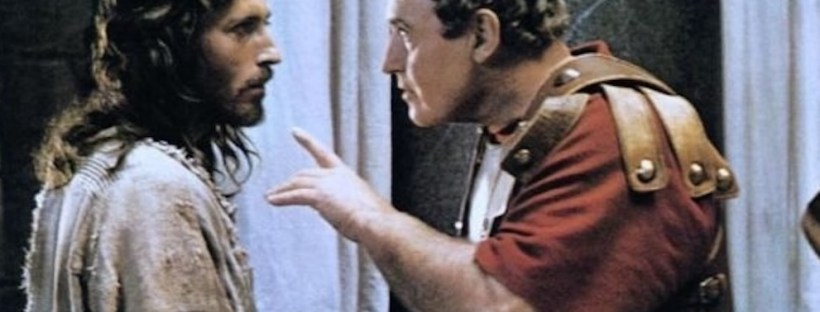
Seeking to understand the danger behind Jesus’ condemnation, Pilate probes his origin and lordship, stepping in and out of his governor’s headquarters to appease the council. After Pilate asks, “Are you King of the Jews”, Jesus answers, “You say that I am a king. For this purpose, I was born and for this purpose I have come into the world—to bear witness to the truth. Everyone who is of the truth listens to my voice.” Hearing more than he likely anticipated, Pilate poses a fair follow-up, “What is truth?“
While a response isn’t recorded, Pilate’s initial verdict is clear. Without criminal proof, Pilate declares Christ’s Innocence to the Sanhedrin: “I find no guilt in him” (v. 38) and encourages his release again before being met with resistance. Stuck in a stall pattern, Pilate orders Jesus to be flogged and beaten, hoping to satisfy the elders. After applying a crown of thorns into Jesus’ head, the soldiers bring him back to Pilate where again, he proclaims Christ’s blamelessness: “Take him yourselves and crucify him, for I find no guilt in him.” Desperate for control, the elders double-down and ‘double-mind’ their earlier statement (18:31): “We have a law, and according to that law he ought to die because he has made himself the Son of God.” Fearful of a riot, Pilate makes one last attempt to gain clarity from Jesus in a classic ‘help me help you’ moment.
Starting in John 19:9: “He entered his headquarters again and said to Jesus, “Where are you from?” But Jesus gave him no answer. So, Pilate said to him, ‘You will not speak to me? Do you not know that I have authority to release you and authority to crucify you?’ Jesus answered him, ‘You would have no authority over me at all unless it had been given you from above. Therefore, he who delivered me over to you has the greater sin.’ From then on Pilate sought to release him, but the Jews cried out, ‘If you release this man, you are not Caesar’s friend. Everyone who makes himself a king opposes Caesar.” So, when Pilate heard these words, he brought Jesus out and sat down on the judgment seat at a place called The Stone Pavement, and in Aramaic Gabbatha. Now it was the day of Preparation of the Passover. It was about the sixth hour. He said to the Jews, “Behold your King!”
In re-examining this passage, several insights stand out. For starters, the irony of these chapters is largely filtered through its symmetry and the awkwardness of Pilate’s position. The in-and-out of governor’s headquarters, the tug-of-war wavering between two parties keen on not defiling themselves, the contrast between Peter, a disciple, denying Jesus three times and Pilate, an alien, edifying His nature three times. The content and its layout is undoubtedly rich.
But to me, what resonates the most is how this piece of the narrative ends. Say what you want about Pilate’s predicament and decision-making. When we connect the dots within this exchange, we see nothing but truth (and truth seeking) from one who could relate to being despised by Jews, who communicated from authority to authority, who defended the guiltlessness of what he couldn’t understand even when it stood before him.
Make no mistake: Pilate isn’t a hero in the Passion narrative given his indecisive moments and people-pleasing tendencies; however, he is a worthy case study in the sense he sought to circumvent envy and relate to Christ’s innocence not only from what he boldly promulgated but his washing of hands post-sentence (Matthew 27:24). In essence, Pilate was given a tight-rope over shaky ground yet still pursued due diligence to free a righteous man hell-bent on freeing the world from sin. At the very least, we owe Pilate some props in pursuing truth. After all, if we want to point people to Jesus, we must be willing to discover who He is and from there, allow ourselves to be convinced He is set apart as our Messiah.
As for all of us this Easter season, I submit we re-receive the truth about our identity in light of the Cross. For Pilate, he made every attempt to be made innocent of Christ’s blood. But thanks to God’s master plan and Jesus’ sacrifice, we can walk in innocence because of Christ’s blood. No need to wash our hands as long we intend to wash others’ feet. Forward and onward. It’s all up front from here.
Written 11/26/24 for our latest MercyTalk podcast…
Back in April 2018, four months removed from a seven-year youth pastor assignment, I had a revelation that produced a habit I still practice to this day. As a state employee working in a stale environment, I sensed my walk with the Lord was starting to wane. For so long, motivation and inspiration overflowed naturally courtesy of 50 students and an opportunity to mature leadership in a liturgical setting; however, once I released the calling, I realized how much of my identity had become baked into my influence. Without youth in my life, I felt lost. Apart from my family, there was little to no accountability to guide my relationship with Jesus. Needing a spark, I knew my internal compass needed a reset.
So, I decided I would not only have daily quiet times during each morning commute but record them on my iPhone. With my weekly commutes averaging out to 6.5 hours, I figured I might as well talk and pray with God as I battle the banes of Nashville traffic. The decision turned out to be a game-changer as not only did the practice settle my spirit each day before work but allowed me to hear the mix of truth and lies roaming within. On some days, conviction came by declaring God’s Word out into the open; on others, I found grace simply in coming to Jesus as I was. In either case, my quiet time commutes were my happy hours during which I took thoughts captive and replaced them with holy perspective.
Fast-forward to October 2022 and I’m a month removed from losing my daughter, Jubilee, who took her last breath in my lap after a 393-day fight with chronic lung disease. For weeks I had been stone cold, flooding the pavement with tears during my workouts. Yet, everywhere else, the frozen numbness of grief had overtaken me. That’s when I returned to the practice of recording my quiet times on drives to work. During Jubilee’s life, the habit had faded to back-burner status through all the hustle and bustle. While there were times before Juju’s death when I felt as if I was walking on water, I sensed the sinking heading into 2023. If there ever was a time to rekindle the rhythm, this was it.
Like five years prior, I found myself pressing the red record button in my Audio app more frequently. With vulnerability on blast, there was never an intention of sharing the files with anyone. I simply needed to feel a connection with God, to feel His presence and listening ear calming the choppy waters of my soul. Occasionally, I would stumble upon an ‘ah ha’ moment, an epiphany with content-creating potential; however, the end goal was always to make room for God to invade my space and to catch Him doing it so I wouldn’t forget.
Having reached 400 records as of 11/20/2024, I can confidently say this habit has proven effective in stabilizing my mind, emotions, and walk with God all in one swoop. I especially recommend the practice for those in seasons of chaos in which they want to declutter or ‘spring clean’ their heart to hear the Shepherd’s voice more clearly.
Last December, I was taking inventory of my New Years goals and resolutions when the following revelation occurred to me: Why is it we’re more comfortable being for Christ than in Christ? Why does the thought of ‘in Christ’ intimidate us?
For many of us, we trust God and His Word as irrefutable truth, our belief a banner we wave and a root system anchoring our thoughts and behaviors. Like many Christians, we can wrap our minds around Christ in us by way of salvation and sanctification. Yet, even though we know God is infinitely greater, even though we can generally comprehend the life He facilitates, we sometimes struggle to grasp our lives 24/7/365 in Him and accordingly struggle to scale the challenges in front of us.
Often, we settle into rhythms, patterns, and mindsets where faith exists at their core. Still, I can’t help but wonder how they would change if we saw the ‘abiding in Christ’ potential in them. As to how we connect the dots, I submit we start by considering not only what does it mean to be ‘in Christ’ but how do we let our ‘in Christ’ be at work?
First, we must discern what it means to be ‘in Christ’. To be in Christ means we’re unified with Him personally and corporately. In Galatians, Paul talks about our new ‘in Christ’ identity by way of putting our hope and faith in Him. For many, we hear the phrase during baptisms and communions when we identify with Christ in the likeness of His death and resurrection. Where the Cross has power, there we can abide in Christ as we walk in the newness of life (Romans 6:4-5), which defined one way, is resurrection applied to every thought, pattern, belief, decision, temptation, all facets and modes of life.
While ‘newness of life’ can seem like a lofty phrase, one can always translate this to the surface through basic affirmations, saying ‘yes’ to ‘I’m loved by God’, ‘yes’ to the Cross and Jesus purchasing us at a price, ‘yes’ to leaving our sinful pasts behind, to ‘It is finished’, if you will. When we accept Jesus into our hearts, we embrace a new identity as children reconciled to God and our part of one body, the family of God, in which we abide from victory, not for it.
In Christ we find deliverance and healing, victory and life, goodness and godliness. Colossians 3:3 says we have died and our lives are hidden with Christ, notable as this also reflects how we’re to store His Word after spiritually ingesting it.
Effectively, to be ‘in Christ’ means God sees the righteousness of His Son operating in and through us.
But how do we exactly walk in this? For starters, we must position ourselves to be transformed by the renewing of our minds. While many recognize this opportunity as a gift of accepting Christ’s sacrifice as payment for our rap sheets, unfortunately, not all believers allow their minds to be renewed as spiritual walks fatigue and, in some cases, become compartmentalized. Sometimes, the hindrance is due to offenses that have matured to doubts, fears, bitterness, and resentments. When we tolerate these love-forsaken realities, our spiritual accounting becomes off-balance, where the cost of following Christ becomes almost equal to not following Him; hence, why many grow weary and stagnant. Over time, we become like vehicles wanting to hit the road yet are too scared about the fluids required to get there. Eventually, we stomach enough to reset and ramp onto new pathways, but with limited containers of health.
This leads me to another critical point…
When we take stock of our walk every new year, we must understand ‘reset’ and ‘renew’ are not the same.
With a reset, you take your plate to God where grace is received through humility and rest is received by the surrendering of your will in the moment, but to be transformed by the renewing of your mind, one must be daily dying in the context of vertical intimacy. Take it from one who’s failed in this time and time again: It doesn’t make sense to reset our walks, and by proxy, our vocational and spiritual trajectories, if we don’t intend to renew our minds, respond to conviction, and invite God into our brokenness.
Again, the obstacles are many but with them comes a challenge we must relish: In our aims to be equipped and effective, from knowledge base to spiritual growth, in our desire to experience greater wholeness, we must open ourselves up to be healed in our emotions. How we tend our broken hearts corporately cannot be swept under the carpet of mission, in the call we have to lay groundwork for holy repair. In the context of heaven meets earth, we may genuinely desire effectiveness; however, if we’re not acknowledging God in all our ways, if we’re not grasping our ‘loved-by-God, in-Christ identity’, our reach, the authenticity of our influence, will be capped.
So, my hope for us this year is at the least two-fold:
That we release any inhibitions in fully surrendering our lives to God.
That we give God more room to invade our space in all areas of life.
Not just at church, on Sundays, in our quiet times, but in our offices, the phone lines, conversations, yes, even the secret thoughts we have about each other. For if we’re not committed to being in-Christ, then our pride, anger, fear, self-centeredness will remain relevant, hinder our transformation, and prevent our minds from being renewed as God intended.
In summary, to be ‘in Christ’ is more than being content under the shadow of His wings, more than being grateful on account of sovereignty and grace, even more than our redemption. To be ‘in Christ’ is to be so united to Jesus by faith, so in awe of the Cross and the ministry of reconciliation that our dependence detaches from anything that could make it conditional and the transformation by the renewal of our minds become an overflow of discovering God as He pursues us.
May our ‘in Christ’ be at work, always and forever, even as we heal, even as we’re desperate, on and off the clock.