
Written 11/1/2016; revised 4/28/2024
So yesterday I’m reading Mark 5 and it hits me: Why does Jesus tell the once demon-possessed man to go home to his people and tell them how much the Lord has done for him (v. 19), but gives strict orders to the sleeping girl’s family not to let anyone know about her miraculous healing (v. 43)?
At first glance, Jesus seems inconsistent. Why tell one party one thing and contradict it with another?

I mean…yeah, Jesus was always yielded to the Father following the Spirit’s lead. Fair enough. Still, I can’t help but dive a little deeper. As always, let’s grab a shovel and dig in.
Scripture/Observations
In Mark 5:1, we find Jesus, fresh off of calming a tempest (4:35-41), crossing the lake to Garasenes, a country region lying on the east side of the Sea of Galilee. Upon arrival, a demon-possessed man decked with torn chains coming out from the tombs approaches Jesus (Spooky, right? Talk about the ultimate Halloween Bible read). Once within range, the demon reveals itself as Legion (“for we are many” – v. 9) and begs to be cast into swine. From there, Jesus grants the request and inspires the man to proclaim the good news of what He had done John 4 style.
Now, check out v. 21: “When Jesus had again crossed over by boat to the other side of the lake, a large crowd gathered around Him while He was by the lake.”
Like similar encounters, we see life flocking to Jesus upon arrival, perhaps more causal than coincidence given the west side was more populated, not to mention Jesus’ reputation had established momentum. Yet, it’s here I want to pause to highlight a key contrast.
When Jesus arrives at Gerasenes, how many people come to him? At least one that we know of, right? How about the flip side? If you said ‘large crowd’, you’d be correct. Granted, the population difference may seem like a subtle detail; however, when we stack it against proceeding context, we see its connection to part of the answer.

That answer, you ask?
I’ll get to that shortly. For now, we must understand the correlation between Jesus’ intimacy with the Father and how this enabled Him to know the best way to unleash the truth. In the case of Mark 5, Jesus, having already revealed His nature on the west side, knew the best way for the good news to spread at Gerasesnes was for the ex-possessed man to ‘go tell it on the mountain’. After all, what occurred at the Decapolis post-healing centered, in part, on Jesus’ identity being made known to the masses.
Yet, as I teased earlier, the truth of Jesus’ identity was already spreading on the west side. Therefore, it’s fair to say Jesus’ cross-country trek was just as much about manifesting love through power as it was confirming the truth of who He was (see v. 25-34).
Quick side note: I find it amusing how ‘crowd’ is mentioned not once, not twice, but five times between v. 21-31. If in fact the author intended the reader to grasp the chaotic backdrop, mission accomplished. The point here, I submit, is less about Jesus having to endure uncomfortable circumstances than it is Him loving in spite of them. Imagine having zero personal space, teaching to the culprits responsible, and being interrupted mid-sermon setting commotions between people crying and wailing loudly (v. 27). I’d probably lose my mind and grey my hair all at once!
But not Jesus. Instead, look at how unruffled he is, first in v. 36 when he says, ‘Don’t be afraid; just believe’ in response to the disciples telling Jairus’ people, ‘Why bother the teacher anymore?’ and second in v. 39 when he says, ‘The child is not dead but asleep’ after the entire house thought Jairus’ daughter was dead.
Seriously, it’s like Jesus is calming a second storm here.

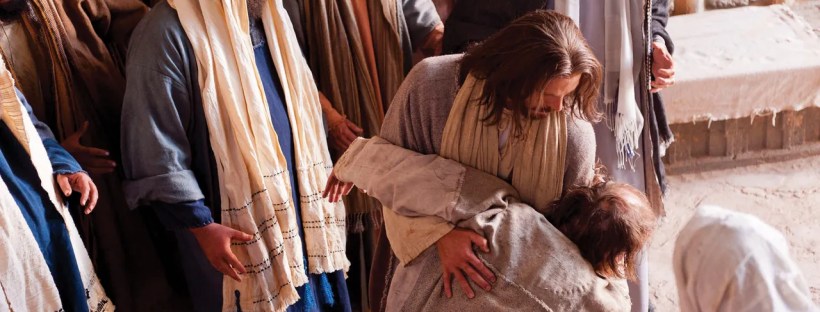
Now, for most, the story ends here, but the truth is Jesus had one more thing to say before peacing out, which in my paraphrasing, goes something like ‘Shhh! What happens here, stays here.’
But again, why would Jesus demand this? Well, go back to v. 36: ‘Don’t be afraid; just believe.’
Throughout this whole chapter, we’ve seen three miracles, three transfers of power; however, this doesn’t mean Jesus was on the ‘power play’. Rather, Jesus was on a mission to inspire belief in people’s hearts. Accordingly, we can assume what mattered most to Jesus more than signs, more than miracles was the truth of His Word.
In this context, Jesus knew if He allowed the news to break in synagogue central, it would lead to a major distraction. Remember there was enough pandemonium leading up to Jesus’ encounter with the little girl. Any more attention would likely have caused an uproar and reduce Jesus to the role of ringmaster. How fascinating it is to see how timely silence was sometimes part of Jesus’ strategy to further the Gospel!
Bottom line: While Jesus was Spirit led in all He said and did, He also discerned the theology of the land and time He was in as He constantly yielded to the Father. As a result, Jesus was able to reach more people through love and teach them with the truth and power of his Word.
Application/Prayer

Cover photo creds: JW Org


 hisgirlfryday.com
