Dust in the Wind: The Beauty in Being ‘Dirty’

Recently, Kansas’ ‘Dust in the Wind’ came on my local oldies FM.

I close my eyes
Only for a moment and the moment’s gone
All my dreams
Pass before my eyes with curiosity
Dust in the win
All they are is dust in the wind

Sounds depressing, right? Like a poor man’s romantic anthem to Ecclesiastes…

“‘Meaningless! Meaningless!’
says the Teacher.
‘Utterly meaningless!
Everything is meaningless’”
(Ecclesiastes 1:2).

Applied to our hopes and ambitions, these lyrics can seem maddening. What about my God given purpose? Is it void, useless, just a vain rat race underneath the cosmos?

Hardly! If anything, within these lyrics lies an affirming contrast, one that marks not only our earthly identity but vocational calling. To illustrate, let’s consider the difference between chaff and dust.

When exploring the reasons why we live, chances are we’re not considering the byproducts of grain processing. Still, the Word is clear our physical bodies were created from dust and will return as such (Genesis 3:19). With eternity in mind, we must accept the metaphor as core to our finiteness. While dust may seem unpleasant, by definition, it is a pure particle occasionally suspended in air but designed to settle whereas chaff is a scaly covering intended to be separated or burned. No wonder the Word often references chaff in the context of iniquity. For chaff to be purified, it must become a new creation. But with dust, it is already fine and capable of influencing everything from cloud formation to nutrient cycling.

Tying this to the surface, we find personal meaning. Although our bodies are fragile pillars, albeit with mind, heart, soul, and spirit, it’s still a sacred vessel created for finding rest and inspiring growth, even in times of displacement and turbulence. Kind of like, oh, I don’t know…dust!

Some of you reading this may be caught in chaotic currents or stuck in a false sense of worthlessness. You may feel as low as dust, easily swept away in the wind, not strong enough to stand in your own strength. But I challenge you, friends, to see the beauty in that. If all else, stand firm (Ephesians 6:13) and if you can’t stand, then settle in Jesus with every intention to rely on Him to carry you. You may feel like you’re passing away; however, rather than wade in insecurity, dare to consider where you’re passing away to.

‘Cause truth is: God can use you even if you feel like dust in the wind. He can use you to inspire vertical growth as you wisp for His glory. He can sustain you as you ignite precipitation to fall and become rivers of living water. He can strengthen you as you sow and position seeds in tough terrain to receive what they need to flourish. I could go on.

Just remember none of this is possible without the Creator and Sustainer of dust; hence, why Qoheleth prologues his book with ‘meaningless’, as life is without the answer and the reason of life. How sweet it is to know with His breath, He purified us from the ground so the ground would have no ultimate authority over our final destination. Yet, even as we come back to it in this life, we can fulfill God’s original design for our lives.

Cheers to being dust in the wind alongside you…

Selahand remember, friends, be excellent to each other...

Cover graphic creds: iStock

Master Plan: How to Discover God’s Will for Your Life

Rooted in the heart of every person there is a question:  What’s the purpose of my life? Perhaps you are reading this blog right now because you are searching for an answer to that question. Or maybe you are wondering if your life is some cosmic mistake. You are not alone. Many of us wrestle with our identity or place in this world at one point or another.  
 
If you follow Christ, or have ever considered following God, this search for purpose and meaning points us to Him – the divine creator that knows our purpose. But maybe you have looked to God or His word to discover your purpose and still feel lost.  
 
No matter how desperate we are to discover our purpose, if we are seeking our own will and not God’s we are destined to struggle. As we crave fulfillment and pine for intimacy and influence with those around us, are we inviting God into our brokenness, our needs, and our search for His will?

Or maybe you really want to discover God’s will for your life but don’t know how to find it. If so, I want to encourage you through a phrase you’ve likely heard before: Where there’s a will, there’s a way. 
 
In this context, I’m not talking about our free will; I’m talking about God’s will, His guide for our lives and a pathway for us to follow.  
 
Micah 6:8 (NIV) says: “…what does the Lord require of you? To act justly, to love mercy, and to walk humbly with your God.” 
 
To me, this verse offers profound peace. No matter what we’re going through, no matter the void we’re eager to fill, we can reference these three instructions and reset our inquiry. Read through this prayer and consider praying it for yourself: 
 
Lord, in this moment, I confess I need You more than anything else. Though I’m anxious to know the next step for my life, I ask first that Your Kingdom come, and that Your will be done on earth as it is in heaven. Purify my heart to be more like Yours, to know the truth of who You are, so even when I’m lost or confused, I can rest knowing I’m loved and made in Your image.  I want your love and your purpose for me to be the lens through which I see myself and the world around me. 
 
Dallán Forgaill captures this in the words of the well-known hymn, ‘Be Thou My Vision’. Here are three verses from that old hymn: 

Be Thou my vision, O Lord of my heart; 

Naught be all else to me, save that Thou art; 

Thou my best thought, by day or by night; 

Waking or sleeping, Thy presence my light. 
 
Riches I heed not, nor man’s empty praise; 

Thou mine inheritance, now and always; 

Thou and Thou only, first in my heart; 

O King of glory, my treasure Thou art. 
 
O King of glory, my victory won; 

Rule and reign in me ’til Thy will be done; 

Heart of my own heart, whatever befall; 

Still be my vision, O Ruler of all. 

In the poem, Forgaill asks God to make Himself known. He does not ask for answers or next steps; simply Jesus. As much as we want to discern the will of God, we must first arrive at a point of complete surrender and total reliance.  
 
And we see this theme of surrender and reliance echo throughout scripture: 
 
“Yes, my soul, find rest in God; my hope comes from him. Truly he is my rock and my salvation; he is my fortress, I will not be shaken. My salvation and my honor depend on God; he is my mighty rock, my refuge. Trust in him at all times, you people; pour out your hearts to him, for God is our refuge.” ~ Psalm 62:5-8 (NIV) 
 
“Then Jesus said to his disciples, “Whoever wants to be my disciple must deny themselves and take up their cross and follow me.” ~ Matthew 16:24 (NIV) 
 
“Cast all your anxiety on him because he cares for you.” ~ 1 Peter 5:7 (NIV) 
 
“Submit yourselves, then, to God. Resist the devil, and he will flee from you.” ~ James 4:7 (NIV) 
 
In doing the things listed in these verses, we can commit our ways to God and abandon unhealthy entitlement, idolatry, lust, and pride. We can even release to God our longing to know His plan! 
 
In summary, if you want to know God’s will for your life, pursue the heart of God, and the plan will come. 
 
 “But seek first his kingdom and his righteousness, and all these things will be given to you as well.” ~ Matthew 6:33  
 
God will help you discover His next best step in His perfect timing. No matter what is happening in your life, when in doubt, simply “pour out” a simple prayer. Here’s one example: 
 
God, I’m too hurt or lost to move in this moment; however, in faith, I cast my fear and anxiety upon you. In this posture of trust, I anchor my hope in you, counting the journey as joy as I wait upon you. Until then, I will say ‘yes’ to your Word in showing justice, kindness, and humility to the world around me. Amen. 
 
Mercy Multiplied offers programs and resources to help people find freedom in Christ and discover the seeds of destiny God has planted in them. Click here for more information about the Keys to Freedom discipleship study. 

Fall Down 7, Get Up 8: A SOAP Bible Study on Proverbs 24

Scripture: Proverbs 24:16 – “For the righteous falls seven times and rises again, but the wicked stumble in times of calamity.”

Prelude: Recently, I was reminded of a late 2000s NBA commercial in which Dwyane Wade collapses to the parquet multiple times over the course of his career. After a montage of tumbles, a new series unfolds in which he rises from each fall before the screen goes to black… 

Coincidently, this connects to a separate memory last decade. Remember the 2017 NAACP Image Awards when Denzel Washington delivered one of his most iconic speeches? 

Fall down seven times, stand up eight.” 

…still gives me chills to this day.

Understandably, many cite this line as a Japanese proverb with a credit to celebrity enlightenment; however, in reality, its true source is the Word of God; hence, this SOAP Bible study in which we will dissect the contrast in greater detail.

As always, let’s dive in…

Observations: In a vacuum, this verse compares the resilience of the righteous to the cowardice of the wicked. Both sides face setbacks and challenges, but only one perseveres through them. While some assume this verse suggests adversity comes to the unwise, the reality is that calamity finds all of us at one point or another. The key is how we respond and endure the way God intended. 

As mentioned in a recent post, even good people fail sometimes, especially as they face new challenges and situations beyond their ability to handle. Humility applied, we must understand these circumstances are not the product of poor character, but a part of God’s plan to develop it. In what we say and do, are we willing to rely on God’s guidance in the fullness of faith and integrity? If not, we will inevitably succumb to stubbornness and disbelief as the trials undo us.

Symbolically, the number seven is used here to emphasize completion and perfection, as God’s grace empowers the righteous to suffer through their failures. Granted, man, in his finiteness, may be ‘one and done’ on certain matters; however, since God sees the entire picture, we can trust that in HIs faithfulness, He will give us multiple opportunities to clear our hurdles. How sweet it is knowing we can live from victory as we wrestle with and for God!

Following v. 16, we find a subsequent call in v. 17-18:

Do not rejoice when your enemy falls and let not your heart be glad when he stumbles, lest the Lord see it and be displeased, and turn away his anger from him.”

As people redeemed by faith through the Cross, this charge cannot be understated. While our flesh may snicker at karma and the kind of justice that enhances our ego, we must never rejoice when others fall and can’t get up. If anything, we should intercede and consider our options to help. Even if we can’t directly intervene, we can pray for a person whose peace is in peril and build a broken brother up from a place of boundary.

Applications: Although chaos and conflict are unavoidable in this life, God is the one true constant through it all. When tough times come, we can rest knowing there’s a vertical response with our name on it. To those feeling God is leading you through a desert or wilderness right now, remember how God used Joseph in the Old Testament (Genesis 39) and Paul in the New Testament (2 Corinthians 1:8-10). You may feel lost in the hole or bind you’re currently in, but this could be part of a grander setup in which God is equipping your heart to reach a promise and purpose He has ordained for you. 

Bottom line: God never fails and has the power to restore our confidence and redeem our failures. Although setbacks will come, as long as we fix our eyes on Jesus and follow His lead one step at a time, God will not only forgive us but also bring us to completion according to His Word (Philippians 1:6). Why not let Him be the fall back you crave when all hope seems lost? 

Prayer:

God, we turn and align to you in this moment. We thank you for being a merciful, faithful God in whom we can trust. Father, as I write this, I think about those in dry valleys, surrounded by bones, needing a spark. As men and women fallen in sin, we confess our need for a Savior, who through His strength and sovereignty, provides the tools and opportunities necessary to rise above the obstacles of life. For those wresting in guilt and shame, for those who feel defeated for not having passed a specific test, we speak peace, grace, truth, and love to their hearts and minds today. May they find you in the wake of their desperation, for others, in the midst of their course-correcting. In our frailty, we admit our limited perspective, our tendency to get way ahead or woefully behind you. Though the ways to faith derailment are many, we choose to lean on your understanding, to follow the prompting of your Holy Spirit, and to press into you with all that is within us. Bless your holy name. Come alive within us. Help us not to give up and give in but as Psalm 57:1 says, lead us from failure’s shadow in and under the shadow of your wings. Amen.

Cover graphic creds: Redbubble

Healing at Work: Why God Leads Us Through Desert Seasons

The other day, I was catching up with a former colleague when the following topic came up: Why does God lead us to places we don’t belong, places so far out of our giftings and comfort zones, they are practically impossible?

These are fair and popular questions during and after seasons of intense shaking and course-correcting. If we’re to start our exploration on the right foot, we must know who God is and how He journeys us. After all, God’s concern is not so much where we’re going as much as who we’re becoming. While man, in his lust for understanding, craves direction for his gain, be it clarity, validation, or something tangible, God is always after our hearts, relentlessly pursuing us in love (1 John 4:19). True to His Word, He never forsakes us and is always ready to help when we ask for it (Matthew 7:7; John 14:13-14).

So, if God is all this and more, why does He migrate us into deserts and wildernesses? Why does God sometimes open doors to places we’re hard-pressed to thrive, to be most effective?

As Jennie Allen suggests in her book, Untangle Your Emotions, when processing these questions, we must start with the right ‘W’. Often, we wonder why so we ask ‘why’, when really, we should be asking, ‘what’. For example, rather than ask God, ‘Why did you lead me here? Why did you let this happen? Why aren’t you manifesting’, inquire with, ‘God, what do you want me to know? What must I do to help this situation? What is it you want me to receive from you at the moment?’ While these are but a few examples, the mere shift in approach gives us a healthy starting point from which we can troubleshoot internal dissonance.

I believe for many of us, we’re searching not only for answers but stillness with a side of healing. Often, to what we hope for, we’re desperate for an improvement of circumstance, character, even health. The problem is while our reliance in the vertical is perpetually possible, the restoration we crave in the horizontal isn’t always plausible; hence, why we sometimes succumb to a ‘why’ question as we seek to bridge the disconnect. The good news is while this divide may hurt in the short term, it can have long-term, large-scale impacts given it validates our call to rely on God when we’re overwhelmed. Feeling down in your doubt? Cast it on Him! Sensing unfair treatment? Pray for peace-making discernment. Struggling to reconcile the past or advance in your way? Submit your intent to Christ knowing He desires to mature you according to His purposes.

Stumble as we may, our grooming for eternity doesn’t pause in the potholes of life but by His stripes can be enhanced in our weakness.

Accordingly, if you’re questioning God at a crucial intersection, if you’re struggling to arrive at peace, rest, forgiveness, whatever it may be, consider changing your ‘Why God’ into a ‘What God’ and watch what happens. Once your ‘what’ questions are in rhythm, marinate in the sweetness of God’s sanctification and strategize ways in which righteousness and holiness can cover your interactions with other people. Like ‘why’ questions, harboring offense and intentionally withholding good things (i.e. availability, a gentle critique/response, a listening ear, an effort to understand, etc.) will only cloud judgment and cap God’s love from flowing through us. Rather than quench the fires of tension or repair the damages of burnout, inquire what God wants to show you as you walk through it in humility. No need to panic or freak out; just leave it to the wrath and ways of God to straighten and enlighten. From there, all you have to do is breathe, release, and release again.

Ultimately, what compels us to journey through impossible places is God’s love filling in possible spaces – those spaces being our ‘deep’ (Psalm 42:7) desiring to know and grow in God within the world around us. As the Word attests, we were made to discover God; however, this cannot happen without the opportunity to trust Him in the desert, the wilderness, and all points in between. Remember God uses all things for good according to His perfect will purposed for those He loves (Romans 8:28). Core to our maturation as believers, we must learn to align faith and hope during adversity so any wresting against God can turn into wrestling with and for Him. Granted, this isn’t possible in our strength and requires daily sacrifice and surrender. But at the very least, we can respond to God’s pursuance and where He’s leading us, knowing we have nothing to lose and everything to gain in Christ Jesus following in His footsteps.

Cover graphic creds: Framework Recovery

Healing Declared: A SOAP Study on Luke 13:10-17

**New excerpt from Juju’s book…**

In Luke 13:10-17, Jesus is teaching in the synagogue on the Sabbath when he notices a woman with a disabling spirit. As she totters through the temple gates, Jesus calls the woman over, confirms her restoration, and heals her condition. No longer crooked, she glorifies God and prompts Jesus to criticize the religious leaders for their lack of compassion.

Digging into this summary, we find meaningful implications, especially where sickness and infirmity dwell. For starters, we must not deny those around us who are poor in spirit and health, desperate for Jesus in a way that extends past their margins.

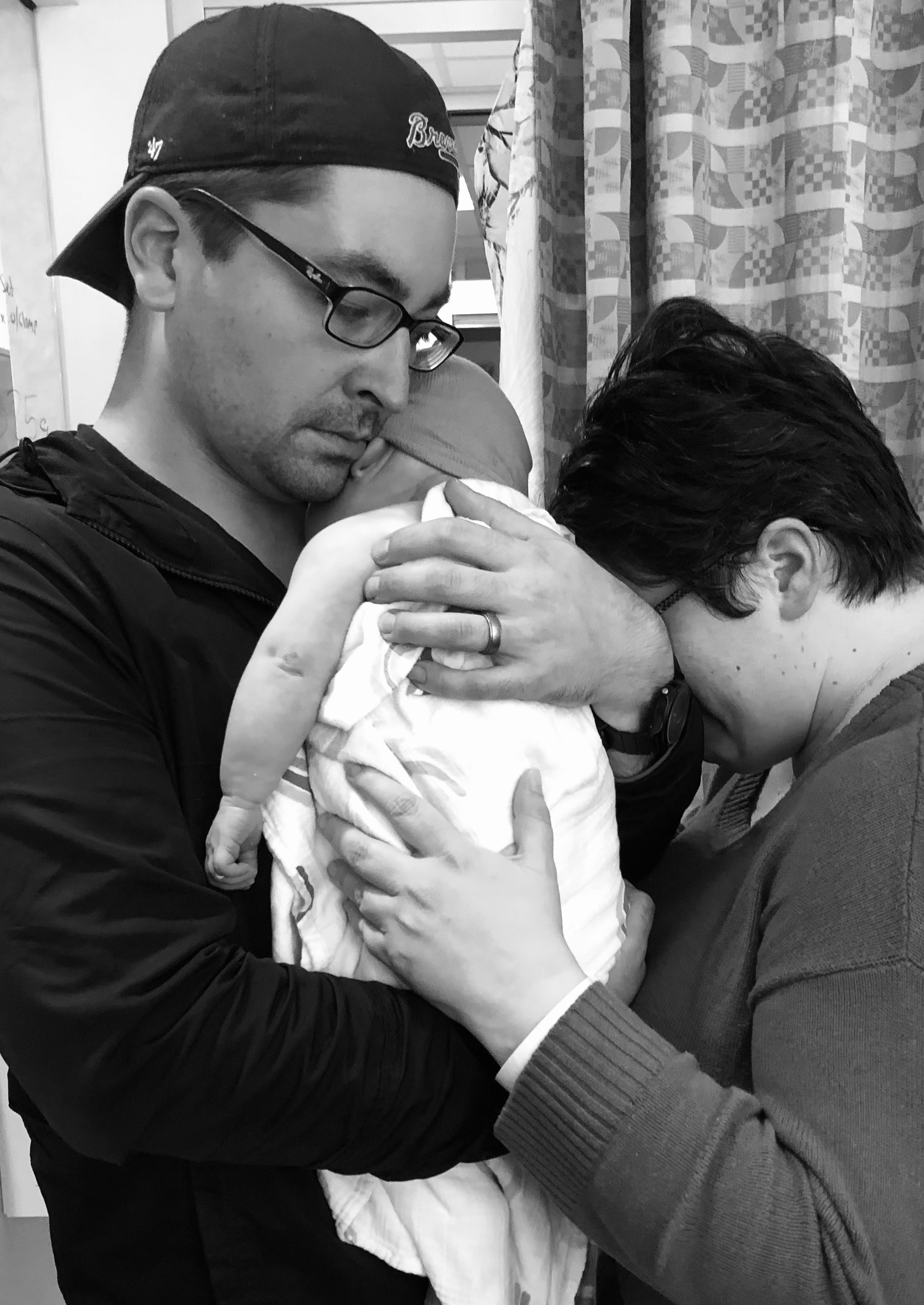
As a NICU alum, I can boldly testify to this. Every day during Juju’s life, Lys and I entered a larger-than-life mystery box, a stream of unknowns where anything could happen. From what we experienced, the emotional highways were unending from dead-end hopelessness to confounding crossroads. In each situation, parents, like the crooked woman, were searching for anything their hope could cling to – comfort, healing, answers, you name it!

Yet, as challenging as that season was, the contrast in processing helped us understand the power within the presence of God. While there were moments when we sought the Lord because there was no other way, there were other times we sensed his call and responded accordingly. So, it was with our protagonist in Luke 13, who not only personified what it meant to be in the right place at the right time but saw her affliction as a catalyst for intervention.

Examining the woman’s transformation, we find some notable takeaways, particularly in v. 10-13, during which Jesus orchestrates his miracle:

1. In v. 10, Jesus sees the woman even though he was already teaching in the synagogue.
2. At the start of v. 12, he calls her over instead of continuing with his message.
3. By the end of v. 12, he declares her freedom before healing her disability.

While circumstantial at the surface, we can behold the intentionality within this order when we assess similar healings in the Gospels. Like the bent woman, Jesus repeatedly modeled his heart alongside his power, relating to the context of suffering even before his presence was recognized. This poses a powerful thought:

To the extent our faith activates when we sense God’s presence, it also stirs when we hear His voice. Like gravity, His Word summons the innermost part of our being in a way that compels us to move in his direction.

No wonder the woman had no issue journeying to Jesus. the joy set before her resonating with the joy set before him.

Upon her arrival, note how Jesus reacts: He doesn’t immediately remove the woman’s iniquity but proclaims her victory! Again, this subtle progression is profound. Though some might question why Jesus would call his shot, the purpose behind his declaration wasn’t to simply highlight his divinity but to deliver salvation while proving his love. Had the purity behind the action lacked, the woman’s response may have reflected differently. But like many before her who battled long-lasting crippling ailments, the outflow of praise rode on the heels of the expectancy. In the end, it was all about Jesus, religious and wishful sentiments be da*rned.

For the griever and/or loved one stuck in the hospital, while our prayers have power and purpose, what we voice as expressions of hope yields the truth of who God is and what he wills from his nature. Ultimately, God is going to finish the good work he started in you (Philippians 1:6) as heaven meets earth in wonder-working fashion (Matthew 6:10). True, we will never have all the answers as to why we must endure in specific ways; however, when we remember how Jesus made space to heal a woman in the middle of a sermon on a day His Father set apart for rest, we can draw encouragement knowing God is always for us, even during the darkest and craziest of days.

Prayer: “Jesus, you told your followers, ‘Do not let your hearts be troubled. You believe in God, so believe in Me as well. Peace, I leave with you; my peace I give you. I do not give to you as the world gives,’ (John 14:1, 27). We confess we need your peace, the peace of God, which transcends all understanding’ (Philippians 4:7) to guard our hearts and minds. We humbly come before you with our weary hearts and pray that you continue to show us fresh levels of love and grace as we go through this season of sorrow and transition. Help us to find peace in your presence. Wipe our tears, Lord, and carry us through this season of mourning and deep sadness. Help us to trust in your unfailing love and to fix our eyes on you, Jesus. As we lift our worries to you, we humbly ask that you lift up our hearts from what may overwhelm us. May your presence bring us joy and comfort as we embark on this journey of healing with you. In your most holy name, we pray. Amen.”

Cover photo creds: Sunflower Seeds