Sevenfold: A Workman’s Guide to the Leadership Gifts

Last decade (2010-2019), I worked in state government: The Department of Labor and Workforce for 2.5 years, and TDOT (Tennessee Department of Transportation) for 7.5 years. As one might expect, the environments, well, they were kind of like your favorite soda but flat – very little in terms of bubbliness, morale, positivity, widespread humility, grace, selflessness, and other hallmarks of a healthy culture.

After my first year at TDOT, I started getting frustrated with God as to why He opened a door for me into a place I didn’t fit, let alone have a clear, defined future. At the time, I was two years into a six-year youth ministry assignment, which provided some sense of purpose punch. But by day, I sometimes wondered ‘God, why did you bring me to this desert? I know you made me for much more than this.’  

After a few months of wrestling, I decided to meet up with my dad and my wife, Lyssah, for lunch. During our talk, we discussed our royal priesthood (1 Peter 2:9) identity and how the concept of being commissioned for ministry was largely confined to licensed liturgy (I.e. only pastors and those called to ‘ministry’ can be ordained, etc.). As we dissected this issue, Lyssah and I disclosed some of our frustrations, one of them being how much energy we were sowing outside our calling, or rather, our perception of calling.

But by conversation’s end, I started to realize how my construct of God-given purpose was off.

Our purpose isn’t given to us by our settings and surroundings, but is given as an inheritance, a faith downpayment, a gift from above that not only connects to our original design but one we’re called to exercise throughout our lives from home to church, from market to marketpla

Once this lightbulb went off, I immediately understood why God called me to the desert – not only did He want to break off strongholds, like pride, ego, and faulty belief structures, but He wanted me to see how it was because He had more for me that He called me there.

For years, I compartmentalized my view of what being on mission, what being in ministry, looked like. Yes, I had a youth pastor outlet; however, I was still often annoyed given the pressure to cram a full-time effort within part-time hours. This is partly why my grudge against the state grew before my eyes were opened to see how God was calling me to lead in both church and marketplace arenas.

While there’s more I could say about this season, what I can speak to now concerns one of the initial impacts. Starting in 2015, I started to study the spiritual gifts (as unpacked in Paul’s letters) with a fresh pair of eyes, all the while creating content catered to two sets of vocationals:

  • Those who had a leg in corporate and ministerial arenas.
  • Those who were called to ministry outside the church.

In some of my explorations, I started to assess the spiritual gifts through work-based themes like work/home/church life balance, leadership, conflict resolution, networking, technology, goal setting, time management, etc. The more I dug in, the more I realized there is no hierarchy or exclusivity when it comes to “working with Jesus”, partnering with Him in daily tasks and fulfilling God’s purpose on our lives. We may be diverse in function but we’re co-equal in value given we’re co-laborers with Christ (1 Corinthians 3:9). The same worldly systems that promote entitlement, reciprocity, self-gratification/preservation/medication, etc. are the same systems that push leadership as a ladder to climb when the Word is clear in its trope of leading being the overflow of serving one another in the hope of unity, in the spirit of humility. 

Concerning the spiritual gifts, not only are there more than we might remember, but our spiritual identity with respect to them is no stranger to God. For each person, there is a divine order with varying weights that often goes unknown or misunderstood in spiritual journeys. Accordingly, it is my belief that any faith-based institution should be keen on helping its participants discover their ‘loved by God’ identity through the gifts and then seeing how they can be at work…at work. 
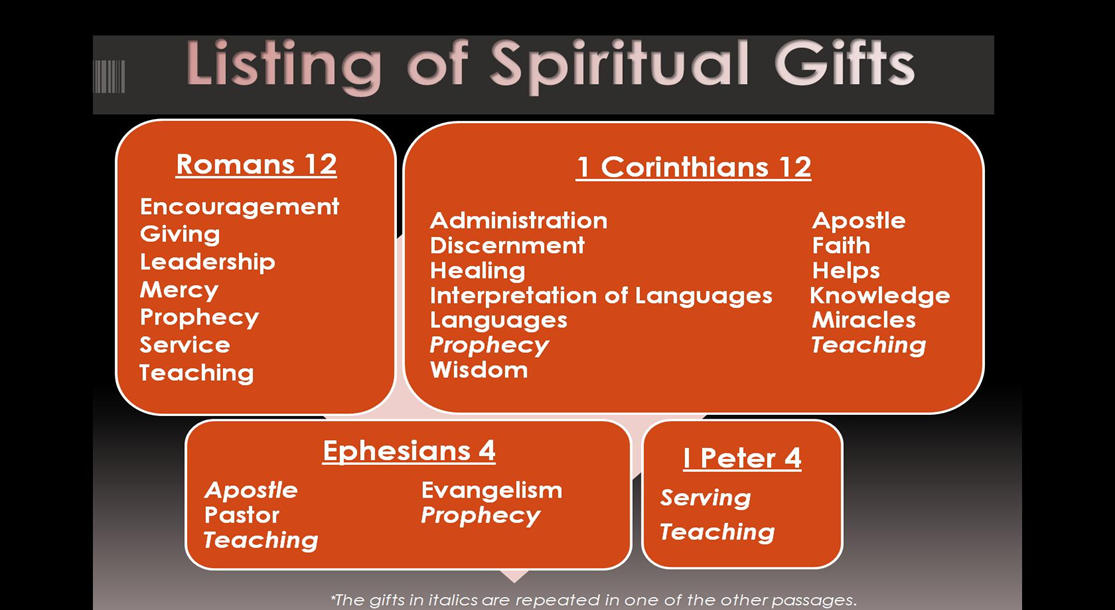
I like this graphic primarily due to its layout. While we don’t have time in this post to dive into all of them, I want to focus today on the seven gifts at the bottom of the screen, starting with the fivefold ministry gifts described in Ephesians 4: Apostles, Prophets, Evangelists, Pastors, and Teachers. These are leadership gifts given by Christ not just to the ordained ministers of the world but too all believers to equip the saints for ministry, build up the body of Christ, and foster unity and maturity in the faith.

As for the two in the bottom-right, these are grace gifts as defined in 1 Peter 4:10-11, service (deacon) and ‘teaching’ (elder) in an exhortation capacity, In this passage, Peter states how God has given every believer a spiritual gift to serve one another as good stewards of God’s grace, with the goal that all things glorify God through Christ. These gifts are not self-focused but are for the benefit and building up of the body at large with different gifts being empowered by the same Spirit and needing to be used with God’s strength for His glory. 

Having said all this, here’s the ‘crashiest’ of courses you may ever receive on the seven leadership gifts and how they’re meant to function in the marketplace…

Prophets…call God’s people to God’s ways. They are more about developing the design of organizational mission, less about developing people. They ‘redeem’ an environment by expressing a wisdom that gives clarifies organization’s vision/mission for co-workers.

Evangelists…those who are gifted to reach unbelievers. They tend to be more gatherers with acts of service being their community gift. Evangelists are more concerned about developing the organization through developing people. They ‘redeem’ an environment by creating an inclusive team environment through love and acceptance.

Pastors…those who encourage believers with the spoken word. More concerned about developing people than managing systems. They ‘redeem’ their environment by creating joy through encouraging people on how important they are as people to the organization and by helping them see how their temperaments complement the organization.

Teachers…those who systematically make disciples and develop management systems. More concerned about preserving the organization. They ‘redeem’ their environment by raising team morale through breaking down systems into easy action steps and by helping them see how the systems help everyone reach their mutual goals.

Apostles…coordinate the other gifts and helps them work together. Leading and directing are their community gifts. They ‘redeem’ their environment by coordinating a team in a way that generates hope by maximizing each team member’s gift and designing products/projects that emphasize a redemptive gift of the organization.

Elders…those who impart themselves. More about managing people/Less about developing people. They are big picture minded in that that they see the value of systems, but they REALLY see the value of helping people find their places in the system. They are manager-developers who gravitate to systems but are motivated to help people find their seat on the bus.

Deacons…more about managing systems for the sake of people. They are motivated to implement proven systems that help people work together*. A deacon is part of the pastoral gift cluster, but in the workplace may not be in a direct support capacity but a ‘hidden’ support capacity. They ‘redeem’ their environment by creating an atmosphere of goodness and gratitude through giving and bringing order to the organizational environment.

*Note: A deacon’s gift is the broader concept of “serving others” through the use of whatever spiritual gifts one has received from God. This isn’t limited to a specific role, but encompasses a general ability to use God-given talents, like mercy, hospitality, administration, and giving, to serve the needs of the Christian community.

Graphic creds: Walk with Scripture

Two Way Street: The Next for Next Gen (Part 1)

I got to get something off my chest.

As a Millennial, I’m starting to wonder if the church is exhausting the ‘next’ in ‘next generation’…if what she considers ‘next’ is ‘new’ and what she considers ‘new’ is ‘more’1.

‘Cause truth is: While I’m all about the emerging generation being poured into, I can’t help but think we, as the body, need to re-evaluate ‘next’ relative to God’s discipleship intent. Granted, I’m a part of the rising leadership community and have much to learn; still, the splinter lingers in the back of my mind:

Should the church replace, ‘The future of church leadership is the next generation‘ with ‘The future of church leadership is discovering the next for each generation‘ in its ‘life on life’ vernacular?

If ‘yes’, then I believe the Lord wants to unveil specific strategies on how we’re to walk this out. But before we can dive into application, we must first bask our context in the Word.

As always, let’s dig in…

tumblr_m088t7ZxS21qioot0o4_400

Starting in Psalm 1452:4

 “One generation shall commend your works to another, and shall declare your mighty acts.” (ESV)
One generation shall praise Your works to another, and shall declare Your mighty and remarkable acts.” (AMP)
Generation after generation stands in awe of your work; each one tells stories of your mighty acts.” (MSG)
One generation will declare Your works to the next and will proclaim Your mighty acts.” (HCSB)
Let each generation tell its children of your mighty acts; let them proclaim your power.” (NLT)

Right away, we see why contrasting different translations is important when studying Scripture. For instance, if you read the ESV, HCSB, AMP, or a similar translation, you might interpret ‘one generation’ to literally mean one generation; however, in context, this is not what David is implying. Rather, David is stating how worship should be a successive and progressive tradition – a two-way street from which one generation can learn from another. Had David been posed with the idea praise3 could only be experienced from top to bottom, it would have been a compromise to adoration in his mind.

As such, the key takeaway here is delighting in God is not only at the core of who we are, but also the core of our unity…which cannot be reduced to a unidirectional expression.

Now, let’s collate this with the parable of the wineskins:

“’No one tears a piece from a new garment and puts it on an old garment. If he does, he will tear the new, and the piece from the new will not match the old. And no one puts new wine into old wineskins. If he does, the new wine will burst the skins and it will be spilled, and the skins will be destroyed. But new wine must be put into fresh wineskins. And no one after drinking old wine desires new, for he says, ‘The old is good.’” ~ Luke 5:36-39 (ESV)

Exegesis applied, Luke is illustrating the fact no one can mix legalism with new faith or religious tradition with divine grace; however, in this case, let’s assume old wineskins apply to older generations and new wineskins apply to rising generations. When Luke suggests the old is good4, he’s not saying aged is better in all regards (though with wine, this is certainly the case) as much as he’s emphasizing the Ecclesiastes 3 reality that for each option, there is a season, a time, and a place.

In other words, what’s new and what’s established are not only meant to co-exist, but partake under the heading of ‘fresh’ or as Hebrew translates it, ‘mechudash’ meaning ‘renewed’. Accordingly, while the literal pouring of wine from new skin to old skin doesn’t make sense, when we consider ‘fresh’ relationally from God’s perspective, we can know God as faithful to renew fresh works in all men for cross-generational education and exultation.

Think of it this way: As disciple-making Christ followers, we can be like wine poured out as drink offerings (Philippians 2:17, 2 Timothy 4:6) upon the sacrificial offering of faith; however, unlike wine, we can serve free from the yoke of wineskins seeking to compartmentalize how that faith operates in action! For example, if you’re an elderly leader, you don’t have to feel your place in church is limited to on-call mentoring and if you’re a teenager, you don’t have to feel disqualified due to youth. Christ in you…if anything is possible, who says you can’t team and serve alongside those twice or half your age? If God has called you, then go for it!

As the Spirit impressed upon me before writing this…

…how sweet it is knowing each generation has the capacity to pour into another? That no matter who is involved, as long as God is being praised and exalted, there is a place for His fresh work in all modes and peoples of life.

To tie this up, I’m all for Millennials, Post-Millennials/Zennials having their opportunity and time to step up. But I also don’t believe the retired generation has to be retired from leadership roles if they’re called and appointed in that season. History has constantly shown the emerging generation to approach the older ones with a ‘what about me‘ mentality. And don’t get me wrong. I get my peers looking around wondering who is willing to pour into them. But the flip side is also true. We can’t neglect pursuing places for those who naturally have more insight or pigeon-hole them where they’re not called as a plug-in for program.

After all, leadership is not a function of age, but a) a way the God can be glorified and b) an outlet for the fear of the Lord to be known. If the body wants to know the fullness of ministry as God intended, age can’t be a primary (key word) filter in finding the balance between giving/receiving…pouring in/pouring out. As long as you have breath, you not only have a purpose, but a place for that purpose to manifest.

giphy

Stay tuned next time when I’ll dive deeper into the ‘next’ vs. ‘new’ vs. ‘more’ dichotomy as alluded to in my opening. Until then, be blessed and refreshed even when pressed and don’t forget to rest in His best.

Selah.

Footnotes

  1. Or visa-versa
  2. One of David’s favorite psalms
  3. In any form, be it discipleship/mentoring, teaching, prophesying, pastoring, etc.
  4. Or ‘better’ in some translations
Cover photo creds: The Beck Group

Proverbial Life: A Quick Guide to Possessing Your Soul

Context: This post was inspired by a May 16 conversation with my dad prior to his Sunday AM message @ The Gate Community Church on May 19. Moving forward, any content centered on internal endurance (and/or a ‘Proverb outside of Proverbs’) will be categorized into this new series called ‘Proverbial Life’.

It’s a complicated theme in Scripture…

God, as love, authoring His will in the deepest still; the epitome of fellowship perfecting faith before it could create.

No question, the infinities of life are complex, sometimes intimidating; however, when we consider God at the beginning, we converge on a central truth:

We were made for connection (for love, with love, by love)…

…to pursue peace with all people1

…and to be unity in community.

Unfortunately, this is easier said than done in a day when relationships are compromised by  busyness, striving, even insecurity. Perhaps you’ve encountered similar barriers wondering how to navigate around them.

If so, I want to encourage you with a Proverb that somehow found itself in Luke 21.

But before I dive in, allow me to uplift the down heart reading this…

  1. You are not alone. You are not here by accident. You are a treasure. You are an asset to an unshakable Kingdom. You are a chosen child of God. Just marinate in these identity statements a bit.
  2. If you’re not in the rhythm of daily dying2, staying the course in any situation will be challenging. An odd segue, I admit, but one I speak from wanting you, the reader, to surrender all trust in God knowing He understands your wants, needs, desires, and dreams better than you do.
  3. In writing this, I don’t want to downplay the struggle of connecting to those preserving their rhythms, content with you being on the outside looking in. I get it. If there’s one mountain in recent church testimony, it’s this. Still, even though the purest of intentions can become unyoked priorities, you can’t take on the wrong burdens even if you’re the only one who sees them.

Having said that, let’s dig into the Word…

giphy

By your patience possess your souls.” ~ Luke 21:19 (NKJV)3 4

By your endurance you will gain your lives.” ~ Luke 21:19 (ESV)

By your [patient] endurance [empowered by the Holy Spirit] you will gain your souls.” ~ Luke 21:19 (AMP)

Stand firm, and you will win life.” ~ Luke 21:19 (NIV)

Staying with it—that’s what is required. Stay with it to the end. You won’t be sorry; you’ll be saved.” ~ Luke 21:19 (MSG)

As expected, wording varies upon translation, but the general concept is the same. When we reference this verse to Matthew 4 and note the heart of Jesus, we find the Son of Man walking in authority by the power of the Holy Spirit. Everywhere he went in this power, every time he returned in this power. Even when Jesus was tempted, Jesus was centered in his identity by…you guessed it…the power of the Holy Spirit.5

Often times, when we think power of the Holy Spirit, we think wonders and miracles, but for Jesus, the most frequent manifestation of the Spirit’s power in him was his reliance upon the Father to possess his emotions. A simple anecdote upon first glance, but one with significant applications when we consider Jesus was tempted in every way like we are today. This in mind, we can’t take lightly the vain thoughts we tolerate in place of deferred hope given the power of fear ultimately numbs us to the power of the Spirit.

Again, Jesus is the way we must model. To him, his ‘standing identity’ wasn’t mutually exclusive from his identity in God. He knew to walk in real authority, whether resisting the enemy or healing the sick, he had to possess his soul to keep it from ruling him. The more opportunities he had to cultivate endurance in this way, the more he walked confidently in his identity and the authority that overflowed.

Furthermore, it’s worth noting Jesus never asserted his authority as a self-evident right, but out of a posture of rest. This is key for us concerning spiritual warfare. To say Jesus asserted his authority out of rest means he didn’t contend for authority with the enemy; rather he exercised it knowing he was free from needing God to approve himself and defend his rights.

This, in turn, allowed his faith to flow from identity and empowered him not to be offended that his purpose was rooted in dying.

So in a weird sense, we should delight in the fact God tests us through relational voids6 given His heart is to refine our rest and trust in our ‘loved by God’ identity. Not to suggest every relational lack is a test from God. I’m just saying when we look at how Jesus lived and what He longs to develop within us, how can we not be grateful knowing our patience can mature as we master our inner man? How can we not be excited our ego-triggered fears can be subdued by the same power Jesus abided in?

giphy (1)

Bottom line: Every day is an opportunity to die to self, receive God’s life, and discover our purpose through our ‘loved by God’ identity.

Accordingly…

  • Next time, you’re alone, remember Jesus was often alone…yet relied on the Father in those moments.
  • Next time, you feel judged, remember Jesus was constantly misunderstood, even in praise…yet consistently ran to the source of his confidence.
  • Next time, you feel drained, remember Jesus was tired on many occasions…yet knew the fruit he bore strengthened his perseverance. 
  • Next time you feel disconnected or discouraged, remember to rejoice as you suffer in steadfastness!

After all, God is always up to something special, something incredible beyond your comprehension. Just keep your eyes centered on the perfecter of your faith, surrender what you think should be present in your life, and stand firm regardless of how you feel…

…knowing no matter what happens…

…the Creator of your soul will be there to gain your souls.

Selah.

Footnotes

  1. Hebrews 12:14 NKJV
  2. To the will of your flesh
  3. Putting NKJV first since I like the way this translation catches the Greek
  4. Patience in Hebrew refers to suffering in steadfastness
  5. So while there’s truth in viewing this verse as a bottom line for a well-disciplined life, the whole point is what connects standing firm to winning life…and that is the power of the Spirit.
  6. And conflicts
Cover photo creds: WallpaperUP

Built to Build: The Call of Vocations (Part 1)

After previously discussing 1 Corinthians 4, I want to rewind a chapter and review our vocational identity – what God intends us to be on the clock.

While we will ultimately need guidance from Colossians 2 to unpack this in full, for now let’s start with 1 Corinthians 3:9-11 (ESV):

For we are God’s fellow workers. You are God’s field, God’s building. According to the grace of God given to me, like a skilled master builder I laid a foundation, and someone else is building upon it. Let each one take care how he builds upon it. For no one can lay a foundation other than that which is laid, which is Jesus Christ.

Here, Paul, having emphasized church divisions (v. 1-4), is reminding the Corinthians to see Christ as their cornerstone (Ephesians 2:19-22), as the foundation of life on which new life can be built. Unfortunately, like the Israelites in Judges, the Corinthians are strong in flesh and weak in discernment. A people ravaged by schismatic impulses, they are plagued by paganism and a past rooted in idolatry. Certainly, Paul couldn’t have been too surprised to hear reports of such dissension.

Athena

Yet, what Paul lacks in suspense, he makes up in candidacy, specifically we are servants designed for unity and God is the source and core of it all. What matters is not who gets this task and who gets that task, but rather why the task exists at all. For most of us, this makes sense, but to the Corinthians, a people who saw their value through who they followed, this would have been difficult to accept. Imagine your political preference and/or denomination of choice being your chief designation. “Hi, my name is Cameron and I’m a charismatic Republican.” A bit off-putting, right?­

Conversely, for Paul, affiliations meant nothing compared to eternal intent as evidenced in v. 9 (AMP):  

For we are God’s fellow workers [His servants working together]; you are God’s cultivated field [His garden, His vineyard], God’s building. “ 

Like 1 Corinthians 4:9-13, this is powerful imagery concerning our vocational identity. We aren’t just God’s workers, but fellow workers on mission with Christ doing good works in Gospel partnership (Phil. 1:5-6). Concerning our colleagues and clients, they’re also designed for God’s assignments, but whether they know it or not should not deter us from working peaceably as it depends on us (Romans 12:18). As long as we accept the call to be Christ’s championing companions, we can embrace unity as helpers of joy (2 Corinthians 1:24) while perceiving our cultivation as an overflow of God’s goodness.

After all…

…we don’t work to lay the foundation; we work because Christ is the foundation!

Put another way, as co-laborers and vocational leaders, we’re meant to be laid on, not laid upon; hence, why Jesus says in Mark 3:25, “…a house divided against itself cannot stand.” If we don’t value teamwork apart from personal gain, our operations will be hindered having affirmed our identity as the foundation.

Again, this offers quite the paradox to the natural mind. Are we the foundation Christ, the master builder, lays or are we the slab plan built on Christ the foundation, by Christ the builder? Personally, I side with the latter, especially when I note the Psalmist and weeping prophet (i.e. Jeremiah) who perceived identity as predestined (Psalm 139:13, Jeremiah 1:5), Christ’s work in them1 as destined, and God’s nature as perpetually present. Applying their worldview, we can rest knowing as vocational influencers, we can mature our reach knowing it is Christ in us who does the cultivating through our work.

Screen Shot 2019-03-16 at 1.03.27 PM

In other words…

He is the vine, we are branches…but we are also a part of His vineyard!

Sometimes, we get so discouraged being branches, we forget the beauty of the garden we’ve been planted in. This tells me not only do we need to know Christ as the foundation on which we stand, but also the cultivator who pours out seeing the growth before it happens.

Colossians 1:4 and 2:2 (AMP) captures this process beautifully.

We have heard of your faith in Christ Jesus [how you lean on Him with absolute confidence in His power, wisdom, and goodness], and of the [unselfish] love2 which you have for all the saints (God’s people)…For my hope is that their hearts may be encouraged as they are knit together in [unselfish] love, so that they may have all the riches that come from the full assurance of understanding [the joy of salvation], resulting in a true [and more intimate] knowledge of the mystery of God, that is, Christ…”

Combining these passages, we find the blueprint to living our vocational identity. When we’re overcome by disappointment, we choose gratitude seeking God in confidence. When we’re overwhelmed by hate, prejudice, and indifference we choose love seeking God in faith. And when we’re overpowered by unbelief and unforgiveness, we choose hope seeking God in His grace and power. In this way, we allow the towel (John 13: 1-9) to unfold as our hearts yearn to see others transformed and united by unselfish love. Granted, when we talk being on the job in the midst of funk and discrimination, this is easier said than done.

Then again, the whole point of Paul writing this is to encourage the Gentiles to desire unity with the Jews in hope to see them know Christ. And it’s this heart posture, I submit, we embrace as believing vocations on marketplace frontlines. Remember we are built up to build up, a process that with God knows no bounds.

As far as what we do between being built up in Christ and building up through Christ, Paul does give an additional template on this later in Colossians 2. For now, let’s pause and revisit the topic in next week’s post on how we contend for unity at work.

Selah.

Footnotes

  1. Ministry of reconciliation/sanctification
  2. The key to understanding this and other statements about love is to know that this love (the Greek word agape) is not so much a matter of emotion as it is of doing things for the benefit of another person, that is, having an unselfish concern for another and a willingness to seek the best for another.
Photo creds: FULLER studio

Chosen to Succeed: A Homily for Vocational Ministers

Shared at The Gate Community on 11/18/18

Many times in this sanctuary we have acknowledged pastoral leaders, ministerial entrepreneurs, and trailblazing missionaries, recognizing their call to churches, organizations, and nations. But until last year, seldom have we, as a local body, celebrated the ministry giftings in vocational leaders and those appointed to corporate frontlines.

For many of us in this room, there’s been a convergence of conviction in recent years centered on the idea that fivefold ministry gifts aren’t exclusive to those with fivefold ministry callings. For instance, like vocational ministers, a CPA with God-given financial skills, a physician, and a businessperson known for quality service can function in pastoral, evangelical, and apostolic anointings.

The question is: Are we helping them make connection between original design and occupation…between sacred and secular offices?

While many answers could be said, the truth is we, at The Gate, believe works of the Spirit are manifold and that there are infinite functional ministries saints can be called to. As such, it is also our belief anyone who is saved and aligned with Christ has difference-making, culture shaking potential as part of their appointed skill and spiritual gift mix…

…which brings us to today where it is with great pleasure we celebrate these individuals who have fulfilled their Commission U course requirements as part of Messenger Fellowship’s initiative to equip and empower marketplace ministers.

For those unaware of what Commission U is all about, in short, it’s more than a credentialing course, more than a biweekly small group, more than a quest for frame-able accomplishment; rather, it’s a pathway for disciple-making believers to discover and apply their spiritual gifts in worldly systems…a training ground for men and women of faith to mature their reach in fallen settings.

Scripturally, the word ‘commission’ is used several times. In Genesis, we find Joseph being commissioned by Pharaoh as the vizier of Egypt. In Numbers, we find Eleazar the priest and Joshua being commissioned in front of large assemblies. In Timothy, we find Timothy being commissioned by Paul to commit to his calling. And in the Gospels, the disciples are commissioned by Jesus to make disciples of all nations.

While these cases may seem random, the point is in each of them God appointed his chosen to succeed. And it’s for this reason we are gathered here: to charge these ambassadors not only to go and make disciples of all nations, but occupational arenas as well, baptizing them in the name of the Father, Son, and Holy Spirit, teaching them to obey not only what they’ve chosen to follow, but what they’re continuously choosing to learn and abide in.

So to our graduates, we employ you to build upon the insight you’ve inherited and to see the Scriptures as God-breathed in what you put your hands to.

As 2 Timothy 3:16-172 Timothy 3:16-17 says…

Do your best to present yourself to God as one approved, a worker who has no need to be ashamed, rightly handling the word of truth [knowing] all Scripture is breathed out by God and profitable for teaching, for reproof, for correction, and for training in righteousness, that the man of God may be competent, equipped for every good work.

And to all of us, understand we carry a priestly, Immanuel’ (God with us) identity embodying the incarnate… with ignitable Kingdom influence wherever we walk…wherever we work.

On this note, we consecrate this moment by commissioning our Commission U graduates.

This slideshow requires JavaScript.

For full service, click here

Photo creds: Lydia Ingegneri