Messiah’s Misfits: Why The Name Says It All

So recently I’m reading 1 Corinthians 4 when suddenly it hits me…

…of all the chapters in all of Paul’s letters, arguably the greatest content on vocational perseverance can be found in v. 9-13 when Paul discusses the nature of true apostleship.

 Let’s check it out…

For I think that God has exhibited us apostles as last of all, like men sentenced to death, because we have become a spectacle to the world, to angels, and to men. We are fools for Christ’s sake, but you are wise in Christ. We are weak, but you are strong. You are held in honor, but we in disrepute. To the present hour we hunger and thirst, we are poorly dressed and buffeted and homeless, and we labor, working with our own hands. When reviled, we bless; when persecuted, we endure; when slandered, we entreat. We have become, and are still, like the scum of the world, the refuse of all things.” (ESV)

It seems to me that God has put us who bear his Message on stage in a theater in which no one wants to buy a ticket. We’re something everyone stands around and stares at, like an accident in the street. We’re the Messiah’s misfits. You might be sure of yourselves, but we live in the midst of frailties and uncertainties. You might be well-thought-of by others, but we’re mostly kicked around. Much of the time we don’t have enough to eat, we wear patched and threadbare clothes, we get doors slammed in our faces, and we pick up odd jobs anywhere we can to eke out a living. When they call us names, we say, “God bless you.” When they spread rumors about us, we put in a good word for them. We’re treated like garbage, potato peelings from the culture’s kitchen. And it’s not getting any better.” (MSG)

For, I think, God has exhibited us apostles at the end of the line, like men sentenced to death [and paraded as prisoners in a procession], because we have become a spectacle to the world [a show in the world’s amphitheater], both to angels and to men. We are [regarded as] fools for Christ, but you are so wise in Christ; we are weak, but you are strong; you are highly esteemed, but we are dishonored. To this present hour we are both hungry and thirsty; we are continually poorly dressed, and we are roughly treated, and wander homeless. We work [for our living], working hard with our own hands. When we are reviled and verbally abused, we bless. When we are persecuted, we take it patiently and endure. When we are slandered, we try to be conciliatory and answer softly. We have become like the scum of the world, the dregs of all things, even until now.” (AMP)

Now, before we dive in, we must understand the broader context.

First, what is the nature of true apostleship? Going back to 4:1, we find the answer: Those who minister Gospel hope as servants/stewards/ambassadors of Christ no matter the cost. The Amplified breaks it down further describing these servants as those who are certain in adoration more than they are uncertain in anything else. Essentially, apostleship goes beyond the office of apostle and involves anyone who is willing to be salt, light, and life in places where there is none. If you are being a faithful steward of God’s call on your life, you’re engaging your apostolic anointing! Whether or not you have a mobile ministry is moot compared to God’s faithfulness being reflected in what you say and do as you draw people to Christ (Colossians 3:17).

Second, how do we abide in the nature of true apostleship? Verses 7-8 give us a hint when paraphrased: We have not only been given everything for goodness and godliness (2 Peter 1:3), but every reason to trust the Lord as our portion (Psalm 73:26)¹. Accordingly, as we reference God in reverence², to live as Christ (Philippians 1:21) becomes the foundation to our perseverance and influence regardless of setting and trial. After all, “there are different kinds of [work], but in all of them and in everyone it is the same God at work (1 Corinthians 12:6).

Finally, we arrive at v. 9 where Paul employs some serious poetic license. Messiah’s misfits (MSG), prisoners of spectacle (AMP, ESV), an accident in the street everyone stands around and stares at…these are all powerful metaphors and similes reminding us there is no earthly honor in apostleship. If, by chance, we are pursuing any glory apart from what is rightfully God’s, our endurance will not stand, but if our satisfaction is rooted in being complete with Christ (Colossians 2:10), if our contentment is secure to His sufficiency, only then will we be victorious as dregs. It’s a paradox to the flesh, but one necessary for our dependence. When we are thirsty, we’ll see the need as being filled as opposed to satisfying a lack. When we are persecuted, we’ll know God is with us as one who relates as opposed to withdrawn as one who can’t. And when we’re struggling to make ends meet, we’ll rest in the mysteries of what God has and hasn’t revealed since our reliance is not contingent on self.

For some of us, it’s hard to accept what doesn’t make sense. It’s like we’re okay being misfits to sin, but not to the minds/culture tolerating it. I know for me, I’d rather be criticized for what I do wrong than be judged for what I do right. At least, with the former I can apply the correction and move on! However, I also know whenever I crave my work to be affirmed and my love to be reciprocated, I can declare God’s grace as sufficient, the fact I can joyfully boast in His power made perfect in my frailty (2 Corinthians 12:9-11). And suddenly those ‘weak as I eke‘ moments fade in something infinitely more…

…the sweet reality that I need JESUS! What a beautiful place to be!

-Jprj2

Bottom line: If you’re a vocational leader, dare to see the identity of what you do through the lens of apostleship, through the lens of being a servant taking light into dark places. And if hard times come, don’t be surprised; rather view them as a sign you’re doing things right³. When you bless others in the face of voids and discouragement, remember the same Christ you ask to bless others is the same Christ who will honor your obedience. If you don’t fit in, remember you were never called to in the first place. Stand out, take what comes, and know the power of you standing through adversity will assuredly have a positive ripple-effect on those around you even if you don’t see it right away.

Selah.

Footnotes

  1. Note how strength in this verse has Hebrew roots to ‘rock’
  2. This form of dependence opens up the Romans 5:1-5 road (more on this in a future post)
  3. Assuming the hard times aren’t consequences of sin, shortcuts, etc.
Cover photo creds: Medium

Visions of Vocation (Part 1)

So lately, I’ve been thinking…

…in my quest to resource the church on marketplace ministry, have I been wrong in using the term, ‘bivocational’?

Have I been misleading people through a lack of definition, context…

…or even worse, discouraging people implying the expression as elite?

If so, please know…

  1. My intent is to encourage people where they’re at as opposed to elevating where I’m at.
  2. My goal is to inspire anyone and everyone to run their race to the fullest.
  3. If I’ve given any evidence to the contrary, I sincerely apologize.

Having said that, permit me to press the ‘reset’ button and clean house…

DD4 reset button image2

Going back to our founding in 2014, no question, Lyssah and I were stirred by lessons learned as we balanced jobs in church and out. A quick jaunt to our ‘about’ page confirms this as its composition datestamps a time when our vision, mission, and target audience were finding their niche.

But somewhere during the writing of, ‘The Bottom Line’ in 2016, the tent pegs of what I had thought about ‘bivocational ministry’ began to expand. Suddenly, I saw how ‘bivocational’ in a bifunctional and spiritual gifting context could apply to anyone. As such, by the time I completed the e-book, my thinking had changed so dramatically, what started as a tool for a minority was now a resource for a majority.

Flash-forward to today and the evolution of thought, heart, and content change is still tough to gauge on the outside looking in; hence, why I wanted to take this minute to inform you while we believe occupation and vocation are related, they are not the same thing.

For example, as a youth pastor, what came first: my job or my calling?

If you answered the latter, you’d be correct.

Before I was alive to have an occupation1, God had a specific vocation or klḗsisover my life the same way he had a vocation (i.e. calling) over your life.

2 Timothy 1:8-9 (ESV) confirms this…

Therefore do not be ashamed of the testimony about our Lord, nor of me his prisoner, but share in suffering for the gospel by the power of God, who saved us and called us to a holy calling, not because of our works but because of his own purpose and grace, which he gave us in Christ Jesus before the ages began.

The problem is we often think of ‘calling’ as this one great thing we’re supposed to do whether it’s writing a New York best seller or rising as a top executive at a fortune 500 company; however, when we consider how “in all things God works for the good of those who love him, who have been called according to his purpose” (Romans 8:38), we find God gives us more than one calling.

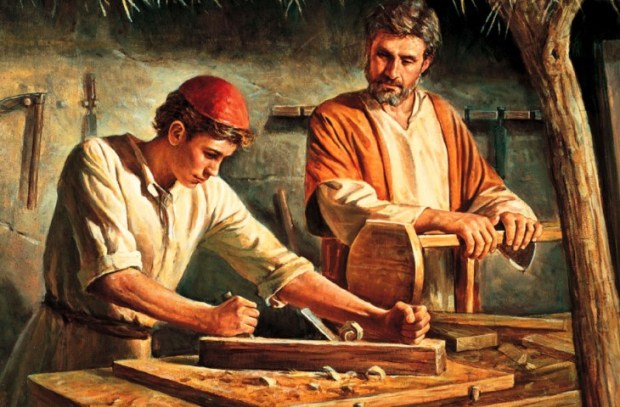
Take Jesus for example: as a child, he was a faithful student; as a teenager, he was a faithful carpenter (with special guest temple cameos); and by thirty, he was a faithful minister.

Now, we can nit-pick whether ‘student’ and ‘carpenter’ are vocations or occupations. Personally, if you used this model to suggest God designated various occupations to prepare His Son for his ultimate vocation (i.e. Matthew 28:19) – “Go therefore and make disciples of all the nations, baptizing them in the name of the Father and the Son and the Holy Spirit“), I wouldn’t disagree.

jesus-nazareth-110-730x480

Whatever the case, my thoughts are…

  1. At each season in Jesus’ life, God was preparing him for his rabbinical destiny.
  2. While there may be seasons we don’t like what we do, God is always preparing us for what we’re meant to do (a truth that exists today just as much as it exists tomorrow).
  3. Therefore, even if our occupations (what we do) and vocations (what we’re meant to do) don’t seem to line up, we can rest in the common denominator of reflecting Jesus.

In essence, while pastors and ministers are multi-occupational in the sense their time is occupied with multiple responsibilities, given we’re all called to ordained vocations3, it makes no sense to promote one “ational” above the other and accordingly, be offended, trip over semantics, or fear political incorrectness.

After all, if we see “bivocational” as God giving us multiple skills and avenues to be salt and light, then divisive misinterpretations (i.e. clergy is on one level, laity is on another) waste away.

As a wise man recently told me…

Every believer has several vocations (rooted in bearing and restoring the image of God) and many occupations. A pastor or minister working 2-3 jobs is no less ordained than one fully supported.”

To this, I 100% agree.

Bottom line: Whether you refer yourself as bivocational and/or multi-occupational, at the end of the day, a) one is not better than the other and b) on a lifetime scale, we are all bivocational and multi-occupational. Remember being bivocational isn’t about having an occupational ministry outlet, but understanding what you’re meant to do (and more importantly, meant to be) regardless of what you do/want to do. It’s knowing no matter how you’re getting paid, the hope of glory (Colossians 1:27) always resides in you.

Selah.

Stay tuned next time when I’ll dive into a recent forum post from a bivocational colleague that testifies to why His Girl Fryday exists.

In the meantime, in all you say and do, remember what and who you’re meant for.

Peace…

~ Cameron

Footnotes

  1. Hebrew translation – Avodah
  2. Vocation in Greek: klḗsis– “to call, summon”) – a calling or invitation into something, specifically receiving God’s gift of salvation – with all His blessings that go with it (Romans 11:29; Ephesians 4:4; 2 Peter 1:10).
  3. And all bear multiple responsibilities

Ephesians 4:1 conveys this…

* NAS: in a manner worthy of the calling with which
* KJV: worthy of the vocation wherewith
* INT: to walk of the calling in which you were called

Cover photo creds: Medium

Integrating Ministry & Marketplace: The Temple Template

The vocational life is hard work.

Early mornings, long days, rough nights…if you wear many hats and juggle multiple responsibilities…you know the drill.

Yet, as tempting survival/‘just get ‘er done’ mode may be, truth is: we were never meant to live this way.

Yes, strategic compartmentalization can center the gravity of focus and break busy days into doable, bite-sized moments; however, when we consider our identity as effective influencers in light of Jesus’ ministry,  we ultimately find…

a) Work (what we commit our hands and minds to) and faith (what we commit our beliefs to) were never meant to be mutually exclusive.

b) The marketplace can be just as much a hub of powerful, life-changing ministry as the church1.

Take Matthew 21:12-17 for instance…

After Jesus kicks off the triumphal entry (v. 1-11), note the first place he targets (i.e. the temple – v. 12) and the reason why (i.e. to cleanse it).

I don’t know about you, but when I consider the fact Jesus deliberately went to the temple to make its original intent known as opposed to simply stopping for a cup of coffee and the ‘Daily Jerusalem’…that speaks to me.

Granted, Jesus channels his inner Adele for time, turning tables and all (v. 12b), but the key here isn’t so much Jesus reacting in frustration as much as Jesus setting things right, being fearlessly intentional in speaking truth and breathing life into what had become a lifeless environment.

So while this passage reference may seem random, when we talk about what pastoral ministry in the marketplace looks like and how to rightfully use our spiritual gifts in similar arenas, I believe there’s important application to be found.

First off, to be an effective marketplace minister, we must be courageous and purposeful with the truth. Yes, we can be highly skilled with the gifts God has given us; yes, we can be articulate, persuasive, and emit confidence, but if what we’re divinely given is utilized with limited integrity, it’s like trying to build a sturdy structure on quicksand.

Secondly, when we consider what grieved Jesus most, we deduce how wise marketplace leaders understand the time and place to deal with financial affairs as they understand the providence of God (i.e. the difference between a love for money and a love for God who provides the money2 ;more on this in future posts).

And finally, when we consider Jesus straight up calls the temple “my house(v. 13 – “My house will be called a house of prayer…”), we find the a) confirmation of marketplace as an extension of sanctuary and b) value in declaring God’s original design over an establishment intended for our good.

In this case, Jesus calls the temple a “house of prayer” not only to reveal the truth of its purpose3 (i.e. a place of dwelling, influence, and vertical communication), but to set the stage for the spiritually/physically impaired to better know that purpose (v. 14).

I-Was-There-at-the-Temple-Image

Hence, it should be no surprise to see a completely transformed temple by the time Jesus peaces out in v. 17.

Bottom line: when we reflect on how Jesus integrated his ministry and spiritual gifts into the marketplace, we see…

  1. Jesus was intentional (in going to the temple courts)…
  2. Jesus was bold with the truth and how he handled conflict…
  3. Jesus lived out the identity he declared over the temple…
  4. Jesus loved at every opportunity…

Thus, I submit if we’re going to thrive in employing our spiritual gifts in our areas of business, we must be willing to live on purpose, be bold with the truth, pray without ceasing, be the change we long for…and most importantly…love at all cost, at all times.

Next time, I’ll look to build upon this foundation with more specifics, more real-life application, but for now, if any of this hits home with you (or if you want to add a point to the list above), feel free to comment below. And as always, if you have a prayer request/praise report, you’re more than welcome to drop us a line.

‘Til then, may you find peace and joy in abundance as you go about your week…

~ Cameron

Footnotes

  1. Sure, the church may be the heart of the operation, but what’s to say the marketplace can’t be the hands and feet?
  2. Seriously…how often are good leaders corrupted by sneaky, under-the-table, ‘will do anything to get an advantage’ maneuvers? More than we’d like to admit, right?
  3. As well as His authority

Photo creds: gospelmovements.org (edited by Cameron Fry) & lds.net

One Voice Q&A’s with Cameron & Steve Fry

Cameron & Steve Fry talk Commission U and marketplace/bivocational ministry @ Messenger Fellowship‘s annual summit

Note: Apologies on the audio (especially the first minute); will aim to obtain higher quality when available.

1. Why is focusing on equipping people in the marketplace so vital for the church?

I believe if the church wants to equip people in the marketplace, it must embrace its transitive nature. The marketplace ministry problem, particularly in the western church, isn’t so much a function of not discipling saints to be like Jesus as much as it is not discipling saints to be like Jesus…within their respective spheres of influence. Considering 90-95% of congregations work in secular settings, we must bridge the disconnect and target these settings if we want to better reach the lost.

2. What is ‘bi-vocational’ ministry?

Bivocational ministry is ministry that bridges the sacred and secular. Whether you’re versatile in the marketplace working multiple gigs or have a foot in both church/workplace arenas, bivocational ministry not only empowers people to be like Jesus at their desks, but also teaches them to make the best possible use with the margins and bandwidths they’ve been given.

3. What have you seen in Commission U that is so helpful to marketplace people?

One of the advantages of Commission U (and courses like it) is how it acknowledges the priesthood in all believers while shattering the mold of ‘pastors do this/non-pastors do that‘. There’s a false paradigm that suggests only those with liturgical callings can be ordained, but with Commission U, as we experienced last night…

…we recognize all as partners in God’s ministry of reconciliation…all as effective ministers and child-like ambassadors…co-equal in value and diverse in function with a unique set of spiritual gifts designed for deployment wherever we influence. Ultimately, the heart of Commission U is to decompartmentalize faith and work so it becomes faith at work…at our work.

Graphic per Vicki Wilstermann/Ryan Hall

3 Keys to Communicating Vision

When it comes to quality leadership, no question, one of the hardest challenges is communicating vision (i.e. important information necessary for growth and progress). From filtering content to personal interaction, the marriage of progress to relationship can be a messy process. Thankfully, where there’s a will, there’s a way, even if it doesn’t happen the way we want or when we want.

That said…here are three keys to communicating vision effectively…

  1. Say What You Need to Say

When casting vision, it’s important to remember conciseness is more valuable than eloquence. After all, a platform should never be about exposing what you know (i.e. show off), but rather what your audience needs to know (i.e. show how)…which brings me to my first point:

When communicating what an audience needs to know, start with what you need to say first.

More specifically, don’t just filter your content; break it down into lucid, bite-sized bits. That way, you can better discern what is necessary and what is footnote material before you communicate.

For instance, as a wordsmith in youth ministry, I’ve learned my best points, whether delivering a sermon or leading a team meeting, are best received when they lack syntactic ambiguity. In other words, when I use words and phrases that don’t mean different things to different people, not only do I enable my content to be coherent, but I empower my students to interpret it the way it was intended.

Bottom line: Vision doesn’t just point people in the right direction (i.e. makes it plain; see Romans 1:19), it shows them how to get there (bonus points if you include illustrations). Therefore, if you want your audience to capture the vision, make sure you say what you need to say and what your audience needs to hear, not what you want to say or what they think they want to hear.

giphy

  1. Speak the Truth in Love

Yeah, yeah…you get this in theory, but if you’re like me in the sense this doesn’t come as easy in execution, remember you may be in a time crunch, you may have a lot on your plate; however, if you’re not communicating truth in love along the way, not only do you risk a discouraged team, but a disjointed vision split from purpose.

To piggy-back off point #1: what you need to say can’t be what you need to say if love isn’t a part of it. Sure, you may be brimming with epiphanies and award-winning ideas, but if vision isn’t vision without truth and truth isn’t truth without love, then vision can’t be vision detached from best intention.

Remember vision not only seeks the best possible corporate outcome, but inspires love among its enforcers.  Thus, if you aim to love, not only will team morale enhance, but  the bond between vision and audience will tighten as well.

Bottom line: 1) Without love, vision is nothing more than a good idea. 2) Vision, in the context of love, motivates people to keep pursuing it. 3) If you know the truth, speak it in love; if you don’t, love as you pursue it. Either way, it’s a win-win.

giphy-1

  1. Make it Memorable

While vision, at its core, is the mergence of point #1 and #2, if it lacks conviction or captivation, chances are it’s not memorable either. Granted, truth should never be a function of marketability; however, while good vision knows its audience, great vision considers what they’ll remember.

Hence, it’s worth asking: how do you take an entire vision and frame it into something that’s easy to remember and hard to forget?

For starters, it’s always best to keep it simple and straightforward. Focus on syntax and word selection. Use correct grammar.  Be exact in meaning. Then, if necessary, add some flair and poetic license (i.e. turn it into a jingle, structure it ABC style, pose it with rhyme scheme, integrate a relatable metaphor/simile, etc.) Whatever method you apply, remember the goal is to make sure your audience can extend the vision. While making vision plain may seem contrary to making it memorable, if you consider ‘plain’ as the foundation, it will ultimately enable you to build your vision in a way people can understand and promote.

Bottom line: When vision becomes memorable, the impacts become inevitable.

giphy-2

Photo creds: Trendy Bloggers, Giphy