Fall Down 7, Get Up 8: A SOAP Bible Study on Proverbs 24

Scripture: Proverbs 24:16 – “For the righteous falls seven times and rises again, but the wicked stumble in times of calamity.”

Prelude: Recently, I was reminded of a late 2000s NBA commercial in which Dwyane Wade collapses to the parquet multiple times over the course of his career. After a montage of tumbles, a new series unfolds in which he rises from each fall before the screen goes to black… 

Coincidently, this connects to a separate memory last decade. Remember the 2017 NAACP Image Awards when Denzel Washington delivered one of his most iconic speeches? 

Fall down seven times, stand up eight.” 

…still gives me chills to this day.

Understandably, many cite this line as a Japanese proverb with a credit to celebrity enlightenment; however, in reality, its true source is the Word of God; hence, this SOAP Bible study in which we will dissect the contrast in greater detail.

As always, let’s dive in…

Observations: In a vacuum, this verse compares the resilience of the righteous to the cowardice of the wicked. Both sides face setbacks and challenges, but only one perseveres through them. While some assume this verse suggests adversity comes to the unwise, the reality is that calamity finds all of us at one point or another. The key is how we respond and endure the way God intended. 

As mentioned in a recent post, even good people fail sometimes, especially as they face new challenges and situations beyond their ability to handle. Humility applied, we must understand these circumstances are not the product of poor character, but a part of God’s plan to develop it. In what we say and do, are we willing to rely on God’s guidance in the fullness of faith and integrity? If not, we will inevitably succumb to stubbornness and disbelief as the trials undo us.

Symbolically, the number seven is used here to emphasize completion and perfection, as God’s grace empowers the righteous to suffer through their failures. Granted, man, in his finiteness, may be ‘one and done’ on certain matters; however, since God sees the entire picture, we can trust that in HIs faithfulness, He will give us multiple opportunities to clear our hurdles. How sweet it is knowing we can live from victory as we wrestle with and for God!

Following v. 16, we find a subsequent call in v. 17-18:

Do not rejoice when your enemy falls and let not your heart be glad when he stumbles, lest the Lord see it and be displeased, and turn away his anger from him.”

As people redeemed by faith through the Cross, this charge cannot be understated. While our flesh may snicker at karma and the kind of justice that enhances our ego, we must never rejoice when others fall and can’t get up. If anything, we should intercede and consider our options to help. Even if we can’t directly intervene, we can pray for a person whose peace is in peril and build a broken brother up from a place of boundary.

Applications: Although chaos and conflict are unavoidable in this life, God is the one true constant through it all. When tough times come, we can rest knowing there’s a vertical response with our name on it. To those feeling God is leading you through a desert or wilderness right now, remember how God used Joseph in the Old Testament (Genesis 39) and Paul in the New Testament (2 Corinthians 1:8-10). You may feel lost in the hole or bind you’re currently in, but this could be part of a grander setup in which God is equipping your heart to reach a promise and purpose He has ordained for you. 

Bottom line: God never fails and has the power to restore our confidence and redeem our failures. Although setbacks will come, as long as we fix our eyes on Jesus and follow His lead one step at a time, God will not only forgive us but also bring us to completion according to His Word (Philippians 1:6). Why not let Him be the fall back you crave when all hope seems lost? 

Prayer:

God, we turn and align to you in this moment. We thank you for being a merciful, faithful God in whom we can trust. Father, as I write this, I think about those in dry valleys, surrounded by bones, needing a spark. As men and women fallen in sin, we confess our need for a Savior, who through His strength and sovereignty, provides the tools and opportunities necessary to rise above the obstacles of life. For those wresting in guilt and shame, for those who feel defeated for not having passed a specific test, we speak peace, grace, truth, and love to their hearts and minds today. May they find you in the wake of their desperation, for others, in the midst of their course-correcting. In our frailty, we admit our limited perspective, our tendency to get way ahead or woefully behind you. Though the ways to faith derailment are many, we choose to lean on your understanding, to follow the prompting of your Holy Spirit, and to press into you with all that is within us. Bless your holy name. Come alive within us. Help us not to give up and give in but as Psalm 57:1 says, lead us from failure’s shadow in and under the shadow of your wings. Amen.

Cover graphic creds: Redbubble

Healing Declared: A SOAP Study on Luke 13:10-17

**New excerpt from Juju’s book…**

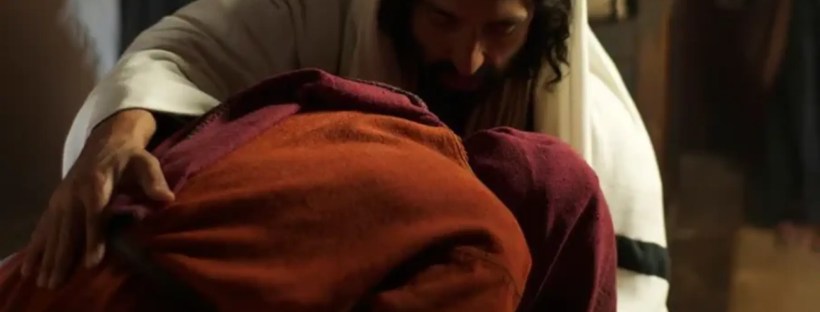
In Luke 13:10-17, Jesus is teaching in the synagogue on the Sabbath when he notices a woman with a disabling spirit. As she totters through the temple gates, Jesus calls the woman over, confirms her restoration, and heals her condition. No longer crooked, she glorifies God and prompts Jesus to criticize the religious leaders for their lack of compassion.

Digging into this summary, we find meaningful implications, especially where sickness and infirmity dwell. For starters, we must not deny those around us who are poor in spirit and health, desperate for Jesus in a way that extends past their margins.

As a NICU alum, I can boldly testify to this. Every day during Juju’s life, Lys and I entered a larger-than-life mystery box, a stream of unknowns where anything could happen. From what we experienced, the emotional highways were unending from dead-end hopelessness to confounding crossroads. In each situation, parents, like the crooked woman, were searching for anything their hope could cling to – comfort, healing, answers, you name it!

Yet, as challenging as that season was, the contrast in processing helped us understand the power within the presence of God. While there were moments when we sought the Lord because there was no other way, there were other times we sensed his call and responded accordingly. So, it was with our protagonist in Luke 13, who not only personified what it meant to be in the right place at the right time but saw her affliction as a catalyst for intervention.

Examining the woman’s transformation, we find some notable takeaways, particularly in v. 10-13, during which Jesus orchestrates his miracle:

1. In v. 10, Jesus sees the woman even though he was already teaching in the synagogue.
2. At the start of v. 12, he calls her over instead of continuing with his message.
3. By the end of v. 12, he declares her freedom before healing her disability.

While circumstantial at the surface, we can behold the intentionality within this order when we assess similar healings in the Gospels. Like the bent woman, Jesus repeatedly modeled his heart alongside his power, relating to the context of suffering even before his presence was recognized. This poses a powerful thought:

To the extent our faith activates when we sense God’s presence, it also stirs when we hear His voice. Like gravity, His Word summons the innermost part of our being in a way that compels us to move in his direction.

No wonder the woman had no issue journeying to Jesus. the joy set before her resonating with the joy set before him.

Upon her arrival, note how Jesus reacts: He doesn’t immediately remove the woman’s iniquity but proclaims her victory! Again, this subtle progression is profound. Though some might question why Jesus would call his shot, the purpose behind his declaration wasn’t to simply highlight his divinity but to deliver salvation while proving his love. Had the purity behind the action lacked, the woman’s response may have reflected differently. But like many before her who battled long-lasting crippling ailments, the outflow of praise rode on the heels of the expectancy. In the end, it was all about Jesus, religious and wishful sentiments be da*rned.

For the griever and/or loved one stuck in the hospital, while our prayers have power and purpose, what we voice as expressions of hope yields the truth of who God is and what he wills from his nature. Ultimately, God is going to finish the good work he started in you (Philippians 1:6) as heaven meets earth in wonder-working fashion (Matthew 6:10). True, we will never have all the answers as to why we must endure in specific ways; however, when we remember how Jesus made space to heal a woman in the middle of a sermon on a day His Father set apart for rest, we can draw encouragement knowing God is always for us, even during the darkest and craziest of days.

Prayer: “Jesus, you told your followers, ‘Do not let your hearts be troubled. You believe in God, so believe in Me as well. Peace, I leave with you; my peace I give you. I do not give to you as the world gives,’ (John 14:1, 27). We confess we need your peace, the peace of God, which transcends all understanding’ (Philippians 4:7) to guard our hearts and minds. We humbly come before you with our weary hearts and pray that you continue to show us fresh levels of love and grace as we go through this season of sorrow and transition. Help us to find peace in your presence. Wipe our tears, Lord, and carry us through this season of mourning and deep sadness. Help us to trust in your unfailing love and to fix our eyes on you, Jesus. As we lift our worries to you, we humbly ask that you lift up our hearts from what may overwhelm us. May your presence bring us joy and comfort as we embark on this journey of healing with you. In your most holy name, we pray. Amen.”

Cover photo creds: Sunflower Seeds

Staying the Course: The Epitome of Workplace Resilience

One of my favorite times of the year occurs during this third week of March. If you’re a hoops fan, you know what’s up.

Of course, I’m talking about March Madness and the bracketology insanity sweeping the nation. Nothing like a barrage of action-packed, down-to-the-wire basketball games highlighting a stretch that sees winter doldrums fade into early spring crazes.

Yet, amidst the signs of seasonal transition, I’m taken back by a certain notion, one often unpopular despite its ~99.9% success rate. That take in three words? Stay…the…course¹.

Perhaps I’m inspired by honest charges rooted in athletic and battle-cry themes. Perhaps I’m getting older and have lived long enough to see the directive verify. Regardless, I wouldn’t be writing this if my motivation lacked potential impact, relevancy, and most importantly, Scriptural ties.

As always, let’s dive in…

In the Word, one can find many examples of what staying the course looks like, both directly and indirectly. For today’s purposes, we’ll concentrate primarily on New Testament themes. Starting with the Beatitudes (Matthew 5), we find a series of entrust statements from Jesus at the Mount of Beatitudes (I.e. “Blessed are those who are poor in spirit for theirs is the kingdom of heaven, blessed are the meek for they shall inherit the earth, blessed are those who mourn for they shall be comforted”, etc). Taking the mean of these eight veracities, we find powerful tropes with eternal implications. While many derivatives can be gleaned, one in particular stands out: You are blessed when you stay the course, walking with God steadily on the road revealed by God while making every effort to seek Him in gratitude.

As Paul testifies in Acts 20:24 and 2 Timothy 4:7, “I do not account my life of any value nor as precious to myself, if only I may finish my course. I have fought the good fight, I have finished the race, I have kept the faith.” All spoken with utmost intention as bedrocks for hope, righteousness, and in some cases, the fulfillment of ministry. The problem for some of us lies in how we conditionally apply and abide within any discipline requiring vertical dependence.

Starting out on any journey, our aim is to anchor what we believe into what we practice.

In every way, in all we say, we aspire to honor God in the culture and community He’s placed us in.

How then do we cope when not everyone is on the same page as to what following God looks like? What if the mission is pure but the roadmap leading there is potentially riddled with fear, compromise, even complacency? What if our loyalty and commitment aren’t acknowledged or matched by those around us? How can we stay the course when the environment around us is harsh, in decay, or forgets we’re playing a part in making the dream fly?

For starters, we must remember any form of faithfulness we exude is a gift from God and a ‘yes’ to following in Christ’s likeness. While we honor our authorities, leaders, and governing principalities, we achieve this through the overflow of surrender unto God for all He has done and continues to accomplish. This is why daily dying to our preferences John 3:30 and 1 Corinthians 2:14-style is crucial to not giving into our anxieties and fleshly desires. Often, we take inventory by way of our shoulder. We pull back, hesitate, and withdraw due to what’s not working, what’s being missed or even the fear of these things happenings; however, as valid as our occupational concerns may be, we must not automatically synonymize them to the satisfaction of our own needs. After all, when we consider Paul’s example, we note true strength is not only relying on God but realizing His desire to mature us through adversity. Accordingly, we shouldn’t assume God is lifting His hand or readying an audible when the presence of pressure or partisan hits. Rather, in those moments, we should see the immediate prompt to recommit our ways and recast our cares, repetition be darned.

Granted, I understand this is easier said than done, especially when transition seems constant; however, as one who has seen his fair share, I implore you: Do not embrace offense when you see people making choices you wouldn’t make or when any form of health is inadvertently withdrawn. As much as we crave peace of mind, we shouldn’t let a temporary lack prevent us from championing the peace of Christ as far as it be with us (Romans 12:18). And hear me, friends, I get the disorientation that comes when traction and stability are moving targets. I understand how hard it can be when you’re waiting years for due diligence and the dust to settle. But at the end of the day…

We can’t move on as God intended without putting ourselves in position for God to reveal His next best steps for us.

For when we’re actively communing with God and relinquishing the entitlement to make sense of our surroundings, only then will we recognize the epitome of resilience, which in vocational terms, is enduring with integrity and humility even when what is right and necessary are concealed.

As Vince Lombardi, Thomas Edison, and many a Chinese and Biblical Proverb have stated, in this life, many will quit prematurely, forge pathways to greener pastures, and manufacture their own resets. Many will find what they’re looking for but in the wrong way. But as for us, regardless of how we’re feeling, our foundation must be God and our call to follow Him. Consider the Psalmist in Psalm 119:1-8 (ESV/MSG):

“Blessed are those whose way is blameless, who walk in the law of the LORD! Blessed are those who stay the course, who seek God with their whole heart…and walk in His ways! You have commanded your pathways to be kept diligently. Oh, that my ways may be steadfast in keeping [them]! Then I shall not be put to shame, having my eyes fixed on all your commandments. I will praise you with an upright heart, when I learn of your [next step]…”

Stay tuned next time when I’ll discuss the right ways we can seek transition from a current employer as a ‘part 2’ to this post using Exodus 33 as a guide. Until then, be blessed, stay classy, and don’t give up.

Selah.

Graphic creds: iStock

Footnotes

  1. Or “stand by your ground

Springs Within You: A SOAP Study on Psalm 85-87

Well, folks. The weather outside is finally changing. You know what that means…

  1. Fire up ‘severe weather mode’ on Flash Weather.
  2. De-winterize the house.
  3. Compose another SOAP Bible study!*

*For those who don’t know, Lys and I are huge fans of this practice having implemented it during our youth pastor tenure. While our time in student ministry is long gone, in recent years, we’ve efforted to tailor these studies towards vocationals as part of our His Girl Fryday initiative; hence, why the legacy lives on.

Today, we’ll examine Psalm 85 and Psalm 87 in the context of Israel’s exile. While these selections may seem random at first glance, my hope is you’ll know why I chose these chapters by the end. 

As always…

Observations: If you’ve studied the Psalms in detail, you know the book is composed of 150 chapters broken down into sections. With Book 3 (Psalm 73-89) focusing on the tragedy of Israel’s uprooting and downfall of David’s family, one might think the tenor of Psalm 87 is out of place; however, this is partly due to how the sons of Korah¹ constructed their songs. Anticipating transition, Psalm 87 represents a confident foreshadowing, specifically Israel’s restoration and relationship to other nations.

A precursor to Psalm 87, Psalm 85 establishes the following tropes, all essential to our spiritual walk:

  1. God is faithful to bring a foundation to our footsteps, especially during seasons of adversity (Psalm 85:13).
  2. God draws near to those who fear and revere Him, who anticipate His voice and glory to manifest (Psalm 85:9).
  3. God’s love and faithfulness aren’t mutually exclusive as they’re intertwined within the same flow (Psalm 85:10-11).

These realities set the stage for Psalm 87, in which the privileges of God’s people are recognized and celebrated. Although the chapter is relatively short, the song lacks no exclamation given the holy tribute and 3:1 ‘verse-to-selah’ ratio. The general gist is straightforward and simple: As salvation comes forth from Zion, God takes note to what He can foresee.

But perhaps my favorite part of Psalm 87 is the final verse (v. 7): “All my springs and sources of joy are in you.”

While the ‘you’ is a cite to Jerusalem, given the polysemy of the Psalms, one could deduce this refers to something more than the city itself. Again, we must discern the tone and style of the author. For instance, the sons of Korah tended to ask questions they knew the answers to but framed anyway. 

Will God do ‘x’? Why, God, do you ‘y’? How long, O Lord, will you ‘z’? 

In almost every case, the resolution comes in the conclusion and inspires a modern-day practice. No matter, how dire, how challenging, how impossible a situation might seem, God, in both His Word and Way, is everlasting. Even if we seem far from the promised land we seek, God’s sovereignty is constant and His love is steadfast. Knowing this, the concerns we have should not interrogate God’s nature but inquire how we must journey with Him to see greater character, intimacy, and fruit result.

As for us, there may be an uptick in storms in the weeks and months ahead, literally and figuratively. but spiritually speaking, why not let the word picture of ‘spring’, both the season and water source, refresh our inner man? As Psalm 85:10-11 and Psalm 87:7 encourage us, why not receive the fullness of God’s springs and assess our return flow? After all, every good and perfect gift is from above. All we are or hope to be, all we have or ever hope to have, all we attain or ever hope to attain is from Him. Let the people of God acknowledge this and praise Him for it. 

Application

Prayer: Lord, as the winds of change surround us, we thank you for being at hand. As we worship you in Spirit and Truth today, we’re reminded how grateful we are that you are Lord of all, the God who sustains our help and gives us everything we need for goodness and godliness. No matter what tomorrow holds, we pause now to reflect on your love, your faithfulness, and how we can allow your currents to purify the rhythms in which we believe and operate. To what needs to be surrendered, convict us with grace so we may properly deal with our baggage. To what needs to be received, we ask you to not only revive us to taste you in full but to broaden our capacity to trust your truth in an increasingly compromising world. Help us not be overly discouraged by where abandonments are occurring. Rather scale our faith to see the grander scheme unfolding and how we can partner with you in victory. Give us this day and season as bread so we may feed your sheep as fed. In your holy and precious name. Amen. 

Footnotes:

  1. The sons of Korah were Levites, from the family of Kohath. By David’s time, they served in the musical aspect of the temple worship (2 Chronicles 20:19).

Cover graphic creds: Wallpapers.com

Real-Life Habits: A Practical Example to Transform Your Life

Written 11/26/24 for our latest MercyTalk podcast…

Back in April 2018, four months removed from a seven-year youth pastor assignment, I had a revelation that produced a habit I still practice to this day.  As a state employee working in a stale environment, I sensed my walk with the Lord was starting to wane. For so long, motivation and inspiration overflowed naturally courtesy of 50 students and an opportunity to mature leadership in a liturgical setting; however, once I released the calling, I realized how much of my identity had become baked into my influence. Without youth in my life, I felt lost. Apart from my family, there was little to no accountability to guide my relationship with Jesus. Needing a spark, I knew my internal compass needed a reset.

So, I decided I would not only have daily quiet times during each morning commute but record them on my iPhone. With my weekly commutes averaging out to 6.5 hours, I figured I might as well talk and pray with God as I battle the banes of Nashville traffic. The decision turned out to be a game-changer as not only did the practice settle my spirit each day before work but allowed me to hear the mix of truth and lies roaming within. On some days, conviction came by declaring God’s Word out into the open; on others, I found grace simply in coming to Jesus as I was. In either case, my quiet time commutes were my happy hours during which I took thoughts captive and replaced them with holy perspective.

Fast-forward to October 2022 and I’m a month removed from losing my daughter, Jubilee, who took her last breath in my lap after a 393-day fight with chronic lung disease. For weeks I had been stone cold, flooding the pavement with tears during my workouts. Yet, everywhere else, the frozen numbness of grief had overtaken me. That’s when I returned to the practice of recording my quiet times on drives to work. During Jubilee’s life, the habit had faded to back-burner status through all the hustle and bustle. While there were times before Juju’s death when I felt as if I was walking on water, I sensed the sinking heading into 2023. If there ever was a time to rekindle the rhythm, this was it.

Like five years prior, I found myself pressing the red record button in my Audio app more frequently. With vulnerability on blast, there was never an intention of sharing the files with anyone. I simply needed to feel a connection with God, to feel His presence and listening ear calming the choppy waters of my soul. Occasionally, I would stumble upon an ‘ah ha’ moment, an epiphany with content-creating potential; however, the end goal was always to make room for God to invade my space and to catch Him doing it so I wouldn’t forget.

Having reached 400 records as of 11/20/2024, I can confidently say this habit has proven effective in stabilizing my mind, emotions, and walk with God all in one swoop. I especially recommend the practice for those in seasons of chaos in which they want to declutter or ‘spring clean’ their heart to hear the Shepherd’s voice more clearly.

Cover photo creds: Medium