Road to Healing: Why Even in Pain, There’s Still Jubilee

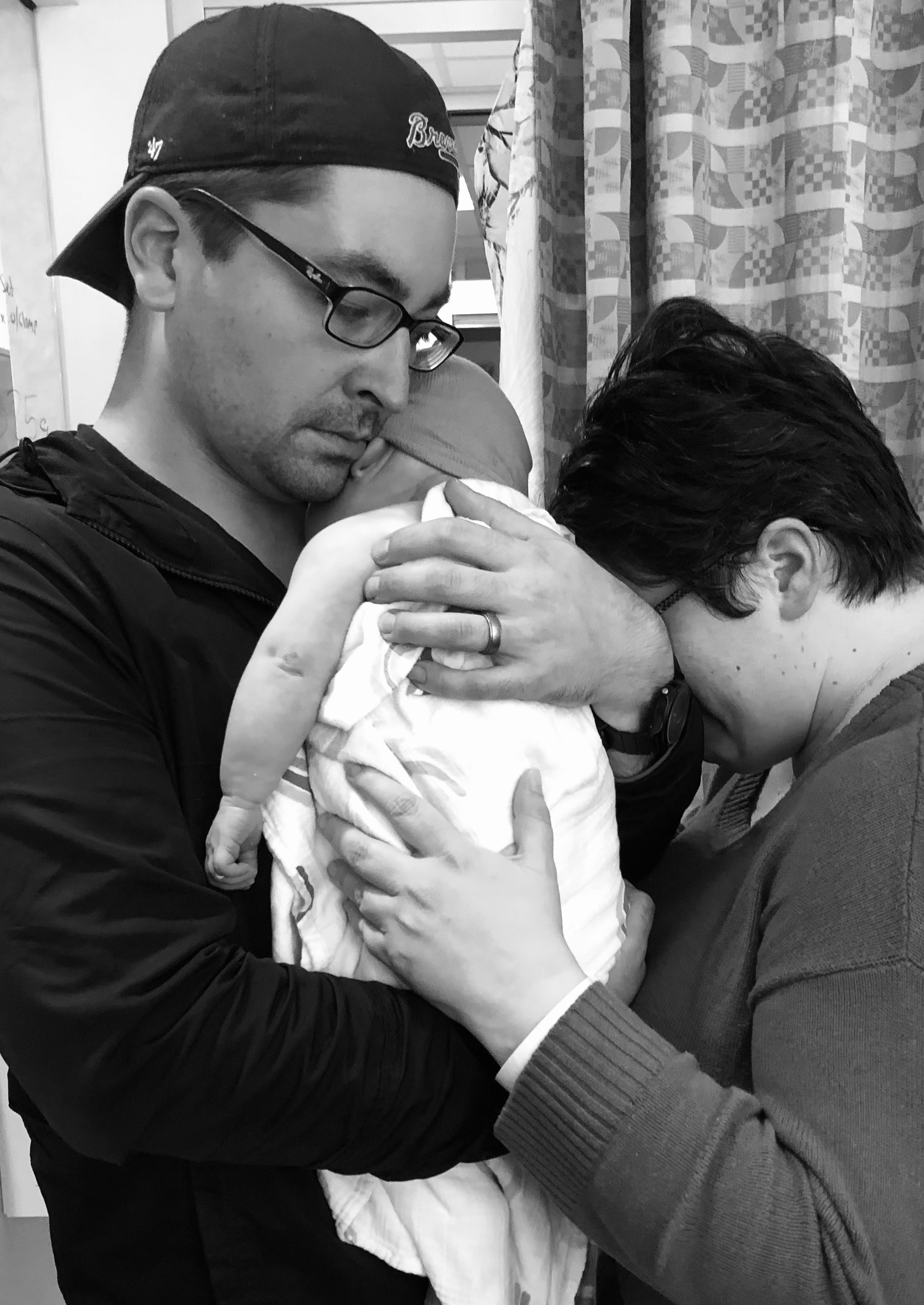
It’s been three years to the day since Juju’s death.

For better and worse, Lys and I haven’t been the same since that fateful day. While grief intensity has lessened, life still feels like a tightrope. One false step and we’re praying for a safety net, just trying to survive – like when Juju was alive only without the hope of tomorrow. If only I were better at patience, maybe this whole waiting thing would be easier.

As Juju proved during her NICU tenure, progression and regression aren’t always mutually exclusive. At times within her fragile body, one element was improving while another was degrading. Her recovery and, at times, lack thereof, was anything but a linear wave. Like life itself, her journey was a winding roller coaster with unexpected turns and unprecedented breakthroughs. Her butterfly tattoo on my heart, not a day goes by that I don’t think of her and consider the glory of what she constantly experiences.

Yet, though the tears have remained mostly at bay the past year, there’s still a temptation to anger. God, why didn’t you somehow, someway cap her suffering? If you knew she was going to barely make it past a year, why defer the inevitable?

In most cases, I can convert those ‘whys’ into ‘look what God did’ and carry on. Where I stumble is the next level down: God, why aren’t people more naturally geared towards the broken-hearted? Why does the silence sometimes increase when it needs to decrease? In the shadows, you were there after Juju’s death. What about those who may not even be able to find you at all? What about them?

These questions have been raised before, and they’ll be raised again. Until the answers come, I, along with the rest of us, must settle in Christ (1 Peter 5:10; Colossians 2:6-7). For those who have lost a child, we don’t have any other option. At day’s end, everyone has a call to embrace their suffering and ditch their baggage. No exceptions. I know for me, sometimes I get into trouble tolerating the baggage while trying to ditch the suffering in a quest to find meaning in pain; however, in times of reset, I catch myself in the striving and commit my ways to God whether I feel like it. It’s hard as heck, don’t get me wrong. I just know as low as I feel sometimes, I’m only hindering my perspective when I punt prayer and vertical reliance.

I love how Paul opens Colossians 3:1: Therefore if you have been raised with Christ, keep seeking the things that are above, where Christ is, seated at the right hand of God.”

For starters, the chapter unpacks our ‘new self’ identity as a garment we can wear regardless of the day. But even more promising, we’re reminded in the intro how we’ve been raised with Christ to a new life, sharing in His resurrection from the dead. In a weird way, this hits home even more so these days. Even when I feel dead on the inside, somehow, I know I’m that much closer to the type of life I crave. Among all the things that are above, where Christ is, seated at the right hand of God is also my daughter. Your son. His grandson. Her granddaughter. Their mother, their father, our friend, etc.

The way God’s lap is designed, there is always a comfort and rest to draw from, even if it’s simply His presence and nothing more.

The problem is we’re not often content with the safety of God’s nearness because we’re dissatisfied with the security of it. Our kid passed away, so we doubt if God is who says He is. If God is a God of love, then why didn’t His sovereignty meet my faith in the middle? If God has the capability, why didn’t His power take pity on a soul that could have done wonders for Him if given the opportunity?

While I’m not condoning this as the correct posture to take, admittingly, this is a popular contention bereaved parents wrestle through. We desire the improbable; we believe in the impossible. We just wish it could have looked a certain way. And that’s okay…assuming we regularly surrender our grief, anxiety, fear, and anger. As Juju reminds us, there’s beauty to be found in the ashes of our sorrow, especially when we reframe our perspective to see a life well fought as an altar pointing people to Jesus. Our lives may always sound like a sad song, but that doesn’t mean what other people hear is the same tenor.

Trust me, life has been brutal, dare I say, savage, this decade. Despite the positive turn in recent years, my debates with God are still on the regular.

Dear Lord, thank you for what you did during Juju’s life and gifting my family with this incredible light, this testimony unfolding, but surely you know what it’s like to grieve. You know what it’s like to be separated from your only begotten Son. If you’re stripping me of anything my life could cling to other than you, so be it. I don’t have to know how you’re exalted in those moments as long you’re exalted at all. And with a daughter dancing in your courts, I dare not lose sight of the new life I have in Christ, knowing that’s exactly what she has.

For all you readers and co-sufferers out there, ask yourself: Will I be too stubborn in my grief to don new garments of praise? To serve and think within new wineskins? Or am I too scared to endure because I don’t want God to let me down again? I know for me, I don’t have the margin, nor do I want to give that question room to manifest. Thus, I will keep looking up and pressing on one step at a time, with Juju’s rays forever on the horizon. The victory’s been won. Let’s choose to walk it in. God, show us the way…

Selah.

Sevenfold: A Workman’s Guide to the Leadership Gifts

Last decade (2010-2019), I worked in state government: The Department of Labor and Workforce for 2.5 years, and TDOT (Tennessee Department of Transportation) for 7.5 years. As one might expect, the environments, well, they were kind of like your favorite soda but flat – very little in terms of bubbliness, morale, positivity, widespread humility, grace, selflessness, and other hallmarks of a healthy culture.

After my first year at TDOT, I started getting frustrated with God as to why He opened a door for me into a place I didn’t fit, let alone have a clear, defined future. At the time, I was two years into a six-year youth ministry assignment, which provided some sense of purpose punch. But by day, I sometimes wondered ‘God, why did you bring me to this desert? I know you made me for much more than this.’  

After a few months of wrestling, I decided to meet up with my dad and my wife, Lyssah, for lunch. During our talk, we discussed our royal priesthood (1 Peter 2:9) identity and how the concept of being commissioned for ministry was largely confined to licensed liturgy (I.e. only pastors and those called to ‘ministry’ can be ordained, etc.). As we dissected this issue, Lyssah and I disclosed some of our frustrations, one of them being how much energy we were sowing outside our calling, or rather, our perception of calling.

But by conversation’s end, I started to realize how my construct of God-given purpose was off.

Our purpose isn’t given to us by our settings and surroundings, but is given as an inheritance, a faith downpayment, a gift from above that not only connects to our original design but one we’re called to exercise throughout our lives from home to church, from market to marketpla

Once this lightbulb went off, I immediately understood why God called me to the desert – not only did He want to break off strongholds, like pride, ego, and faulty belief structures, but He wanted me to see how it was because He had more for me that He called me there.

For years, I compartmentalized my view of what being on mission, what being in ministry, looked like. Yes, I had a youth pastor outlet; however, I was still often annoyed given the pressure to cram a full-time effort within part-time hours. This is partly why my grudge against the state grew before my eyes were opened to see how God was calling me to lead in both church and marketplace arenas.

While there’s more I could say about this season, what I can speak to now concerns one of the initial impacts. Starting in 2015, I started to study the spiritual gifts (as unpacked in Paul’s letters) with a fresh pair of eyes, all the while creating content catered to two sets of vocationals:

  • Those who had a leg in corporate and ministerial arenas.
  • Those who were called to ministry outside the church.

In some of my explorations, I started to assess the spiritual gifts through work-based themes like work/home/church life balance, leadership, conflict resolution, networking, technology, goal setting, time management, etc. The more I dug in, the more I realized there is no hierarchy or exclusivity when it comes to “working with Jesus”, partnering with Him in daily tasks and fulfilling God’s purpose on our lives. We may be diverse in function but we’re co-equal in value given we’re co-laborers with Christ (1 Corinthians 3:9). The same worldly systems that promote entitlement, reciprocity, self-gratification/preservation/medication, etc. are the same systems that push leadership as a ladder to climb when the Word is clear in its trope of leading being the overflow of serving one another in the hope of unity, in the spirit of humility. 

Concerning the spiritual gifts, not only are there more than we might remember, but our spiritual identity with respect to them is no stranger to God. For each person, there is a divine order with varying weights that often goes unknown or misunderstood in spiritual journeys. Accordingly, it is my belief that any faith-based institution should be keen on helping its participants discover their ‘loved by God’ identity through the gifts and then seeing how they can be at work…at work. 

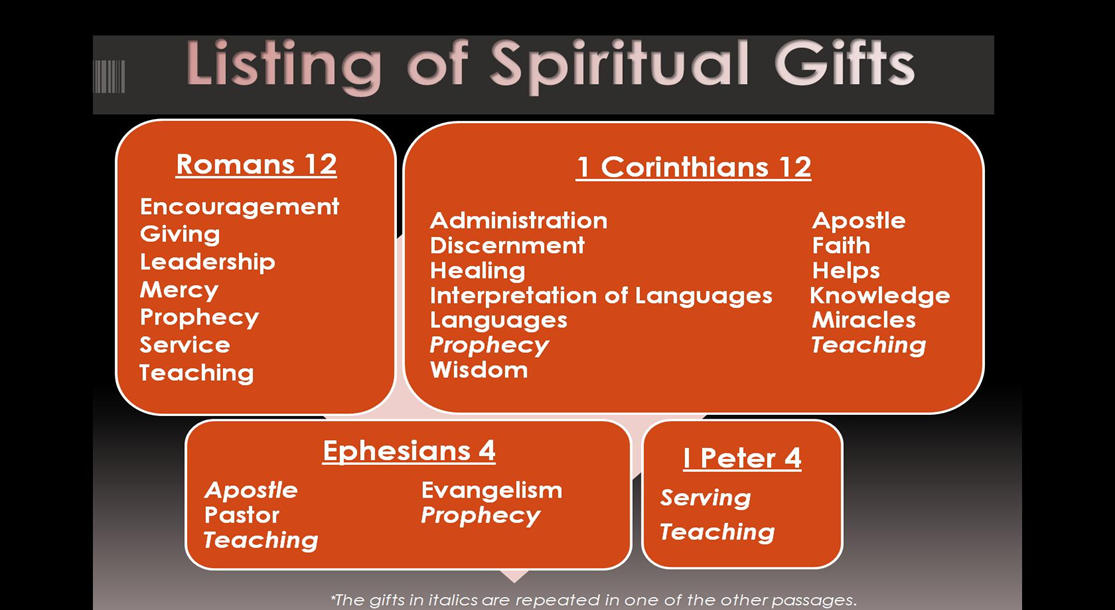
I like this graphic primarily due to its layout. While we don’t have time in this post to dive into all of them, I want to focus today on the seven gifts at the bottom of the screen, starting with the fivefold ministry gifts described in Ephesians 4: Apostles, Prophets, Evangelists, Pastors, and Teachers. These are leadership gifts given by Christ not just to the ordained ministers of the world but too all believers to equip the saints for ministry, build up the body of Christ, and foster unity and maturity in the faith.

As for the two in the bottom-right, these are grace gifts as defined in 1 Peter 4:10-11, service (deacon) and β€˜teaching’ (elder) in an exhortation capacity, In this passage, Peter states how God has given every believer a spiritual gift toΒ serve one another as good stewards of God’s grace, with the goal that all things glorify God through Christ. These gifts are not self-focused but are for the benefit and building up of the body at large with different gifts being empowered by the same Spirit and needing to be used with God’s strength for His glory.Β 

Having said all this, here’s the ‘crashiest’ of courses you may ever receive on the seven leadership gifts and how they’re meant to function in the marketplace…

Prophets…call God’s people to God’s ways. They are more about developing the design of organizational mission, less about developing people. They β€˜redeem’ an environment by expressing a wisdom that gives clarifies organization’s vision/mission for co-workers.

Evangelists…those who are gifted to reach unbelievers. They tend to be more gatherers with acts of service being their community gift. Evangelists are more concerned about developing the organization through developing people. They β€˜redeem’ an environment by creating an inclusive team environment through love and acceptance.

Pastors…those who encourage believers with the spoken word. More concerned about developing people than managing systems. They β€˜redeem’ their environment by creating joy through encouraging people on how important they are as people to the organization and by helping them see how their temperaments complement the organization.

Teachers…those who systematically make disciples and develop management systems. More concerned about preserving the organization. They β€˜redeem’ their environment by raising team morale through breaking down systems into easy action steps and by helping them see how the systems help everyone reach their mutual goals.

Apostles…coordinate the other gifts and helps them work together. Leading and directing are their community gifts. They β€˜redeem’ their environment by coordinating a team in a way that generates hope by maximizing each team member’s gift and designing products/projects that emphasize a redemptive gift of the organization.

Elders…those who impart themselves. More about managing people/Less about developing people. They are big picture minded in that that they see the value of systems, but they REALLY see the value of helping people find their places in the system. They are manager-developers who gravitate to systems but are motivated to help people find their seat on the bus.

Deacons…more about managing systems for the sake of people. They are motivated to implement proven systems that help people work together*. A deacon is part of the pastoral gift cluster, but in the workplace may not be in a direct support capacity but a β€˜hidden’ support capacity. They β€˜redeem’ their environment by creating an atmosphere of goodness and gratitude through giving and bringing order to the organizational environment.

*Note: A deacon’s gift is the broader concept of “serving others” through the use of whatever spiritual gifts one has received from God. This isn’t limited to a specific role, but encompasses a general ability to use God-given talents, like mercy, hospitality, administration, and giving, to serve the needs of the Christian community.

Graphic creds: Walk with Scripture

Dust in the Wind: The Beauty in Being ‘Dirty’

Recently, Kansas’ ‘Dust in the Wind’ came on my local oldies FM.

I close my eyes
Only for a moment and the moment’s gone
All my dreams
Pass before my eyes with curiosity
Dust in the win
All they are is dust in the wind

Sounds depressing, right? Like a poor man’s romantic anthem to Ecclesiastes…

β€œβ€˜Meaningless! Meaningless!’
says the Teacher.
β€˜Utterly meaningless!
Everything is meaningless’”
(Ecclesiastes 1:2).

Applied to our hopes and ambitions, these lyrics can seem maddening. What about my God given purpose? Is it void, useless, just a vain rat race underneath the cosmos?

Hardly! If anything, within these lyrics lies an affirming contrast, one that marks not only our earthly identity but vocational calling. To illustrate, let’s consider the difference between chaff and dust.

When exploring the reasons why we live, chances are we’re not considering the byproducts of grain processing. Still, the Word is clear our physical bodies were created from dust and will return as such (Genesis 3:19). With eternity in mind, we must accept the metaphor as core to our finiteness. While dust may seem unpleasant, by definition, it is a pure particle occasionally suspended in air but designed to settle whereas chaff is a scaly covering intended to be separated or burned. No wonder the Word often references chaff in the context of iniquity. For chaff to be purified, it must become a new creation. But with dust, it is already fine and capable of influencing everything from cloud formation to nutrient cycling.

Tying this to the surface, we find personal meaning. Although our bodies are fragile pillars, albeit with mind, heart, soul, and spirit, it’s still a sacred vessel created for finding rest and inspiring growth, even in times of displacement and turbulence. Kind of like, oh, I don’t know…dust!

Some of you reading this may be caught in chaotic currents or stuck in a false sense of worthlessness. You may feel as low as dust, easily swept away in the wind, not strong enough to stand in your own strength. But I challenge you, friends, to see the beauty in that. If all else, stand firm (Ephesians 6:13) and if you can’t stand, then settle in Jesus with every intention to rely on Him to carry you. You may feel like you’re passing away; however, rather than wade in insecurity, dare to consider where you’re passing away to.

‘Cause truth is: God can use you even if you feel like dust in the wind. He can use you to inspire vertical growth as you wisp for His glory. He can sustain you as you ignite precipitation to fall and become rivers of living water. He can strengthen you as you sow and position seeds in tough terrain to receive what they need to flourish. I could go on.

Just remember none of this is possible without the Creator and Sustainer of dust; hence, why Qoheleth prologues his book with ‘meaningless’, as life is without the answer and the reason of life. How sweet it is to know with His breath, He purified us from the ground so the ground would have no ultimate authority over our final destination. Yet, even as we come back to it in this life, we can fulfill God’s original design for our lives.

Cheers to being dust in the wind alongside you…

Selahand remember, friends, be excellent to each other...

Cover graphic creds: iStock

Master Plan: How to Discover God’s Will for Your Life

Rooted in the heart of every person there is a question:β€― What’s the purpose of my life? Perhaps you are reading this blog right now because you are searching for an answer to that question. Or maybe you are wondering if your life is some cosmic mistake. You are not alone. Many of us wrestle with our identity or place in this world at one point or another.  
 
If you follow Christ, or have ever considered following God, this search for purpose and meaning points us to Him – the divine creator that knows our purpose. But maybe you have looked to God or His word to discover your purpose and still feel lost.  
 
No matter how desperate we are to discover our purpose, if we are seeking our own will and not God’s we are destined to struggle. As we crave fulfillment and pine for intimacy and influence with those around us, are we inviting God into our brokenness, our needs, and our search for His will?

Or maybe you really want to discover God’s will for your life but don’t know how to findβ€―it. If so, I want to encourage you through a phrase you’ve likely heard before: Where there’s a will, there’s a way.Β 
Β 
In this context, I’m not talking about our free will; I’m talking about God’s will, His guide for our lives and a pathway for us to follow.Β Β 
Β 
Micah 6:8 (NIV) says:Β β€œβ€¦what does the Lord require of you? To act justly, to love mercy, and to walk humbly with your God.” 
Β 
To me, this verse offers profound peace. No matter what we’re going through, no matter the void we’re eager to fill, we can reference these three instructions and reset our inquiry. Read through this prayer and consider praying it for yourself:Β 
Β 
Lord, in this moment, I confess I need You more than anything else. Though I’m anxious to know the next step for my life, I ask first that Your Kingdom come, and that Your will be done on earth as it is in heaven. Purify my heart to be more like Yours, to know the truth of who You are, so even when I’m lost or confused, I can rest knowing I’m loved and made in Your image.Β Β I want your love and your purpose for me to be the lens through which I see myself and the world around me.Β 
Β 
DallΓ‘n Forgaill captures this in the words of the well-known hymn, β€˜Be Thou My Vision’. Here are three verses from that old hymn:Β 

Be Thou my vision, O Lord of my heart; 

Naught be all else to me, save that Thou art; 

Thou my best thought, by day or by night; 

Waking or sleeping, Thy presence my light.Β 
Β 
Riches I heed not, nor man’s empty praise;Β 

Thou mine inheritance, now and always; 

Thou and Thou only, first in my heart; 

O King of glory, my treasure Thou art.Β 
Β 
O King of glory, my victory won; 

Rule and reign in me ’til Thy will be done; 

Heart of my own heart, whatever befall; 

Still be my vision, O Ruler of all.Β 

In the poem, Forgaill asks God to make Himself known. He does not ask for answers or next steps; simply Jesus. As much as we want to discern the will of God, we must first arrive at a point of complete surrender and total reliance.  
 
And we see this theme of surrender and reliance echo throughout scripture: 
 
β€œYes, my soul, find rest in God; my hope comes from him. Truly he is my rock and my salvation; he is my fortress, I will not be shaken. My salvation and my honor depend on God; he is my mighty rock, my refuge. Trust in him at all times, you people; pour out your hearts to him, for God is our refuge.” ~ Psalm 62:5-8 (NIV) 
 
β€œThen Jesus said to his disciples, β€œWhoever wants to be my disciple must deny themselves and take up their cross and follow me.” ~ Matthew 16:24 (NIV) 
 
β€œCast all your anxiety on him because he cares for you.” ~ 1 Peter 5:7 (NIV) 
 
β€œSubmit yourselves, then, to God. Resist the devil, and he will flee from you.” ~ James 4:7 (NIV) 
 
In doing the things listed in these verses, we can commit our ways to God and abandon unhealthy entitlement, idolatry, lust, and pride. We can even release to God our longing to know His plan! 
 
In summary, if you want to know God’s will for your life, pursue the heart of God, and the plan will come. 
 
 β€œBut seek first his kingdomβ€―and his righteousness, and all these things will be given to you as well.” ~ Matthew 6:33  
 
God will help you discover His next best step in His perfect timing. No matter what is happening in your life, when in doubt, simplyβ€―β€œpour out” a simple prayer.β€―Here’s one example: 
 
God, I’m too hurt or lost to move in this moment; however, in faith, I cast my fear and anxiety upon you. In this posture of trust, I anchor my hope in you, counting the journey as joy as I wait upon you.β€―Until then, I will say β€˜yes’ to your Word in showing justice, kindness, and humility to the world around me.β€―Amen. 
 
Mercy Multiplied offers programs and resources to help people find freedom in Christ and discover the seeds of destiny God has planted in them. Click here for more information about the Keys to Freedom discipleship study. 

Fall Down 7, Get Up 8: A SOAP Bible Study on Proverbs 24

Scripture: Proverbs 24:16 – “For the righteous falls seven times and rises again, but the wicked stumble in times of calamity.”

Prelude: Recently, I was reminded of a late 2000s NBA commercial in which Dwyane Wade collapses to the parquet multiple times over the course of his career. After a montage of tumbles, a new series unfolds in which he rises from each fall before the screen goes to black… 

Coincidently, this connects to a separate memory last decade. Remember the 2017 NAACP Image Awards when Denzel Washington delivered one of his most iconic speeches? 

Fall down seven times, stand up eight.” 

…still gives me chills to this day.

Understandably, many cite this line as a Japanese proverb with a credit to celebrity enlightenment; however, in reality, its true source is the Word of God; hence, this SOAP Bible study in which we will dissect the contrast in greater detail.

As always, let’s dive in…

Observations: In a vacuum, this verse compares the resilience of the righteous to the cowardice of the wicked. Both sides face setbacks and challenges, but only one perseveres through them. While some assume this verse suggests adversity comes to the unwise, the reality is that calamity finds all of us at one point or another. The key is how we respond and endure the way God intended. 

As mentioned in a recent post, even good people fail sometimes, especially as they face new challenges and situations beyond their ability to handle. Humility applied, we must understand these circumstances are not the product of poor character, but a part of God’s plan to develop it. In what we say and do, are we willing to rely on God’s guidance in the fullness of faith and integrity? If not, we will inevitably succumb to stubbornness and disbelief as the trials undo us.

Symbolically, the number seven is used here to emphasize completion and perfection, as God’s grace empowers the righteous to suffer through their failures. Granted, man, in his finiteness, may be ‘one and done’ on certain matters; however, since God sees the entire picture, we can trust that in HIs faithfulness, He will give us multiple opportunities to clear our hurdles. How sweet it is knowing we can live from victory as we wrestle with and for God!

Following v. 16, we find a subsequent call in v. 17-18:

Do not rejoice when your enemy falls and let not your heart be glad when he stumbles, lest the Lord see it and be displeased, and turn away his anger from him.”

As people redeemed by faith through the Cross, this charge cannot be understated. While our flesh may snicker at karma and the kind of justice that enhances our ego, we must never rejoice when others fall and can’t get up. If anything, we should intercede and consider our options to help. Even if we can’t directly intervene, we can pray for a person whose peace is in peril and build a broken brother up from a place of boundary.

Applications: Although chaos and conflict are unavoidable in this life, God is the one true constant through it all. When tough times come, we can rest knowing there’s a vertical response with our name on it. To those feeling God is leading you through a desert or wilderness right now, remember how God used Joseph in the Old Testament (Genesis 39) and Paul in the New Testament (2 Corinthians 1:8-10). You may feel lost in the hole or bind you’re currently in, but this could be part of a grander setup in which God is equipping your heart to reach a promise and purpose He has ordained for you. 

Bottom line: God never fails and has the power to restore our confidence and redeem our failures. Although setbacks will come, as long as we fix our eyes on Jesus and follow His lead one step at a time, God will not only forgive us but also bring us to completion according to His Word (Philippians 1:6). Why not let Him be the fall back you crave when all hope seems lost? 

Prayer:

God, we turn and align to you in this moment. We thank you for being a merciful, faithful God in whom we can trust. Father, as I write this, I think about those in dry valleys, surrounded by bones, needing a spark. As men and women fallen in sin, we confess our need for a Savior, who through His strength and sovereignty, provides the tools and opportunities necessary to rise above the obstacles of life. For those wresting in guilt and shame, for those who feel defeated for not having passed a specific test, we speak peace, grace, truth, and love to their hearts and minds today. May they find you in the wake of their desperation, for others, in the midst of their course-correcting. In our frailty, we admit our limited perspective, our tendency to get way ahead or woefully behind you. Though the ways to faith derailment are many, we choose to lean on your understanding, to follow the prompting of your Holy Spirit, and to press into you with all that is within us. Bless your holy name. Come alive within us. Help us not to give up and give in but as Psalm 57:1 says, lead us from failure’s shadow in and under the shadow of your wings. Amen.

Cover graphic creds: Redbubble