Quick post today – archiving some thoughts for future reference per a recent conversation at work. My plan will be to build a series off this concept in 2026…
There are times in life when ‘yes’ is and will be the right answer. You may not understand the full ‘why’; the logic may trail the intuition. But obedience as goal, we will ultimately encounter moments when reason must yield to faith. Sometimes, it’s as simple as seasoned patience, waiting for an open door to illuminate the path we’re meant to walk. Other times, it’s like guided flight within cloudy turbulence, watching God correct the trajectory as we cling to Him. Either way, God has a plan, a purpose, and a promise behind the places He takes us (Proverbs 16:9, Psalm 37:23-24, Jeremiah 29:11, Ephesians 2:10).
As for the effect of these places, we must expect variability. At any point, we always have the capacity to learn and grow from something for something. To breathe is to absorb. To absorb is to process. And how we process, in most cases, inclines critical choices from trusting God in the midst of challenging circumstances to those micro-moments every day when we must decrease.
So, what then when these impacts net negative on paper and in person? What if the only meaningful consequences are confined to scars and sagacities fortified in fire? For most, if they can’t carry a positive tangible forward, then they write off the exiting season as a failure. ‘Tis a mentality of the world and wisdom of the flesh.
Yet, in truth, in the Word, and every place that matters, the reality is you can’t quantify growth in motion or scale the ripple effect a fallen face turned hopeful can produce. When lessons learned become fastened to the soul, when they click, find momentum, and plant themselves as fertile seeds, what you have is a vital, appreciable asset – one of the most important of all! Some might call it ‘addition by subtraction’ character-building or by a ‘one step back, two steps forward’ platitude. But those wouldn’t serve due justice, let alone what is full in the Lord’s eyes.
Again, you can’t measure or compute the long-term influence humility has in the wake of voids and failures. Do you have much to learn, much to apply, but have subdued the urge to stay where you’ve fallen? If so, rejoice! Shake the dust off your feet and rejoice again.
My friends, we must not undermine the virtue of endurance as God intended. Forgive the versions of yourself that didn’t know better, that didn’t have the support you needed, that lacked the safe space. After all, you can’t move on if you don’t love on and you can’t love on if you’re committed to a hardened state. Remember what you crave, God already is. So…
Don’t just get up, look up. Don’t just sing in the rain; dance in the pain. Why? Because Christ in you, you can count it all joy because who you’re becoming is far more significant than where you’ve been.
I’m blessed to serve where I work in this season. As my employer‘s name suggests, the extension of opportunity and grace has proven effective in recent years, a corporate Godsend in the sense I’ve discovered what I can offer within a healthy environment.
That said, I’m also blessed to have worked in places where support and psychological safety were absent. Granted, those shortages came during a period when people weren’t as woke on the subject of neurodiversity as they are today.
Still, given the uptick of autism awareness in recent years, I want to examine ways employers can assist employees who are on the spectrum or struggling beyond their emotional or mental capacity. Too often, businesses will take reactive approaches to painful situations instead of proactively collaborating in humility. For what is working and what isn’t, consider this breakdown an attempt from experience to bridge the divide.
Let’s dive in…
Make Space, Show Grace
As one who is high functioning autistic, I can attest to the profound challenges—and lost potential—that come from working in environments where neurodiversity is misunderstood or undervalued. According to the Word, our individual design is not separate from our corporate identity given we are diverse in function and co-equal in value (Romans 12:4–8; 1 Corinthians 12:12–27). If we want to see our organizations thrive, we must understand this extends beyond job responsibilities to the very ways we perceive and process information.
For example, in previous roles, I was occasionally criticized for requesting additional technology, explicit communication, and extra time to process information—needs that stem from how I best contribute. At the time, I was embarrassed in the face of pushback; however, in hindsight, I recognize how advocating for these supports is not a weakness, but a strength that benefits the masses. Embracing neurodiversity requires courage from both sides. Leaders and managers have the opportunity—and the responsibility—to create inclusive environments where neurodivergent team members can excel. In turn, spectrum workers can extend patience and understanding to those who may not immediately relate. By fostering mutual respect and open dialogue, organizations can unlock innovation, loyalty, and a deeper sense of belonging for all.
Withhold Premature Character Judgments
When we examine an autistic colleague, there are certain factors to consider. For starters, many on the spectrum have heightened awareness not only to sensory stimuli but also rejection, exclusion, or just being misunderstood. Conversely, they can display diminished or skewed responses to social cues and nonverbal forms of communication, such as body language, facial expressions, even social media tact. In certain instances, an acute reaction may result when an autistic worker struggles to find words, senses a lack of psychological safety, and/or discerns discrimination. To the allistic eye, an autistic co-worker may be considered immature, irrational, emotional, or even complicated; however, in reality and within our behavior assessment, the truth is often beneath the surface of perception.
Regardless of our role, we must be slow to judge, if at all. While some mannerisms can seem confusing, the best move in general is to merge authority and/or care with curiosity before delegating constructive criticism. Rather than rebuke an accommodation, seek to understand its necessity. Don’t chastise an essential need when it might contradict your desire for conformity. Instead, assess workplace practices that can be unique and specific to each team member. In doing this, you’ll enhance a sense of security within your organization and decrease the odds of false labeling, treatment imbalances, and premature character judgments.
Nurture Their Strengths
Whatever you make of the spectrum, one thing is for sure: It is significantly broader and more complex than we think. As new information emerges, more people are discovering their place on neurodivergent planes. For those like me who didn’t discover their autism until adulthood, this can be quite the wake-up call. Yet, when we consider the big picture, we can find peace knowing once a diagnosis is confirmed and accepted, one can better understand how the difference between allistic and autistic is not to be compartmentalized but utilized!
For instance, most agree that autistic people tend to exhibit unconventional ways of perceiving instruction and execution. Some take directives down to the letter; others allot for creative interpretation. While understanding the behaviors, patterns, and preferences of autistic workers may be challenging at times, we must remember there’s value in not only acknowledging strengths and accommodations but nurturing them! For those in leadership, know your profiles, validate special needs, and as needed, receive and calibrate them to company policy without bias. Even though your supporting autistic colleague may talk differently and process more visually, you can still reel in their thoughts and fine-tune their priorities with precision. Be empowered, not discouraged in those moments.
Of course, in all this, taking the time to know the person you’re pouring into is key. On some days, you’ll find a ‘hands off’ approach is best; on other days, you’ll note a direct angle into constructive moments is more ideal. Regardless of the situation, bear in mind an autistic person benefits from stimuli conducive to their focus and security. Why not use your voice and support to be part of what they need to find safety and success in their role?
Now, I turn the podium over to you. What do you think about this topic? What other points would you add to this list? Do you have experience on either end of the spectrum? If so, I encourage you to share your thoughts. In the spirit of building one another up (Ephesians 4:11-16), Lys and I are here as always if you need us.
Last decade (2010-2019), I worked in state government: The Department of Labor and Workforce for 2.5 years, and TDOT (Tennessee Department of Transportation) for 7.5 years. As one might expect, the environments, well, they were kind of like your favorite soda but flat – very little in terms of bubbliness, morale, positivity, widespread humility, grace, selflessness, and other hallmarks of a healthy culture.
After my first year at TDOT, I started getting frustrated with God as to why He opened a door for me into a place I didn’t fit, let alone have a clear, defined future. At the time, I was two years into a six-year youth ministry assignment, which provided some sense of purpose punch. But by day, I sometimes wondered ‘God, why did you bring me to this desert? I know you made me for much more than this.’
After a few months of wrestling, I decided to meet up with my dad and my wife, Lyssah, for lunch. During our talk, we discussed our royal priesthood (1 Peter 2:9) identity and how the concept of being commissioned for ministry was largely confined to licensed liturgy (I.e. only pastors and those called to ‘ministry’ can be ordained, etc.). As we dissected this issue, Lyssah and I disclosed some of our frustrations, one of them being how much energy we were sowing outside our calling, or rather, our perception of calling.
But by conversation’s end, I started to realize how my construct of God-given purpose was off.
Our purpose isn’t given to us by our settings and surroundings, but is given as an inheritance, a faith downpayment, a gift from above that not only connects to our original design but one we’re called to exercise throughout our lives from home to church, from market to marketpla
Once this lightbulb went off, I immediately understood why God called me to the desert – not only did He want to break off strongholds, like pride, ego, and faulty belief structures, but He wanted me to see how it was because He had more for me that He called me there.
For years, I compartmentalized my view of what being on mission, what being in ministry, looked like. Yes, I had a youth pastor outlet; however, I was still often annoyed given the pressure to cram a full-time effort within part-time hours. This is partly why my grudge against the state grew before my eyes were opened to see how God was calling me to lead in both church and marketplace arenas.
While there’s more I could say about this season, what I can speak to now concerns one of the initial impacts. Starting in 2015, I started to study the spiritual gifts (as unpacked in Paul’s letters) with a fresh pair of eyes, all the while creating content catered to two sets of vocationals:
Those who had a leg in corporate and ministerial arenas.
Those who were called to ministry outside the church.
In some of my explorations, I started to assess the spiritual gifts through work-based themes like work/home/church life balance, leadership, conflict resolution, networking, technology, goal setting, time management, etc. The more I dug in, the more I realized there is no hierarchy or exclusivity when it comes to “working with Jesus”, partnering with Him in daily tasks and fulfilling God’s purpose on our lives. We may be diverse in function but we’re co-equal in value given we’re co-laborers with Christ (1 Corinthians 3:9). The same worldly systems that promote entitlement, reciprocity, self-gratification/preservation/medication, etc. are the same systems that push leadership as a ladder to climb when the Word is clear in its trope of leading being the overflow of serving one another in the hope of unity, in the spirit of humility.
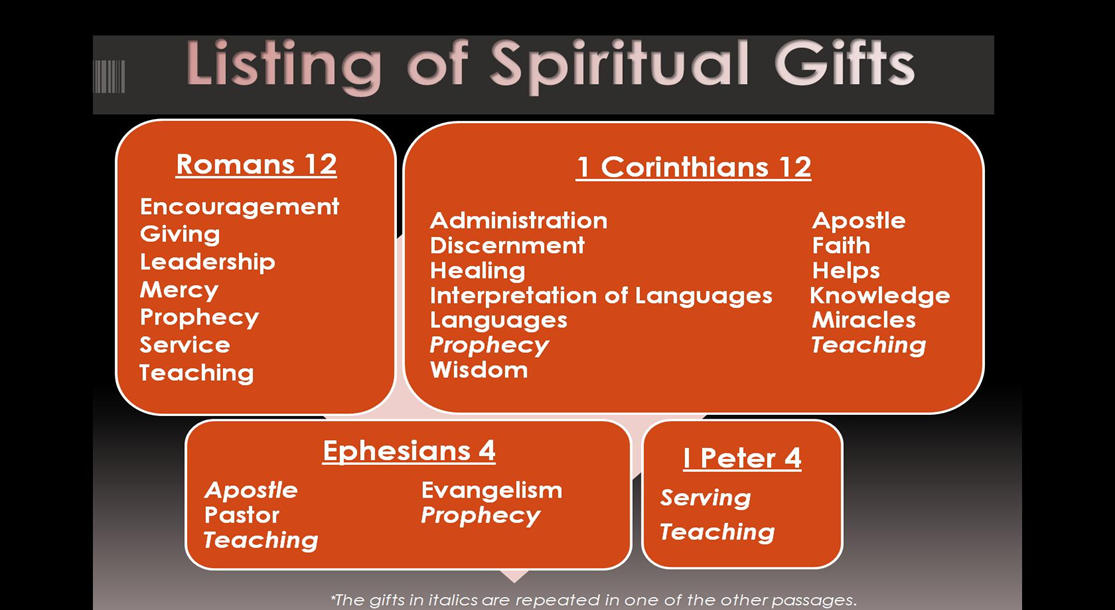
Concerning the spiritual gifts, not only are there more than we might remember, but our spiritual identity with respect to them is no stranger to God. For each person, there is a divine order with varying weights that often goes unknown or misunderstood in spiritual journeys. Accordingly, it is my belief that any faith-based institution should be keen on helping its participants discover their ‘loved by God’ identity through the gifts and then seeing how they can be at work…at work.
I like this graphic primarily due to its layout. While we don’t have time in this post to dive into all of them, I want to focus today on the seven gifts at the bottom of the screen, starting with the fivefold ministry gifts described in Ephesians 4: Apostles, Prophets, Evangelists, Pastors, and Teachers. These are leadership gifts given by Christ not just to the ordained ministers of the world but too all believers to equip the saints for ministry, build up the body of Christ, and foster unity and maturity in the faith.
As for the two in the bottom-right, these are grace gifts as defined in 1 Peter 4:10-11, service (deacon) and ‘teaching’ (elder) in an exhortation capacity, In this passage, Peter states how God has given every believer a spiritual gift to serve one another as good stewards of God’s grace, with the goal that all things glorify God through Christ. These gifts are not self-focused but are for the benefit and building up of the body at large with different gifts being empowered by the same Spirit and needing to be used with God’s strength for His glory.
Having said all this, here’s the ‘crashiest’ of courses you may ever receive on the seven leadership gifts and how they’re meant to function in the marketplace…
Prophets…call God’s people to God’s ways. They are more about developing the design of organizational mission, less about developing people. They ‘redeem’ an environment by expressing a wisdom that gives clarifies organization’s vision/mission for co-workers.
Evangelists…those who are gifted to reach unbelievers. They tend to be more gatherers with acts of service being their community gift. Evangelists are more concerned about developing the organization through developing people. They ‘redeem’ an environment by creating an inclusive team environment through love and acceptance.
Pastors…those who encourage believers with the spoken word. More concerned about developing people than managing systems. They ‘redeem’ their environment by creating joy through encouraging people on how important they are as people to the organization and by helping them see how their temperaments complement the organization.
Teachers…those who systematically make disciples and develop management systems. More concerned about preserving the organization. They ‘redeem’ their environment by raising team morale through breaking down systems into easy action steps and by helping them see how the systems help everyone reach their mutual goals.
Apostles…coordinate the other gifts and helps them work together. Leading and directing are their community gifts. They ‘redeem’ their environment by coordinating a team in a way that generates hope by maximizing each team member’s gift and designing products/projects that emphasize a redemptive gift of the organization.
Elders…those who impart themselves. More about managing people/Less about developing people. They are big picture minded in that that they see the value of systems, but they REALLY see the value of helping people find their places in the system. They are manager-developers who gravitate to systems but are motivated to help people find their seat on the bus.
Deacons…more about managing systems for the sake of people. They are motivated to implement proven systems that help people work together*. A deacon is part of the pastoral gift cluster, but in the workplace may not be in a direct support capacity but a ‘hidden’ support capacity. They ‘redeem’ their environment by creating an atmosphere of goodness and gratitude through giving and bringing order to the organizational environment.
*Note: A deacon’s gift is the broader concept of “serving others” through the use of whatever spiritual gifts one has received from God. This isn’t limited to a specific role, but encompasses a general ability to use God-given talents, like mercy, hospitality, administration, and giving, to serve the needs of the Christian community.
So, this isn’t a newsflash, but I’ll go ahead and say it anyway.
I’m an autistic adult who’s lost a kid yet believes in his story. While there’s a lot I don’t know, I know a lot about things I wouldn’t wish upon anyone, from holding a child taking her last breath to being unfairly labeled in school for lacking social cues, and at past jobs for having neurodivergent tendencies.
Not to suggest I’m a victim or anything. I’m just different, perhaps a little anomalous, and that’s okay. Honestly, the world needs more people who are content and confident in their uniqueness, in how they see and understand the world around them.
Yet, as for why I’m writing this, consider it a call for corporate introspection, from churches and counseling centers to employers across the country. No matter what organizational structure is employed, there must be support for spectrum people as well as those who are struggling with trauma and loss. In our interactions with colleagues, providers, subordinates, and those in our household, we must not only prioritize grace, compassion, and understanding in our dealings but also make additional room for them with certain people in specific situations.
The reason is simple: While every day is a gift, it can also feel like a burden for the one walking through complexities they can’t understand. Are we actively thinking of ways to steward psychological safety in our workplaces, to share requests and concerns? Are we screening people at strategic junctures to know what their accommodations should be? Are we seeking to understand the ‘why’ behind select needs, tools, and outputs? Are we willing to learn more about what doesn’t directly apply to us but applies to those on our team, from the cubicle peer next door to the prospect who could be the missing link to our company’s next big thing?
Again, I’m not looking to force conviction, but stir some questions for thought. Are we, as influencers and leaders with varying degrees of authority, considering ways we can facilitate healthy environments for those who may struggle to regulate on overwhelming, high-pressure days? Are we contributing our availability and wisdom to potentially detrimental dynamics? Are we being bold to sow life while being emotionally sensitive to those who could use a piece of our positivity, perspective, or direction?
Whatever your answers are, I’m not entitled to know, though I will say this in closing. Dare to care enough to know when an unjust tag is applied, when bias is infiltrating a pride-centric culture where hurting and/or neurodiverse people are somehow inferior. In all we say and do, let’s keep our hearts intact, our protocols fine-tuned, and our attitudes open to adjustments.
The other day, I was catching up with a former colleague when the following topic came up: Why does God lead us to places we don’t belong, places so far out of our giftings and comfort zones, they are practically impossible?
These are fair and popular questions during and after seasons of intense shaking and course-correcting. If we’re to start our exploration on the right foot, we must know who God is and how He journeys us. After all, God’s concern is not so much where we’re going as much as who we’re becoming. While man, in his lust for understanding, craves direction for his gain, be it clarity, validation, or something tangible, God is always after our hearts, relentlessly pursuing us in love (1 John 4:19). True to His Word, He never forsakes us and is always ready to help when we ask for it (Matthew 7:7; John 14:13-14).
So, if God is all this and more, why does He migrate us into deserts and wildernesses? Why does God sometimes open doors to places we’re hard-pressed to thrive, to be most effective?
As Jennie Allen suggests in her book, Untangle Your Emotions, when processing these questions, we must start with the right ‘W’. Often, we wonder why so we ask ‘why’, when really, we should be asking, ‘what’. For example, rather than ask God, ‘Why did you lead me here? Why did you let this happen? Why aren’t you manifesting’, inquire with, ‘God, what do you want me to know? What must I do to help this situation? What is it you want me to receive from you at the moment?’ While these are but a few examples, the mere shift in approach gives us a healthy starting point from which we can troubleshoot internal dissonance.
I believe for many of us, we’re searching not only for answers but stillness with a side of healing. Often, to what we hope for, we’re desperate for an improvement of circumstance, character, even health. The problem is while our reliance in the vertical is perpetually possible, the restoration we crave in the horizontal isn’t always plausible; hence, why we sometimes succumb to a ‘why’ question as we seek to bridge the disconnect. The good news is while this divide may hurt in the short term, it can have long-term, large-scale impacts given it validates our call to rely on God when we’re overwhelmed. Feeling down in your doubt? Cast it on Him! Sensing unfair treatment? Pray for peace-making discernment. Struggling to reconcile the past or advance in your way? Submit your intent to Christ knowing He desires to mature you according to His purposes.
Stumble as we may, our grooming for eternity doesn’t pause in the potholes of life but by His stripes can be enhanced in our weakness.
Accordingly, if you’re questioning God at a crucial intersection, if you’re struggling to arrive at peace, rest, forgiveness, whatever it may be, consider changing your ‘Why God’ into a ‘What God’ and watch what happens. Once your ‘what’ questions are in rhythm, marinate in the sweetness of God’s sanctification and strategize ways in which righteousness and holiness can cover your interactions with other people. Like ‘why’ questions, harboring offense and intentionally withholding good things (i.e. availability, a gentle critique/response, a listening ear, an effort to understand, etc.) will only cloud judgment and cap God’s love from flowing through us. Rather than quench the fires of tension or repair the damages of burnout, inquire what God wants to show you as you walk through it in humility. No need to panic or freak out; just leave it to the wrath and ways of God to straighten and enlighten. From there, all you have to do is breathe, release, and release again.
Ultimately, what compels us to journey through impossible places is God’s love filling in possible spaces – those spaces being our ‘deep’ (Psalm 42:7) desiring to know and grow in God within the world around us. As the Word attests, we were made to discover God; however, this cannot happen without the opportunity to trust Him in the desert, the wilderness, and all points in between. Remember God uses all things for good according to His perfect will purposed for those He loves (Romans 8:28). Core to our maturation as believers, we must learn to align faith and hope during adversity so any wresting against God can turn into wrestling with and for Him. Granted, this isn’t possible in our strength and requires daily sacrifice and surrender. But at the very least, we can respond to God’s pursuance and where He’s leading us, knowing we have nothing to lose and everything to gain in Christ Jesus following in His footsteps.








 hisgirlfryday.com