Proverbial Life: A Quick Guide to Possessing Your Soul

Context: This post was inspired by a May 16 conversation with my dad prior to his Sunday AM message @ The Gate Community Church on May 19. Moving forward, any content centered on internal endurance (and/or a ‘Proverb outside of Proverbs’) will be categorized into this new series called ‘Proverbial Life’.

It’s a complicated theme in Scripture…

God, as love, authoring His will in the deepest still; the epitome of fellowship perfecting faith before it could create.

No question, the infinities of life are complex, sometimes intimidating; however, when we consider God at the beginning, we converge on a central truth:

We were made for connection (for love, with love, by love)…

…to pursue peace with all people1

…and to be unity in community.

Unfortunately, this is easier said than done in a day when relationships are compromised by  busyness, striving, even insecurity. Perhaps you’ve encountered similar barriers wondering how to navigate around them.

If so, I want to encourage you with a Proverb that somehow found itself in Luke 21.

But before I dive in, allow me to uplift the down heart reading this…

  1. You are not alone. You are not here by accident. You are a treasure. You are an asset to an unshakable Kingdom. You are a chosen child of God. Just marinate in these identity statements a bit.
  2. If you’re not in the rhythm of daily dying2, staying the course in any situation will be challenging. An odd segue, I admit, but one I speak from wanting you, the reader, to surrender all trust in God knowing He understands your wants, needs, desires, and dreams better than you do.
  3. In writing this, I don’t want to downplay the struggle of connecting to those preserving their rhythms, content with you being on the outside looking in. I get it. If there’s one mountain in recent church testimony, it’s this. Still, even though the purest of intentions can become unyoked priorities, you can’t take on the wrong burdens even if you’re the only one who sees them.

Having said that, let’s dig into the Word…

giphy

By your patience possess your souls.” ~ Luke 21:19 (NKJV)3 4

By your endurance you will gain your lives.” ~ Luke 21:19 (ESV)

By your [patient] endurance [empowered by the Holy Spirit] you will gain your souls.” ~ Luke 21:19 (AMP)

Stand firm, and you will win life.” ~ Luke 21:19 (NIV)

Staying with it—that’s what is required. Stay with it to the end. You won’t be sorry; you’ll be saved.” ~ Luke 21:19 (MSG)

As expected, wording varies upon translation, but the general concept is the same. When we reference this verse to Matthew 4 and note the heart of Jesus, we find the Son of Man walking in authority by the power of the Holy Spirit. Everywhere he went in this power, every time he returned in this power. Even when Jesus was tempted, Jesus was centered in his identity by…you guessed it…the power of the Holy Spirit.5

Often times, when we think power of the Holy Spirit, we think wonders and miracles, but for Jesus, the most frequent manifestation of the Spirit’s power in him was his reliance upon the Father to possess his emotions. A simple anecdote upon first glance, but one with significant applications when we consider Jesus was tempted in every way like we are today. This in mind, we can’t take lightly the vain thoughts we tolerate in place of deferred hope given the power of fear ultimately numbs us to the power of the Spirit.

Again, Jesus is the way we must model. To him, his ‘standing identity’ wasn’t mutually exclusive from his identity in God. He knew to walk in real authority, whether resisting the enemy or healing the sick, he had to possess his soul to keep it from ruling him. The more opportunities he had to cultivate endurance in this way, the more he walked confidently in his identity and the authority that overflowed.

Furthermore, it’s worth noting Jesus never asserted his authority as a self-evident right, but out of a posture of rest. This is key for us concerning spiritual warfare. To say Jesus asserted his authority out of rest means he didn’t contend for authority with the enemy; rather he exercised it knowing he was free from needing God to approve himself and defend his rights.

This, in turn, allowed his faith to flow from identity and empowered him not to be offended that his purpose was rooted in dying.

So in a weird sense, we should delight in the fact God tests us through relational voids6 given His heart is to refine our rest and trust in our ‘loved by God’ identity. Not to suggest every relational lack is a test from God. I’m just saying when we look at how Jesus lived and what He longs to develop within us, how can we not be grateful knowing our patience can mature as we master our inner man? How can we not be excited our ego-triggered fears can be subdued by the same power Jesus abided in?

giphy (1)

Bottom line: Every day is an opportunity to die to self, receive God’s life, and discover our purpose through our ‘loved by God’ identity.

Accordingly…

  • Next time, you’re alone, remember Jesus was often alone…yet relied on the Father in those moments.
  • Next time, you feel judged, remember Jesus was constantly misunderstood, even in praise…yet consistently ran to the source of his confidence.
  • Next time, you feel drained, remember Jesus was tired on many occasions…yet knew the fruit he bore strengthened his perseverance. 
  • Next time you feel disconnected or discouraged, remember to rejoice as you suffer in steadfastness!

After all, God is always up to something special, something incredible beyond your comprehension. Just keep your eyes centered on the perfecter of your faith, surrender what you think should be present in your life, and stand firm regardless of how you feel…

…knowing no matter what happens…

…the Creator of your soul will be there to gain your souls.

Selah.

Footnotes

  1. Hebrews 12:14 NKJV
  2. To the will of your flesh
  3. Putting NKJV first since I like the way this translation catches the Greek
  4. Patience in Hebrew refers to suffering in steadfastness
  5. So while there’s truth in viewing this verse as a bottom line for a well-disciplined life, the whole point is what connects standing firm to winning life…and that is the power of the Spirit.
  6. And conflicts
Cover photo creds: WallpaperUP

Integrating Ministry & Marketplace: The Temple Template (2nd Ed.)

As shared at the Transmission 2019 conference on May 3, 2019

Original: https://hisgirlfryday.com/2018/04/24/integrating-ministry-marketplace-temple-template/

Today I want to talk about why Jesus’ temple entrance post-triumphal entry is significant for us as leaders.

But before I dive in, let me just say one of my favorite things to talk about is leadership identity. As vocationals, it’s important to believe what God says about us and how He’s made us to be. In Colossians 2 and Ephesians 2, Paul talks about how we’re called to be effective influencers and reconcilers; in 2 Corinthians 5, Paul talks about how we’re to be Kingdom ambassadors, in 1 Peter 2, Peter talks about how we’re a royal priesthood, a chosen race, a holy nation.

But to be all these things, we must walk in three strengths: courage, boldness, and confidence.

Interestingly, one of the places Jesus demonstrates all three of these qualities is the temple. So if you have your Bibles/Bible apps, turn to Matthew 21:12-17

As mentioned, after Jesus finishes the triumphal entry (v. 1-11), note the first place he goes to (i.e. the temple – v. 12) and the reason why he went there (i.e. to cleanse it).

I don’t know about you, but when I consider the fact Jesus deliberately went to the temple to make its original intent known…that speaks to me. While we tend to focus on Jesus’ frustration in this passage, the key is Jesus setting things right, being fearlessly intentional with the truth, and breathing life into what had become a lifeless environment.

When we talk about our identity as leaders, I believe there’s important application to be found.

First off, to be an effective leader, we must be courageous and purposeful with the truth. Yes, we can be highly skilled with our spiritual gifts; yes, we can be articulate and persuasive, but if what we’ve given from God is used with limited integrity, if we’re tolerating fear in any way, we won’t be able to walk in our leadership identity fully.

Secondly, when we consider Jesus calls the temple “my house” (v. 13 – “My house will be called a house of prayer…”), we find God’s view of leadership as an extension of our priesthood and a place He intended for our good where we can be influencers, reconcilers and ambassadors.

In this case, Jesus calls the temple a “house of prayer” not only to reveal its purpose (i.e. a place where the Holy Spirit could dwell, of influence and vertical communication), but to inspire the sick, the poor and downcast to better know that purpose (v. 14).

Accordingly, it should be no surprise to see a completely transformed temple by the time Jesus leaves in v. 17. Jesus didn’t come to assert his identity, but re-establish an identity his Father intended. This is a big part of why those who weren’t offended were drawn to him…because he had something in him bigger than himself…something that pointed to being loved by God.

At this time, I want to introduce a fairly new concept inspired by Benji Block.

Going back to our aforementioned three strengths (i.e. courage, boldness, and strength), it’s important we understand them as separate yet linked entities. While a future post will be written on their relationship, here’s what I will say for now:

  1. Courage is yielded trust, relying on God’s strength in the moment.

  2. Boldness is matured courage (courage in rhythm).

  3. Confidence is matured boldness (boldness in rhythm).

Using a race analogy, courage gets us to the starting line regardless of fear. While choosing courage doesn’t automatically remove the fear, it ultimately positions us to see the value in running the race.

Put another way, if courage says ‘yes’ to run the race, boldness says ‘yes’ to keep running once the gun goes off.  Granted, you may still have doubts and cramps, but nothing can change the fact your commitment is etched in action. Once established in pace, boldness can then yield to confidence, which in this case, manifests as an unshakable belief in finishing the race. Once you’re running with confidence, the fear of pain and other obstacles pales in comparison to the joy set before you.

YellowishWeirdAustraliankelpie-size_restricted.gif

Step by step, the fear diminishes as what your reliance has now peaked in full. You cross the finish line and marvel not only in the fact you’ve died to your flesh, but also in the reality of having relied on a confidence not your own.¹

Again, I’ll unpack these concepts down the road, but for now, we can apply them to Matthew 21.

Bottom line: When we reflect on how Jesus integrated his ministry and spiritual gifts in the temple, we see…

1. Jesus was intentional (in going to the temple courts). This represents courage.

2. Jesus was bold with the truth and how he handled conflict (some translations reference how Jesus drove out what needed to be driven out with force). This represents courage and boldness

3. Jesus lived out the identity he declared over the temple (in doing this his true identity became apparent to those who would ultimately flock to him; he didn’t come to the temple looking to assert his identity). This represents courage, boldness, and confidence

4. Jesus loved at every opportunity (his reputation in many ways preceded him which is part of the reason so many came to him). This represents courage, boldness, and confidence

I submit if we’re going to thrive in our areas of influence, we must choose courage through obedience and prayer, be bold with the truth even in conflict, and walk in confidence as we enter the places and purposes God has appointed for us.

In summary…we choose courage to lead in boldness to walk in confidence.

When we pursue these strengths, that’s how we know we’re living our identity as leaders.

Selah.

Footnotes

  1. Original illustration built on Benji’s ‘matured’ comparison
Cover photo creds: Free Great Picture

Rolling Stones: Why The Torn Veil & Split Rocks Matter

It’s the most pivotal moment in history…

…Jesus…on the cross…

…a joy once set before him, now the weight of the world.

Battered and bruised, he waits; the darkness of sin in foreign space. The epitome of innocence now weeping for his father…

“My God, My God, why have you forsaken me?”

One can only imagine what it must have been like to be a bystander watching this wonder working power helpless on a tree…to stand amidst this moment in time as it became a moment for eternity.

2ywqod

Would you agree?

If not, permit me to explain through the lens of some rocks, a veil and why it tore immediately after Jesus’ last breath.

During Jesus’ ministry, the holy temple in Jerusalem was the hub of Jewish religious life, a place where animal sacrifices and scroll readings were carried out according to the Law of Moses. In this temple, a veil separated the Holy of Holies from the outer court for three reasons:

  1. The Holy of Holies was a landing spot for God’s presence
  2. The Holy of Holies was a place of consecrated communion between God and the high priest.
  3. The Holy of Holies signified man’s separation from God by sin foreshadowing sanctification through atonement.

Isaiah 59:1-2 (ESV) and Hebrews 9:6-9 (AMP) capture this in tandem:

“Behold, the Lord’s hand is not shortened, that it cannot save, or his ear dull, that it cannot hear; but your iniquities have made a separation between you and your God, and your sins have hidden his face from you so that he does not hear.”

“…the priests continually enter the outer [or first section of the] tabernacle [that is, the Holy Place] performing [their ritual acts of] the divine worship, but into the second [inner tabernacle, the Holy of Holies], only the high priest enters [and then only] once a year, and never without [bringing a sacrifice of] blood, which he offers [as a substitutionary atonement] for himself and for the sins of the people committed in ignorance. By this the Holy Spirit signifies that the way into the Holy Place [the true Holy of Holies and the presence of God] has not yet been disclosed as long as the first or outer tabernacle is still standing [that is, as long as the Levitical system of worship remains a recognized institution], for this [first or outer tabernacle] is a symbol [that is, an archetype or paradigm] for the present time. Accordingly both gifts and sacrifices are offered which are incapable of perfecting the conscience and renewing the [inner self of the] worshiper.”

To recap, that’s over a millennium of one high priest making one annual visit to encounter God under first covenant law. That’s intense. I can only imagine if memes existed back then, how many would hinge on ‘no pressure’ taglines.  Not to mention if John 3:16 was extrapolated back to Exodus:

Before God could send His one and only Son, He had one and only day to meet one and only mediator1, a high priest oblivious to how the blood of his lambs bode the blood of the Lamb.”

Of course, I’m being jocose in my paraphrasing. But perhaps you’re still wondering, ‘What does any of this have to do with Jesus dying on the cross?

To answer this, let’s compare Matthew 27:50-51, Mark 15:37-39, Luke 23:44-47 respectively:

“And Jesus cried out again with a loud voice and yielded up his spirit. And behold, the curtain of the temple was torn in two, from top to bottom. And the earth shook, and the rocks were split.”

And Jesus uttered a loud cry and breathed his last. And the curtain of the temple was torn in two, from top to bottom. And when the centurion, who stood facing him, saw that in this way he breathed his last, he said, “Truly this man was the Son of God!”

It was now about the sixth hour, and there was darkness over the whole land until the ninth hour, while the sun’s light failed. And the curtain of the temple was torn in two. Then Jesus, calling out with a loud voice, said, ‘Father, into your hands I commit my spirit!’ And having said this he breathed his last. Now when the centurion saw what had taken place, he praised God, saying, ‘Certainly this man was innocent!’”

Now, before we pursue our bottom line, let’s note some contrasts:

  1. In Matthew, we see the veil tearing and rocks splitting; no mention of the centurion.
  2. In Mark, we don’t have rocks splitting, but the centurion is introduced confessing Christ as the Son of God.
  3. In Luke, we have time stamps and are re-introduced to the centurion who this time confesses Christ as innocent. Unlike Matthew and Mark, the veil is said to have been torn prior to Jesus’ death.
  4. Interestingly, the common denominator in all accounts is the torn veil. While not mathematically confirmed by Scripture, Exodus suggests this veil was likely near 60 feet high and four inches thick meaning not even Samson could not tear this thing.

Merging the differences, the moment fleshes out…

 “It was now about the sixth hour, and there was darkness over the whole land until the ninth hour, while the sun’s light failed. Then Jesus, calling out with a loud voice, said, ‘Father, into your hands I commit my spirit!’ Having breathed his last, the earth shook, the rocks were split, and the curtain of the temple was torn in two from top to bottom. Now when the centurion saw what had taken place, he praised God, saying, ‘Certainly this man was the Son of God!’”

From here, we can now grasp the magnitude of the moment.

Once Jesus surrenders his spirit, it’s at this point the veil tears; however, the orientation of the tear is significant as it didn’t occur randomly, but from top to bottom. The commentary on this can be simplified as follows:

  1. The significance of the torn veil was the consummation of Christ’s sacrifice and atonement.
  2. The significance of the torn veil splitting top to bottom was the Holy Holies now being open to all people for all times.

Put another way, the veil tearing top to bottom not only captured the movement of God’s holy temple from manmade structure to internal dwelling, but also foreshadowed the coming of the Holy Spirit in Acts 2.  No longer was the Old Covenant relevant where high priests represented the masses; rather, Christ could now be both our High Priest and the way to get to Him.

Hebrews 8-10 breaks this down beautifully, specifically when 8:13, 9:8-9, and 10:19-20 (ESV) are linked together:

In speaking of a new covenant, he makes the first one obsolete. And what is becoming obsolete and growing old is ready to vanish away. By this the Holy Spirit indicates that the way into the holy places is not yet opened as long as the first section is still standing (which is symbolic for the present age). According to this arrangement, gifts and sacrifices are offered that cannot perfect the conscience of the worshiper. Therefore, brothers, since we have confidence to enter the holy places by the blood of Jesus, by the new and living way that he opened for us through the curtain, that is, through his flesh.” 2

To quote Michael Houdmann, “The things of the temple were shadows of things to come, and they all ultimately point to Jesus Christ. He was the veil to the Holy of Holies, and through His death the faithful now have free access to God.

As for the rocks splitting, though often lost in context, this, too, is a meaningful anecdote. While the torn veil signified the tearing of Jesus’ flesh, reconciliation between God and man, and Christ’s post-salvation residence, the split rocks captured the effects these had on the physical world. A preview of the tomb, the split rocks were more than a consequence of the earthquake following Jesus’ final breath, but rather a permanent reminder for humanity that death is the ground of resurrection…that what happens in the spiritual can’t be excluded from the physical.

The rocks, in a way, also signaled the resurrection of our earthly bodies (see 1 Corinthians 15:35-54) and a Kingdom that cannot be shaken (Hebrews 12:18-29). Granted, theologies vary enough to warrant a second post for a different day; the bottom line is the rocks were both imagery and analogy to God’s sovereignty in creation, His power in death, and His intent for new life.

I love how John Piper paints this in Desiring God:  “The earth was shaken and rocks split by a sovereign earth-controller and a powerful rock-ruler. Human deaths don’t shake the earth and split rocks. God does. Rocks don’t have a mind of their own. They do what God bids them do. And they shook and split.”

Come to think of it, what a visual the rocks are to Christ’s identity as our everlasting rock (Isaiah 26:3-5), our fortress in whom we take refuge (Psalm 144:1-2). True, the veil reminds us the barriers once between God and man are now a pathway to walk in boldness (Hebrews 4:14-16), but the rocks remind us that pathway is also one we can walk in confidence.3

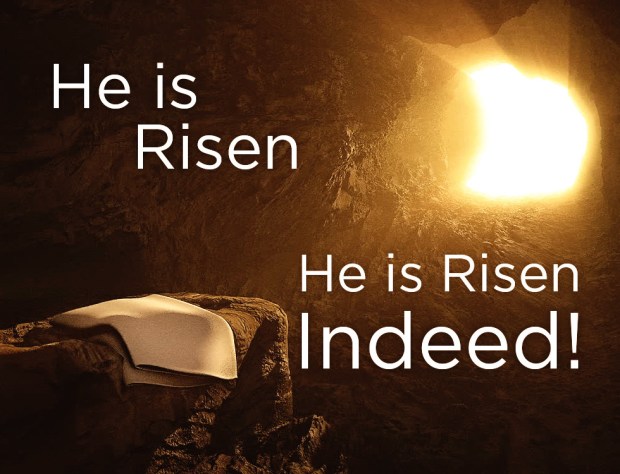
And that, my friends, is why we celebrate Easter: To commemorate Christ as our greatest anchor amidst a shaking world and our greatest security amidst a collapsing one. When life is unstable, He is able. How sweet it is to know the power of the Cross will always be enough to crack the rocks of life…

…that at the mention of His name, mountains bow down and the seas roar…

…the work of His hand having taken the nails for us

As we approach Easter, my prayer for you is that as you come into a fresh understanding not only of what Christ came to do, but what He longs to do in and through you in the days to come.

Until then, I wish you all a wonderful Easter full of peace and rest as you reflect on the ultimate sacrifice.

1-1-1-1-He-is-Risen

Selah.

Footnotes

  1. Already the math gives me tingles
  2. Pretty remarkable how fluid those passages run when put together
  3. Courage is for today; boldness is courage matured; confidence is boldness matured. Shout-out to Benji Block for the breakdown. (Edited by Cameron Fry via Canva)
Cover photo creds: newagechristianity.org (Edited by Cameron Fry via Canva)

Built to Build: The Call of Vocations (Part 1)

After previously discussing 1 Corinthians 4, I want to rewind a chapter and review our vocational identity – what God intends us to be on the clock.

While we will ultimately need guidance from Colossians 2 to unpack this in full, for now let’s start with 1 Corinthians 3:9-11 (ESV):

For we are God’s fellow workers. You are God’s field, God’s building. According to the grace of God given to me, like a skilled master builder I laid a foundation, and someone else is building upon it. Let each one take care how he builds upon it. For no one can lay a foundation other than that which is laid, which is Jesus Christ.

Here, Paul, having emphasized church divisions (v. 1-4), is reminding the Corinthians to see Christ as their cornerstone (Ephesians 2:19-22), as the foundation of life on which new life can be built. Unfortunately, like the Israelites in Judges, the Corinthians are strong in flesh and weak in discernment. A people ravaged by schismatic impulses, they are plagued by paganism and a past rooted in idolatry. Certainly, Paul couldn’t have been too surprised to hear reports of such dissension.

Athena

Yet, what Paul lacks in suspense, he makes up in candidacy, specifically we are servants designed for unity and God is the source and core of it all. What matters is not who gets this task and who gets that task, but rather why the task exists at all. For most of us, this makes sense, but to the Corinthians, a people who saw their value through who they followed, this would have been difficult to accept. Imagine your political preference and/or denomination of choice being your chief designation. “Hi, my name is Cameron and I’m a charismatic Republican.” A bit off-putting, right?­

Conversely, for Paul, affiliations meant nothing compared to eternal intent as evidenced in v. 9 (AMP):  

For we are God’s fellow workers [His servants working together]; you are God’s cultivated field [His garden, His vineyard], God’s building. “ 

Like 1 Corinthians 4:9-13, this is powerful imagery concerning our vocational identity. We aren’t just God’s workers, but fellow workers on mission with Christ doing good works in Gospel partnership (Phil. 1:5-6). Concerning our colleagues and clients, they’re also designed for God’s assignments, but whether they know it or not should not deter us from working peaceably as it depends on us (Romans 12:18). As long as we accept the call to be Christ’s championing companions, we can embrace unity as helpers of joy (2 Corinthians 1:24) while perceiving our cultivation as an overflow of God’s goodness.

After all…

…we don’t work to lay the foundation; we work because Christ is the foundation!

Put another way, as co-laborers and vocational leaders, we’re meant to be laid on, not laid upon; hence, why Jesus says in Mark 3:25, “…a house divided against itself cannot stand.” If we don’t value teamwork apart from personal gain, our operations will be hindered having affirmed our identity as the foundation.

Again, this offers quite the paradox to the natural mind. Are we the foundation Christ, the master builder, lays or are we the slab plan built on Christ the foundation, by Christ the builder? Personally, I side with the latter, especially when I note the Psalmist and weeping prophet (i.e. Jeremiah) who perceived identity as predestined (Psalm 139:13, Jeremiah 1:5), Christ’s work in them1 as destined, and God’s nature as perpetually present. Applying their worldview, we can rest knowing as vocational influencers, we can mature our reach knowing it is Christ in us who does the cultivating through our work.

Screen Shot 2019-03-16 at 1.03.27 PM

In other words…

He is the vine, we are branches…but we are also a part of His vineyard!

Sometimes, we get so discouraged being branches, we forget the beauty of the garden we’ve been planted in. This tells me not only do we need to know Christ as the foundation on which we stand, but also the cultivator who pours out seeing the growth before it happens.

Colossians 1:4 and 2:2 (AMP) captures this process beautifully.

We have heard of your faith in Christ Jesus [how you lean on Him with absolute confidence in His power, wisdom, and goodness], and of the [unselfish] love2 which you have for all the saints (God’s people)…For my hope is that their hearts may be encouraged as they are knit together in [unselfish] love, so that they may have all the riches that come from the full assurance of understanding [the joy of salvation], resulting in a true [and more intimate] knowledge of the mystery of God, that is, Christ…”

Combining these passages, we find the blueprint to living our vocational identity. When we’re overcome by disappointment, we choose gratitude seeking God in confidence. When we’re overwhelmed by hate, prejudice, and indifference we choose love seeking God in faith. And when we’re overpowered by unbelief and unforgiveness, we choose hope seeking God in His grace and power. In this way, we allow the towel (John 13: 1-9) to unfold as our hearts yearn to see others transformed and united by unselfish love. Granted, when we talk being on the job in the midst of funk and discrimination, this is easier said than done.

Then again, the whole point of Paul writing this is to encourage the Gentiles to desire unity with the Jews in hope to see them know Christ. And it’s this heart posture, I submit, we embrace as believing vocations on marketplace frontlines. Remember we are built up to build up, a process that with God knows no bounds.

As far as what we do between being built up in Christ and building up through Christ, Paul does give an additional template on this later in Colossians 2. For now, let’s pause and revisit the topic in next week’s post on how we contend for unity at work.

Selah.

Footnotes

  1. Ministry of reconciliation/sanctification
  2. The key to understanding this and other statements about love is to know that this love (the Greek word agape) is not so much a matter of emotion as it is of doing things for the benefit of another person, that is, having an unselfish concern for another and a willingness to seek the best for another.
Photo creds: FULLER studio

Messiah’s Misfits: Why The Name Says It All

So recently I’m reading 1 Corinthians 4 when suddenly it hits me…

…of all the chapters in all of Paul’s letters, arguably the greatest content on vocational perseverance can be found in v. 9-13 when Paul discusses the nature of true apostleship.

 Let’s check it out…

For I think that God has exhibited us apostles as last of all, like men sentenced to death, because we have become a spectacle to the world, to angels, and to men. We are fools for Christ’s sake, but you are wise in Christ. We are weak, but you are strong. You are held in honor, but we in disrepute. To the present hour we hunger and thirst, we are poorly dressed and buffeted and homeless, and we labor, working with our own hands. When reviled, we bless; when persecuted, we endure; when slandered, we entreat. We have become, and are still, like the scum of the world, the refuse of all things.” (ESV)

It seems to me that God has put us who bear his Message on stage in a theater in which no one wants to buy a ticket. We’re something everyone stands around and stares at, like an accident in the street. We’re the Messiah’s misfits. You might be sure of yourselves, but we live in the midst of frailties and uncertainties. You might be well-thought-of by others, but we’re mostly kicked around. Much of the time we don’t have enough to eat, we wear patched and threadbare clothes, we get doors slammed in our faces, and we pick up odd jobs anywhere we can to eke out a living. When they call us names, we say, “God bless you.” When they spread rumors about us, we put in a good word for them. We’re treated like garbage, potato peelings from the culture’s kitchen. And it’s not getting any better.” (MSG)

For, I think, God has exhibited us apostles at the end of the line, like men sentenced to death [and paraded as prisoners in a procession], because we have become a spectacle to the world [a show in the world’s amphitheater], both to angels and to men. We are [regarded as] fools for Christ, but you are so wise in Christ; we are weak, but you are strong; you are highly esteemed, but we are dishonored. To this present hour we are both hungry and thirsty; we are continually poorly dressed, and we are roughly treated, and wander homeless. We work [for our living], working hard with our own hands. When we are reviled and verbally abused, we bless. When we are persecuted, we take it patiently and endure. When we are slandered, we try to be conciliatory and answer softly. We have become like the scum of the world, the dregs of all things, even until now.” (AMP)

Now, before we dive in, we must understand the broader context.

First, what is the nature of true apostleship? Going back to 4:1, we find the answer: Those who minister Gospel hope as servants/stewards/ambassadors of Christ no matter the cost. The Amplified breaks it down further describing these servants as those who are certain in adoration more than they are uncertain in anything else. Essentially, apostleship goes beyond the office of apostle and involves anyone who is willing to be salt, light, and life in places where there is none. If you are being a faithful steward of God’s call on your life, you’re engaging your apostolic anointing! Whether or not you have a mobile ministry is moot compared to God’s faithfulness being reflected in what you say and do as you draw people to Christ (Colossians 3:17).

Second, how do we abide in the nature of true apostleship? Verses 7-8 give us a hint when paraphrased: We have not only been given everything for goodness and godliness (2 Peter 1:3), but every reason to trust the Lord as our portion (Psalm 73:26)¹. Accordingly, as we reference God in reverence², to live as Christ (Philippians 1:21) becomes the foundation to our perseverance and influence regardless of setting and trial. After all, “there are different kinds of [work], but in all of them and in everyone it is the same God at work (1 Corinthians 12:6).

Finally, we arrive at v. 9 where Paul employs some serious poetic license. Messiah’s misfits (MSG), prisoners of spectacle (AMP, ESV), an accident in the street everyone stands around and stares at…these are all powerful metaphors and similes reminding us there is no earthly honor in apostleship. If, by chance, we are pursuing any glory apart from what is rightfully God’s, our endurance will not stand, but if our satisfaction is rooted in being complete with Christ (Colossians 2:10), if our contentment is secure to His sufficiency, only then will we be victorious as dregs. It’s a paradox to the flesh, but one necessary for our dependence. When we are thirsty, we’ll see the need as being filled as opposed to satisfying a lack. When we are persecuted, we’ll know God is with us as one who relates as opposed to withdrawn as one who can’t. And when we’re struggling to make ends meet, we’ll rest in the mysteries of what God has and hasn’t revealed since our reliance is not contingent on self.

For some of us, it’s hard to accept what doesn’t make sense. It’s like we’re okay being misfits to sin, but not to the minds/culture tolerating it. I know for me, I’d rather be criticized for what I do wrong than be judged for what I do right. At least, with the former I can apply the correction and move on! However, I also know whenever I crave my work to be affirmed and my love to be reciprocated, I can declare God’s grace as sufficient, the fact I can joyfully boast in His power made perfect in my frailty (2 Corinthians 12:9-11). And suddenly those ‘weak as I eke‘ moments fade in something infinitely more…

…the sweet reality that I need JESUS! What a beautiful place to be!

-Jprj2

Bottom line: If you’re a vocational leader, dare to see the identity of what you do through the lens of apostleship, through the lens of being a servant taking light into dark places. And if hard times come, don’t be surprised; rather view them as a sign you’re doing things right³. When you bless others in the face of voids and discouragement, remember the same Christ you ask to bless others is the same Christ who will honor your obedience. If you don’t fit in, remember you were never called to in the first place. Stand out, take what comes, and know the power of you standing through adversity will assuredly have a positive ripple-effect on those around you even if you don’t see it right away.

Selah.

Footnotes

  1. Note how strength in this verse has Hebrew roots to ‘rock’
  2. This form of dependence opens up the Romans 5:1-5 road (more on this in a future post)
  3. Assuming the hard times aren’t consequences of sin, shortcuts, etc.
Cover photo creds: Medium