Quick post today – archiving some thoughts for future reference per a recent conversation at work. My plan will be to build a series off this concept in 2026…
There are times in life when ‘yes’ is and will be the right answer. You may not understand the full ‘why’; the logic may trail the intuition. But obedience as goal, we will ultimately encounter moments when reason must yield to faith. Sometimes, it’s as simple as seasoned patience, waiting for an open door to illuminate the path we’re meant to walk. Other times, it’s like guided flight within cloudy turbulence, watching God correct the trajectory as we cling to Him. Either way, God has a plan, a purpose, and a promise behind the places He takes us (Proverbs 16:9, Psalm 37:23-24, Jeremiah 29:11, Ephesians 2:10).
As for the effect of these places, we must expect variability. At any point, we always have the capacity to learn and grow from something for something. To breathe is to absorb. To absorb is to process. And how we process, in most cases, inclines critical choices from trusting God in the midst of challenging circumstances to those micro-moments every day when we must decrease.
So, what then when these impacts net negative on paper and in person? What if the only meaningful consequences are confined to scars and sagacities fortified in fire? For most, if they can’t carry a positive tangible forward, then they write off the exiting season as a failure. ‘Tis a mentality of the world and wisdom of the flesh.
Yet, in truth, in the Word, and every place that matters, the reality is you can’t quantify growth in motion or scale the ripple effect a fallen face turned hopeful can produce. When lessons learned become fastened to the soul, when they click, find momentum, and plant themselves as fertile seeds, what you have is a vital, appreciable asset – one of the most important of all! Some might call it ‘addition by subtraction’ character-building or by a ‘one step back, two steps forward’ platitude. But those wouldn’t serve due justice, let alone what is full in the Lord’s eyes.
Again, you can’t measure or compute the long-term influence humility has in the wake of voids and failures. Do you have much to learn, much to apply, but have subdued the urge to stay where you’ve fallen? If so, rejoice! Shake the dust off your feet and rejoice again.
My friends, we must not undermine the virtue of endurance as God intended. Forgive the versions of yourself that didn’t know better, that didn’t have the support you needed, that lacked the safe space. After all, you can’t move on if you don’t love on and you can’t love on if you’re committed to a hardened state. Remember what you crave, God already is. So…
Don’t just get up, look up. Don’t just sing in the rain; dance in the pain. Why? Because Christ in you, you can count it all joy because who you’re becoming is far more significant than where you’ve been.
It’s been a weird month. One of those in which much could be said but…
For Lys and I, we’re exiting a pronounced stretch of remembrance. By now, each year feels more like clockwork with a grief uptick during the dog days only to lift by the fall equinox. Even now, I sense the heaviness dissipating. Lord knows He’s given me and my family plenty of reason to keep going.
Yet, taking a corporate temperature, I can’t help but wonder if our present peace is set to stun mode. Restless nights have picked up for some, for others, the fatigue of the unknown (i.e. what to do next, how to respond now, etc.). Of course, there are those, who may be weary with their former toil. Probably a combination of ‘all of the above’, if we’re perfectly honest.
I know for me, there’s been much I’ve needed to release of late – the weight of carrying past positives into the present, the hope of connection and reconciliation in certain situations, the right for my right calls to be seen. Sometimes, it’s hard to make sense of the burdens we desperately want to flush out. Thankfully, as complex as our knots may be, the opportunity to surrender them is anything but.
Take last Tuesday for instance. Sitting on my front step, I started to go down a familiar rabbit hole, the one in which I try to make sense of where I’ve been and where I’m going. But unlike other episodes, I hit a point of exhale earlier in the process. Maybe it was the lower humidity and refreshing air mass. Perhaps I was giddy from just setting up some fall decor. Either way, I looked down the street from my porch on a hill and with what seemed like misplaced contentment, started to empty myself in the moment.
Then, after a few minutes, something bizarre happened: I began to shiver…in 75 degrees, calm winds, and a setting sun to my right. Suddenly, I needed a second layer and a flip to 1 Corinthians 2. With disrupted thermodynamics, I dug in.
In his letter, Paul confirms his posture in v. 2-3 (AMP):
“I made the decision to know nothing [to forego philosophical or theological discussions regarding inconsequential things and opinions while] among you except Jesus Christ, and Him crucified [and the meaning of His redemptive, substitutionary death and His resurrection]. I came to you in weakness, fear, and great trembling. And my message…[was] not in persuasive words of clever rhetoric but delivered in demonstration of the Spirit operating through me and of His power stirring the minds…so that your faith would not rest on the wisdom of men, but on the power of God.”
Relating and resonating, I kept on.
“For what person knows the thoughts and motives of a man except the man’s spirit within him? So also no one knows the thoughts of God except the Spirit of God. Now we have received, not the spirit of the world, but the Spirit who is from God, so that we may know and understand the wonderful things freely given to us by God. We also speak of these things, not in words taught or supplied by human wisdom, but in those taught by the Spirit, combining and interpreting spiritual thoughts with spiritual words for those being guided by the Holy Spirit” (v. 11-13, AMP).
Now, I’m not the savviest theologian; however, I’m confident when in doubt, in trouble, and/or in pain, the best response is to invite God in by making room for the Cross. In doing this, we position ourselves to be overwhelmed by the power of the Spirit, a move we cannot conjure or manufacture. Far too often, we’re consumed by our own capacities when we must remember there’s no capacity for what matters without the Spirit. We may crave daily bread, but we cannot receive it without pure vertical reliance in which we declare our substitutions, replacing worldly guesses and opinions with God’s Word. Every day, we must be mindful of the exchanges we’re called to make, especially if we long to process through clear channels; hence, why this chapter is so enriching. By God’s Spirit, the depth we were designed with has access, not just a channel but an invitation to know what He’s thinking, at least bits and pieces.
My encouragement to you, friends: Let the Spirit bridge the Cross’ wake to your present circumstances and fall forward. As challenging as your immediate may be, simplicity can still be found in moments of surrender. For in the power of God’s Spirit, we can know Christ and Christ crucified more intimately as we breathe, live, move, and have our being (Acts 17:28). The more we mature in this mindset, the more we will experience this as a sweet reality from our personal walks to corporate communions.
As for what keeps us from standing together, praying with/for one another, and sharing with one another, may we be willing to put them all on the altar as we lay down our dreams, agendas, weapons, all the way down to our revisionist fantasies. In all that we do, may we embrace and rediscover the joy of holy dependency.
After all, a new season dawns. May it be one in which we let go and let God all the more.
Last decade (2010-2019), I worked in state government: The Department of Labor and Workforce for 2.5 years, and TDOT (Tennessee Department of Transportation) for 7.5 years. As one might expect, the environments, well, they were kind of like your favorite soda but flat – very little in terms of bubbliness, morale, positivity, widespread humility, grace, selflessness, and other hallmarks of a healthy culture.
After my first year at TDOT, I started getting frustrated with God as to why He opened a door for me into a place I didn’t fit, let alone have a clear, defined future. At the time, I was two years into a six-year youth ministry assignment, which provided some sense of purpose punch. But by day, I sometimes wondered ‘God, why did you bring me to this desert? I know you made me for much more than this.’
After a few months of wrestling, I decided to meet up with my dad and my wife, Lyssah, for lunch. During our talk, we discussed our royal priesthood (1 Peter 2:9) identity and how the concept of being commissioned for ministry was largely confined to licensed liturgy (I.e. only pastors and those called to ‘ministry’ can be ordained, etc.). As we dissected this issue, Lyssah and I disclosed some of our frustrations, one of them being how much energy we were sowing outside our calling, or rather, our perception of calling.
But by conversation’s end, I started to realize how my construct of God-given purpose was off.
Our purpose isn’t given to us by our settings and surroundings, but is given as an inheritance, a faith downpayment, a gift from above that not only connects to our original design but one we’re called to exercise throughout our lives from home to church, from market to marketpla
Once this lightbulb went off, I immediately understood why God called me to the desert – not only did He want to break off strongholds, like pride, ego, and faulty belief structures, but He wanted me to see how it was because He had more for me that He called me there.
For years, I compartmentalized my view of what being on mission, what being in ministry, looked like. Yes, I had a youth pastor outlet; however, I was still often annoyed given the pressure to cram a full-time effort within part-time hours. This is partly why my grudge against the state grew before my eyes were opened to see how God was calling me to lead in both church and marketplace arenas.
While there’s more I could say about this season, what I can speak to now concerns one of the initial impacts. Starting in 2015, I started to study the spiritual gifts (as unpacked in Paul’s letters) with a fresh pair of eyes, all the while creating content catered to two sets of vocationals:
Those who had a leg in corporate and ministerial arenas.
Those who were called to ministry outside the church.
In some of my explorations, I started to assess the spiritual gifts through work-based themes like work/home/church life balance, leadership, conflict resolution, networking, technology, goal setting, time management, etc. The more I dug in, the more I realized there is no hierarchy or exclusivity when it comes to “working with Jesus”, partnering with Him in daily tasks and fulfilling God’s purpose on our lives. We may be diverse in function but we’re co-equal in value given we’re co-laborers with Christ (1 Corinthians 3:9). The same worldly systems that promote entitlement, reciprocity, self-gratification/preservation/medication, etc. are the same systems that push leadership as a ladder to climb when the Word is clear in its trope of leading being the overflow of serving one another in the hope of unity, in the spirit of humility.
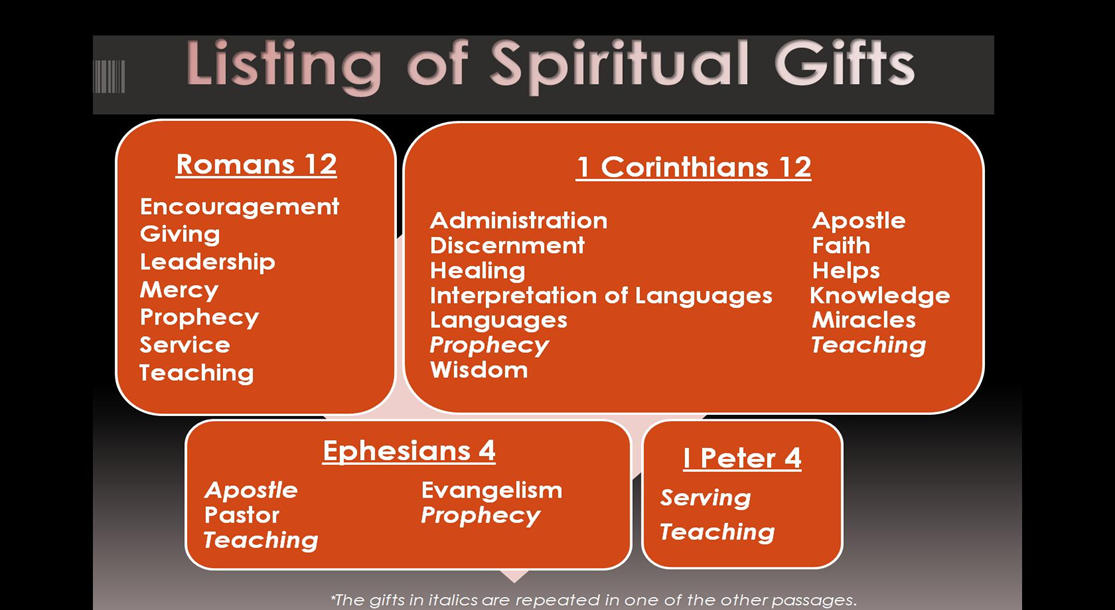
Concerning the spiritual gifts, not only are there more than we might remember, but our spiritual identity with respect to them is no stranger to God. For each person, there is a divine order with varying weights that often goes unknown or misunderstood in spiritual journeys. Accordingly, it is my belief that any faith-based institution should be keen on helping its participants discover their ‘loved by God’ identity through the gifts and then seeing how they can be at work…at work.
I like this graphic primarily due to its layout. While we don’t have time in this post to dive into all of them, I want to focus today on the seven gifts at the bottom of the screen, starting with the fivefold ministry gifts described in Ephesians 4: Apostles, Prophets, Evangelists, Pastors, and Teachers. These are leadership gifts given by Christ not just to the ordained ministers of the world but too all believers to equip the saints for ministry, build up the body of Christ, and foster unity and maturity in the faith.
As for the two in the bottom-right, these are grace gifts as defined in 1 Peter 4:10-11, service (deacon) and ‘teaching’ (elder) in an exhortation capacity, In this passage, Peter states how God has given every believer a spiritual gift to serve one another as good stewards of God’s grace, with the goal that all things glorify God through Christ. These gifts are not self-focused but are for the benefit and building up of the body at large with different gifts being empowered by the same Spirit and needing to be used with God’s strength for His glory.
Having said all this, here’s the ‘crashiest’ of courses you may ever receive on the seven leadership gifts and how they’re meant to function in the marketplace…
Prophets…call God’s people to God’s ways. They are more about developing the design of organizational mission, less about developing people. They ‘redeem’ an environment by expressing a wisdom that gives clarifies organization’s vision/mission for co-workers.
Evangelists…those who are gifted to reach unbelievers. They tend to be more gatherers with acts of service being their community gift. Evangelists are more concerned about developing the organization through developing people. They ‘redeem’ an environment by creating an inclusive team environment through love and acceptance.
Pastors…those who encourage believers with the spoken word. More concerned about developing people than managing systems. They ‘redeem’ their environment by creating joy through encouraging people on how important they are as people to the organization and by helping them see how their temperaments complement the organization.
Teachers…those who systematically make disciples and develop management systems. More concerned about preserving the organization. They ‘redeem’ their environment by raising team morale through breaking down systems into easy action steps and by helping them see how the systems help everyone reach their mutual goals.
Apostles…coordinate the other gifts and helps them work together. Leading and directing are their community gifts. They ‘redeem’ their environment by coordinating a team in a way that generates hope by maximizing each team member’s gift and designing products/projects that emphasize a redemptive gift of the organization.
Elders…those who impart themselves. More about managing people/Less about developing people. They are big picture minded in that that they see the value of systems, but they REALLY see the value of helping people find their places in the system. They are manager-developers who gravitate to systems but are motivated to help people find their seat on the bus.
Deacons…more about managing systems for the sake of people. They are motivated to implement proven systems that help people work together*. A deacon is part of the pastoral gift cluster, but in the workplace may not be in a direct support capacity but a ‘hidden’ support capacity. They ‘redeem’ their environment by creating an atmosphere of goodness and gratitude through giving and bringing order to the organizational environment.
*Note: A deacon’s gift is the broader concept of “serving others” through the use of whatever spiritual gifts one has received from God. This isn’t limited to a specific role, but encompasses a general ability to use God-given talents, like mercy, hospitality, administration, and giving, to serve the needs of the Christian community.
Recently, Kansas’ ‘Dust in the Wind’ came on my local oldies FM.
I close my eyes Only for a moment and the moment’s gone All my dreams Pass before my eyes with curiosity Dust in the win All they are is dust in the wind
Sounds depressing, right? Like a poor man’s romantic anthem to Ecclesiastes…
“‘Meaningless! Meaningless!’ says the Teacher. ‘Utterly meaningless! Everything is meaningless’” (Ecclesiastes 1:2).
Applied to our hopes and ambitions, these lyrics can seem maddening. What about my God given purpose? Is it void, useless, just a vain rat race underneath the cosmos?
Hardly! If anything, within these lyrics lies an affirming contrast, one that marks not only our earthly identity but vocational calling. To illustrate, let’s consider the difference between chaff and dust.
When exploring the reasons why we live, chances are we’re not considering the byproducts of grain processing. Still, the Word is clear our physical bodies were created from dust and will return as such (Genesis 3:19). With eternity in mind, we must accept the metaphor as core to our finiteness. While dust may seem unpleasant, by definition, it is a pure particle occasionally suspended in air but designed to settle whereas chaff is a scaly covering intended to be separated or burned. No wonder the Word often references chaff in the context of iniquity. For chaff to be purified, it must become a new creation. But with dust, it is already fine and capable of influencing everything from cloud formation to nutrient cycling.
Tying this to the surface, we find personal meaning. Although our bodies are fragile pillars, albeit with mind, heart, soul, and spirit, it’s still a sacred vessel created for finding rest and inspiring growth, even in times of displacement and turbulence. Kind of like, oh, I don’t know…dust!
Some of you reading this may be caught in chaotic currents or stuck in a false sense of worthlessness. You may feel as low as dust, easily swept away in the wind, not strong enough to stand in your own strength. But I challenge you, friends, to see the beauty in that. If all else, stand firm (Ephesians 6:13) and if you can’t stand, then settle in Jesus with every intention to rely on Him to carry you. You may feel like you’re passing away; however, rather than wade in insecurity, dare to consider where you’re passing away to.
‘Cause truth is: God can use you even if you feel like dust in the wind. He can use you to inspire vertical growth as you wisp for His glory. He can sustain you as you ignite precipitation to fall and become rivers of living water. He can strengthen you as you sow and position seeds in tough terrain to receive what they need to flourish. I could go on.
Just remember none of this is possible without the Creator and Sustainer of dust; hence, why Qoheleth prologues his book with ‘meaningless’, as life is without the answer and the reason of life. How sweet it is to know with His breath, He purified us from the ground so the ground would have no ultimate authority over our final destination. Yet, even as we come back to it in this life, we can fulfill God’s original design for our lives.
Cheers to being dust in the wind alongside you…
Selah…and remember, friends, be excellent to each other...
Scripture: Proverbs 24:16 – “For the righteous falls seven times and rises again, but the wicked stumble in times of calamity.”
Prelude: Recently, I was reminded of a late 2000s NBA commercial in which Dwyane Wade collapses to the parquet multiple times over the course of his career. After a montage of tumbles, a new series unfolds in which he rises from each fall before the screen goes to black…
Coincidently, this connects to a separate memory last decade. Remember the 2017 NAACP Image Awards when Denzel Washington delivered one of his most iconic speeches?
“Fall down seven times, stand up eight.”
…still gives me chills to this day.
Understandably, many cite this line as a Japanese proverb with a credit to celebrity enlightenment; however, in reality, its true source is the Word of God; hence, this SOAP Bible study in which we will dissect the contrast in greater detail.
As always, let’s dive in…
Observations: In a vacuum, this verse compares the resilience of the righteous to the cowardice of the wicked. Both sides face setbacks and challenges, but only one perseveres through them. While some assume this verse suggests adversity comes to the unwise, the reality is that calamity finds all of us at one point or another. The key is how we respond and endure the way God intended.
As mentioned in a recent post, even good people fail sometimes, especially as they face new challenges and situations beyond their ability to handle. Humility applied, we must understand these circumstances are not the product of poor character, but a part of God’s plan to develop it. In what we say and do, are we willing to rely on God’s guidance in the fullness of faith and integrity? If not, we will inevitably succumb to stubbornness and disbelief as the trials undo us.
Symbolically, the number seven is used here to emphasize completion and perfection, as God’s grace empowers the righteous to suffer through their failures. Granted, man, in his finiteness, may be ‘one and done’ on certain matters; however, since God sees the entire picture, we can trust that in HIs faithfulness, He will give us multiple opportunities to clear our hurdles. How sweet it is knowing we can live from victory as we wrestle with and for God!
Following v. 16, we find a subsequent call in v. 17-18:
“Do not rejoice when your enemy falls and let not your heart be glad when he stumbles, lest the Lord see it and be displeased, and turn away his anger from him.”
As people redeemed by faith through the Cross, this charge cannot be understated. While our flesh may snicker at karma and the kind of justice that enhances our ego, we must never rejoice when others fall and can’t get up. If anything, we should intercede and consider our options to help. Even if we can’t directly intervene, we can pray for a person whose peace is in peril and build a broken brother up from a place of boundary.
Applications: Although chaos and conflict are unavoidable in this life, God is the one true constant through it all. When tough times come, we can rest knowing there’s a vertical response with our name on it. To those feeling God is leading you through a desert or wilderness right now, remember how God used Joseph in the Old Testament (Genesis 39) and Paul in the New Testament (2 Corinthians 1:8-10). You may feel lost in the hole or bind you’re currently in, but this could be part of a grander setup in which God is equipping your heart to reach a promise and purpose He has ordained for you.
Bottom line: God never fails and has the power to restore our confidence and redeem our failures. Although setbacks will come, as long as we fix our eyes on Jesus and follow His lead one step at a time, God will not only forgive us but also bring us to completion according to His Word (Philippians 1:6). Why not let Him be the fall back you crave when all hope seems lost?
Prayer:
“God, we turn and align to you in this moment. We thank you for being a merciful, faithful God in whom we can trust. Father, as I write this, I think about those in dry valleys, surrounded by bones, needing a spark. As men and women fallen in sin, we confess our need for a Savior, who through His strength and sovereignty, provides the tools and opportunities necessary to rise above the obstacles of life. For those wresting in guilt and shame, for those who feel defeated for not having passed a specific test, we speak peace, grace, truth, and love to their hearts and minds today. May they find you in the wake of their desperation, for others, in the midst of their course-correcting. In our frailty, we admit our limited perspective, our tendency to get way ahead or woefully behind you. Though the ways to faith derailment are many, we choose to lean on your understanding, to follow the prompting of your Holy Spirit, and to press into you with all that is within us. Bless your holy name. Come alive within us. Help us not to give up and give in but as Psalm 57:1 says, lead us from failure’s shadow in and under the shadow of your wings. Amen.“