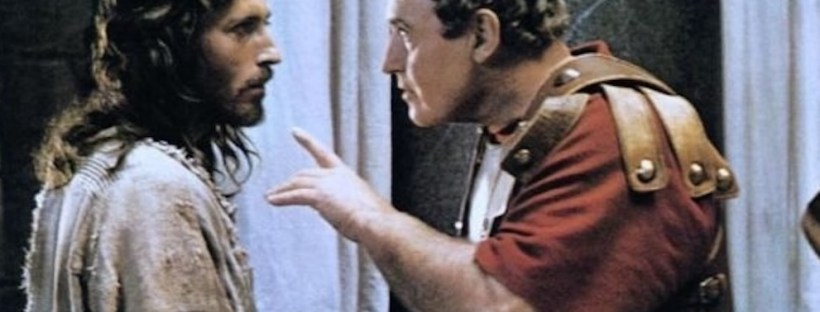
Auto Pilate: A Procurator in a Plane Crazy Situation

Imagine being Pontius Pilate. A man of high esteem among the Romans but despised by the people of Israel. A leader marked by confidence and chaos, peace and provocations. An ambassador puppet to a foreign land where conflict comes with the territory, where everything you stand for promotes a visceral, divisive reaction. 

For a while, things are status quo with the occasional shaking here and there. But then, without warning, in walks a king, the Son of God, a man whose very name was questioned, whose presence would foreshadow the greatest kingdom collapses in history. Who could have known outside the divine? How epic a decision, how dramatic the plate in your lap? 

Yet, that’s exactly what you have in John 18-19, a chapter duo ridden with deep denial, betrayal, and surprise confessions. 

For many, the chapters read as a prelude to the greatest account of eternal measure, and rightfully so; however, what if I told you the books are more than just a literary overture? What if I told you the exchange between Pilate and Jesus would preview the kind of perspective and contrast we dare embrace today? Where naivety begets a redemptive recognition of truth. Would your mind not be changed or at least freshened to reconsider? 

Either way, my curiosity is compelled to Pilate and his part in the resurrection narrative. As always, let’s drill down and dive in…

In the first half of John 18, the Sanhedrin, a council of priestly and lay elders, arrests Jesus during the Jewish festival of Passover, threatened by his teachings and kingdom assertions. After Annas and Caiaphas determine Jesus guilty of blasphemy, he’s brought before Pontius Pilate for judgment in v. 28. At the time, Jewish law prohibited killing one of their own. With Pilate being the only one with power to impose a death sentence, the elders pressure him to crucify Jesus. Amidst the commotion, Peter denies Jesus three times before the rooster’s crow as was foretold. 

Seeking to understand the danger behind Jesus’ condemnation, Pilate probes his origin and lordship, stepping in and out of his governor’s headquarters to appease the council. After Pilate asks, “Are you King of the Jews”, Jesus answers, “You say that I am a king. For this purpose, I was born and for this purpose I have come into the world—to bear witness to the truth. Everyone who is of the truth listens to my voice.” Hearing more than he likely anticipated, Pilate poses a fair follow-up, “What is truth?

While a response isn’t recorded, Pilate’s initial verdict is clear. Without criminal proof, Pilate declares Christ’s Innocence to the Sanhedrin: “I find no guilt in him” (v. 38) and encourages his release again before being met with resistance. Stuck in a stall pattern, Pilate orders Jesus to be flogged and beaten, hoping to satisfy the elders. After applying a crown of thorns into Jesus’ head, the soldiers bring him back to Pilate where again, he proclaims Christ’s blamelessness: “Take him yourselves and crucify him, for I find no guilt in him.” Desperate for control, the elders double-down and ‘double-mind’ their earlier statement (18:31): “We have a law, and according to that law he ought to die because he has made himself the Son of God.” Fearful of a riot, Pilate makes one last attempt to gain clarity from Jesus in a classic ‘help me help you’ moment. 

Starting in John 19:9: “He entered his headquarters again and said to Jesus, “Where are you from?” But Jesus gave him no answer. So, Pilate said to him, ‘You will not speak to me? Do you not know that I have authority to release you and authority to crucify you?’ Jesus answered him, ‘You would have no authority over me at all unless it had been given you from above. Therefore, he who delivered me over to you has the greater sin.’ From then on Pilate sought to release him, but the Jews cried out, ‘If you release this man, you are not Caesar’s friend. Everyone who makes himself a king opposes Caesar.” So, when Pilate heard these words, he brought Jesus out and sat down on the judgment seat at a place called The Stone Pavement, and in Aramaic Gabbatha. Now it was the day of Preparation of the Passover. It was about the sixth hour. He said to the Jews, “Behold your King!

In re-examining this passage, several insights stand out. For starters, the irony of these chapters is largely filtered through its symmetry and the awkwardness of Pilate’s position. The in-and-out of governor’s headquarters, the tug-of-war wavering between two parties keen on not defiling themselves, the contrast between Peter, a disciple, denying Jesus three times and Pilate, an alien, edifying His nature three times. The content and its layout is undoubtedly rich.

But to me, what resonates the most is how this piece of the narrative ends. Say what you want about Pilate’s predicament and decision-making. When we connect the dots within this exchange, we see nothing but truth (and truth seeking) from one who could relate to being despised by Jews, who communicated from authority to authority, who defended the guiltlessness of what he couldn’t understand even when it stood before him.

Make no mistake: Pilate isn’t a hero in the Passion narrative given his indecisive moments and people-pleasing tendencies; however, he is a worthy case study in the sense he sought to circumvent envy and relate to Christ’s innocence not only from what he boldly promulgated but his washing of hands post-sentence (Matthew 27:24). In essence, Pilate was given a tight-rope over shaky ground yet still pursued due diligence to free a righteous man hell-bent on freeing the world from sin. At the very least, we owe Pilate some props in pursuing truth. After all, if we want to point people to Jesus, we must be willing to discover who He is and from there, allow ourselves to be convinced He is set apart as our Messiah.

As for all of us this Easter season, I submit we re-receive the truth about our identity in light of the Cross. For Pilate, he made every attempt to be made innocent of Christ’s blood. But thanks to God’s master plan and Jesus’ sacrifice, we can walk in innocence because of Christ’s blood. No need to wash our hands as long we intend to wash others’ feet. Forward and onward. It’s all up front from here. 

Selah.  Ecce homo. 

Photo creds: pshir.com

Simon Says: The Realigned Passion of the Zealot

I’m sitting in a Wendy’s watching Jesus of Nazareth (1977) for the 24th straight spring. My car just down the street getting that Midas touch, not exactly how I envisioned my Saturday afternoon when the day started. However, I have a laptop. I’m submerged in holy content. I have what I need to preserve a meaningful tradition. Let the Holy Saturday illuminations begin…

As some of you know, each year, I pick an obscure part of the Resurrection narrative to dissect, some closer to the Cross than others. This year, I want to discuss the Zealot component, specifically the contrast between Simon and Judas who prior to Jesus’ condemnation, wrestle with their idea of Jesus’ Messiahship.

While not much is said directly regarding Simon, we can deduce a few truths about his upbringing:

  • He was saturated in extremist notions and conditioned by a pack hell-bent on retaliation and reciprocity,
  • He heard the teachings of Jesus and was inspired to lay down the cause of vengeance against the Romans.
  • He became a disciple after realizing change would come internally, not externally.

The Bible also notes Simon’s whereabouts (Matthew 10:4; Mark 3:18; Luke 6:15, Acts 1:13), proving he, like the other disciples not named Judas, was anointed and appointed to spread the gospel and lay down church foundation in the process. Essentially, the Romans Road in the midst of Roman oppression was more than a pathway for Simon but also a revelation of God’s Kingdom being encountered through repentance as opposed to force. While implied, Simon’s willingness to let go of the past as well as toxic relationships and attached paradigms, models the type of practical sacrifice we must sometimes make to advance the influence and ways of God.

As for Judas, we find a stronger stubbornness in releasing ambitions and presumptions. Blessed with a scholarly mind, the ‘wisdom’ of Judas was more based in rationale and divine proximity than faith and intent to surrender. Blinded by grandiose expectations and Satan alike, Judas seldom operated outside of agenda during His time with Jesus; hence, why Judas never repented when remorseful as unlike Simon, the lifeblood of Jesus’ message never sunk in. Granted, for Jesus’ mission to be realized, he needed to be condemned and crucified first, which couldn’t have happened without a mole, a son of perdition (John 17:12) as prophesied in Zechariah. A scapegoat setting up the sacrificial Lamb, one can only imagine what would have happened to Judas had he held out a little longer and received grace in Peter-esque fashion.

Either way, while Judas’ fate was sealed by his transgressions and refusal to repent, there’s a peace to derive from his part in Gospel history. For all have fallen short of the glory of God and have been blinded by the enemy within the context of sovereignty. Yet, even in the midst of high-level rebellion and disobedience, God’s purposes cannot and will not be thwarted. While Judas’ demise is a cautionary tale, we can humbly relate to his shortcomings, knowing there have been times in our own lives we have wanted God to manifest on our own terms. If any of you reading this have ever craved freedom in a way that made sense, remember the joy of the Cross set before you. Show compassion. Receive forgiveness, Carry on.

As for the rest of us, may we marvel at Christ’s exhibition of rightly aligned passion and change course in the direction of Jesus courtesy of Simon’s example. Before kingdoms change, the hearts of men must change (Isaiah 32:1-5) and in this era of chaos and uncertainty, let’s appreciate how the prophecies of old eclipsed by the Cross still have resounding relevance today.

Selah.

Cover photo creds: Baptist News Global

Fragile Rock: The Denial & Restoration of Peter

Inspired by Matthew 26:31-35, Matthew 26:69-75; Luke 22:31-34...

Imagine being Peter.

The most on-the-sleeve, off-the-cuff disciple. Ahead of his time, ahead of the curve.

You’ve perceived your Master with truth from the Father. Flesh hasn’t revealed it as you have concealed it.

Yet, as you sense His final approach, old habits kick in, you sink past reproach. You want to believe but can’t receive. You want to take part but can’t depart…this idea of loss. How can you take heart?

Though loyal to faults, you are rash in your state. A love for God’s Son meets enemy’s bait.

  • So you ‘buse your devotion pledging death prematurely.
  • You say you won’t stumble though records say contrary.
  • And abuse the blade though you once heard so clearly…I’ve not come to bring peace but a sword.

Stubborn as always, you’re one step behind now, a faith not yet ripe but not far from fruit. Your prayers lack direction though brim with affection. You want to be ready but still lack the steady. Whatever, you’re still holding on.

Imagine being Peter.

Called out by Jesus after vowing your allegiance. Exposed as a shape-shifter, weak as wheat, a coward. You think you are tested but the real test awaits.

While there’s no way to scale the weight of the moment, that bittersweet sting still rings in your ear.

For before He said, ‘Peter, the rooster will crow...’ (v. 34), He said, ‘But I’ve prayed for your faith to still grow‘ (v. 32). And not fail in turn amidst the great smothers. In time you will turn and strengthen your brothers.

And so you proceed to keep tracking and cracking. Heck, you tread water, but still much is lacking. Always bold, always proud, with cling lost in the shroud. Again, that is you, who you will be and then some. After all, who could fathom the darkness to come?

Whatever, you got this. no innocence to preserve. You’ll keep following the Master to whom you still serve. Your forward march, a prophecy unfolding in face, one woman, two men confirming disgrace.

You hear the crow and now you know. Jesus was right; there’s no need to fight.

And so, you’re still holding on.

Imagine being Peter.

Even before the Cross, Jesus was bearing your shame. Why else would He preview your restoration pre-sin? Your call to help others with grief still within?

I tell you why: ‘Cause He knows and He gets you! Your passion’s now fearless, a part of what’s new. Not to mention a prompt to process ahead and heal in front of the others in stead.

Or perhaps I should say it this way: Days from now, when most are still down, you’ll be on the rise with Him, back in stride with Him. From whom are still scattered with tears still bitter, your calling is now, your emotions are fitter. Once slow to conceive it, now quick to receive it. Your chance to eat crow, to make fishers soon after, will sharpen the sheep you tend well thereafter.

Fallen down once, your faith has not failed. ‘Tis why Jesus took it with hands and feet nailed.

Selah.

Cover photo creds: Redeeming God

Master Messiah: The Final Lessons of Jesus

When we reflect on the Easter story, we often dwell on the Cross and its aftermath. We consider Jesus’ final moments, the empty tomb, and the ascension sealing the end of Jesus’ first coming. 

However, while Jesus’ death and resurrection is the greatest climax the world has ever known, one must not forget the lead-up to Jesus’ conviction and crucifixion. True, He took the nails for our transgressions, paid our ransom in blood, and secured our freedom with the keys from hell. But He also offered some crucial reminders on how we’re to press into the Father during life’s greatest trials…when we feel betrayed, abandoned, even abused. 

Accordingly, as we prepare for the ultimate remembrance, may we heed and receive these final lessons of Jesus…our Master Messiah.

  1. How to Overcome Verbal Abuse

For those familiar with the Gospel culmination, we know Jesus was accused, mocked, and beaten before dying a criminal’s death ahead of His vindication. Yet, what’s sometimes lost in translation is the verbal nature of Christ’s abuse. While Jesus was accustomed to being misunderstood from ministry origins to His triumphal entry, the assault taken as He carried the cross is worth noting.

First, imagine bleeding to death, muscles exposed, your beard ripped out, a scarlet robe dangling from reclotting wounds, all the while carrying a 100-lb wooden crossbeam two miles to your execution site. Then, ponder the compounding pain of venomous falsehoods cracking your spirits simultaneously. I don’t know about you, but words and modern-day recreations can only go so far though this scene is a valiant effort…

Although Jesus had cultivated a lifelong habit of not taking offense, who knows what thoughts and temptations crossed His mind at this juncture. After all, it’s one thing to be mistaken as you’re praised; it’s another to be scorned as you’re dying. Still, even with the weight of the Cross on His shoulders, the Cross was still before Him. Despite the brutal slew of ridicule, Jesus, with fading strength, knew these people not only represented the very thing He came to die for but also what future generations would continue to do. 

Think about it: What we do in secret and subdued fashion tacks on to this moment. In times of misjudgments, we react out of confusion and anger, subconsciously doubting Jesus is who He says He is. From there, we take matters into our own hands and curse our troubles as if the victory on Calvary never happened. Granted, I know an insult to fallenness before us is different than a personal attack; however, I suppose the relatability from present to past is what grips me – the idea we, though millenniums apart, played a part in Jesus’ death, the future weight of our sins notwithstanding.

Like those who cast their slights on the first Good Friday, we, too, must confess the times we’ve a) failed to identify our Lord as Savior amidst our struggles and b) undermined His authority by not taking captive what He took captive 2,000 years ago. 

Of course, given we’ve been forgiveness and restored, why not learn from Jesus by turning the other cheek when we’re derided and declaring His sovereignty during suffering?

For when the world interrogates our faith wondering if we truly believe Jesus is the Son of God who died for our deliverance, our life should speak with or without the words.

Even though we can’t control what others say, we can love by an unwavering stand to deflect offense Luke 23:34-style while stilling ourselves to pray…

Bottom line: Jesus was cursed but not crushed in the face of verbal abuse. While we, like Peter, may occasionally renounce Jesus in word or in thought, this doesn’t mean we can’t stand firm amidst verbal onslaughts. As long as we know what we wrestle with is not a matter of flesh and blood (Ephesians 6:12), we can invite God into the calibration of our emotions.

2. How to Pray Amidst Anxiety

Between The Last Supper and Jesus’ arrest, we note Jesus goes to Gethsemane for one last communion with the Father, a time during which He asks God not once, but twice for the cup of His wrath be removed. Anxious to the point of hematohidrosis, He cries out in desperation longing for God’s nearness and an assurance of His will. If there was any possibility of an audible, now was the time to reveal it. 

Yet, even in anguish, a lamb among wolves, Jesus stood firm modeling one last lesson to the disciples before His betrayal. We see this in Matthew 26:36 when Jesus asks His followers to sit and watch as opposed to incorporating them in group prayer. No question, Jesus needed the vertical one-on-one under the circumstances, but this didn’t mean He was cavalier concerning what the 12 would witness. Hence, why Jesus’ charge matures from ‘sit and watch’ (v. 38) to ‘watch and pray’ (v. 41) in a final effort to encourage them. Specifically…

Just because I’m not physically with you doesn’t mean you can’t participate with me. The spirit is willing, the flesh is weak…but fear and faint not. For I long to take comfort with you as the Comforter preps His homecoming. Until then, join in, stay with me, and keep watch though my enemies are lurking, though evil abounds. Taste and see one last time:

You don’t have to be overcome because I have overcome the world (John 16:33). 

Bottom line: Although Jesus was in great despair, He used this emotion to steer Him into the Father, showcasing the epitome of reliance in the process.

3. How To Let God Go Before

Following Jesus’ death and descent into hell, we note an almost anticlimactic return to start Matthew 28. Rereading v. 3, one would think the description of the angels would have been assigned to Jesus as part of a grander entrance; however, just like His triumphal entry, we find Jesus applying the symmetry in v. 7. As the angels tell the Mary’s…

 “…go quickly and tell His disciples that he has risen from the dead, and behold, He is going before you

Now, I know this may seem like a random pivot point but just let that bold phrase sink in a little. During the final days of Jesus, His life message to His followers, in part, was a progression of hope:

For a short time, I was with you, then I went before you to seal the greatest act of love the world has ever seen. And now, I am back going before you one last time before taking my place on the right side of the Father so like Him, like my Spirit, I can be among you. 

So, it’s interesting as much play we give to Christ’s sacrifice and redemption, the education never stopped. Until the end of His human tenure, Jesus was steadfast to reinforce our corporate calling:

  1. To love one another as a people covered in grace, secured in freedom, and strengthened by faith.
  2. To inspire our unity and resolve to know He who is in us is greater than he who is in the world. 

To the Mary’s, the disciples, and future generations to come…this is why He came back. To make sure we, scattered as we might be, could understand the truth – that as we go tell it on the mountain, the streets, at work, even the most hostile environments, as Christ is in us, God is with us, as in heaven…so on earth.

Bottom line: While Christ’s death allowed Him to take the keys to the Kingdom, it also served as a reminder to generations of believers to come: Since I have overcome the world, I can be with you and among you simultaneously. That is why I, as your forerunner (Hebrews 6:20), will never stop going before you as you learn to teach my ways to the ends of earth…to the ends of time. 

Selah. 

Cover photo creds: Pinterest

Rock of Rages: Why Peter’s Denial Was a Necessary Trial

Passage: Mark 14:26-31 (ESV); Mark 14:66-72 (ESV)

Jesus Foretells Peter’s Denial

26 And when they had sung a hymn, they went out to the Mount of Olives. 27 And Jesus said to them, “You will all fall away, for it is written, ‘I will strike the shepherd, and the sheep will be scattered.’ 28 But after I am raised up, I will go before you to Galilee.” 29 Peter said to him, “Even though they all fall away, I will not.” 30 And Jesus said to him, “Truly, I tell you, this very night, before the rooster crows twice, you will deny me three times.” 31 But he said emphatically, “If I must die with you, I will not deny you.” And they all said the same.

Peter Denies Jesus

66 And as Peter was below in the courtyard, one of the servant girls of the high priest came, 67 and seeing Peter warming himself, she looked at him and said, “You also were with the Nazarene, Jesus.” 68 But he denied it, saying, “I neither know nor understand what you mean.” And he went out into the gateway and the rooster crowed.69 And the servant girl saw him and began again to say to the bystanders, “This man is one of them.” 70 But again he denied it. And after a little while the bystanders again said to Peter, “Certainly you are one of them, for you are a Galilean.” 71 But he began to invoke a curse on himself and to swear, “I do not know this man of whom you speak.” 72 And immediately the rooster crowed a second time. And Peter remembered how Jesus had said to him, “Before the rooster crows twice, you will deny me three times.” And he broke down and wept.

It’s a hard scene to process.

Peter. The Rock. Cracking under pressure.

The Cross set before His Master, a sliver in the back of his mind.

Never would he fall astray; never would he run away. That was Peter. Or rather that was going to be Peter.

But before the Shepherd could be battered, the sheep of the flock would soon be scattered. And it’s here where despite our cringes, we must appreciate this sequence: The ultimate Shepherd grooming his undershepherd through a defining moment of weakness. A prophecy centuries in the making (Zechariah 7:13) now an emerging hallmark of humility for the early church to thrive on. The man in the middle?

The Rock. The epitome of moniker though something far greater. You see, ‘The Rock’ was not just a designated nickname but the proof of Christ’s identity realized. One could say the greatest insight received by man came in Mark 8:29 when Peter, the Rock, confessed Jesus as cornerstone – the Son of the Living God.

Still, as keen as this inspiration was, the symmetry of it could not have occurred without an epic fail. For before Peter could sleep on his call to keep active watch at Gethsemane, he had to first confront and fall to a fear of abandonment. Without this fear, Peter’s resolve could not have been tested – a paradox considering a less distracted Peter would have meant more fervent prayer during Jesus’ final hours.

Granted, that’s the beauty of Jesus’ perfect love in this passage. For Jesus knew a humbling of Peter ahead of His death was necessary to calibrate his boasting to the power he’d rightfully appropriated. No matter how much Peter confessed his devotion, he had to first wrestle with the fragility of his hope before he could shepherd a flock with a more mature version. How incredible it is to consider Jesus, the weight of the world on His shoulders, was working all this for good before the good could be known and shared.

As for us, no matter how long we’ve walked with God, we’ve all denied Jesus at one point or another. And while we have the Holy Spirit to act as our rooster in those times, let’s not take for granted the ministry of reconciliation in those instances. The sting of sin may prick our hearts but in a way that’s why Jesus came to die in the first place: To not only liberate us from captivity but awaken and sharpen us to higher faith.

Accordingly, as we enter into God’s gates with thanksgiving this Easter weekend, may our denials become trials intended for glory. You may feel discouraged about your shortcomings, but this doesn’t mean you have to bask in them. Rather repent, receive God’s grace afresh and anew, and feed His sheep. After all, Christ didn’t take the nails to deliver us from disappointment but to free us into intimacy through the growing pains of life.

Selah.

Cover photo creds: Christianity.com