Purifying our Priorities (Part 1)

Well, folks…it’s that time of year again.

  • HR Block is heating up its campaign…
  • Companies are sending out their W-2/1099’s…
  • TV’s are going on sale’
  • …and New Year resolutions are officially underway2.

After all, ’tis the season to be better, right? To start afresh and anew…and to grab change by the horns…

But perhaps you’re like me in the sense you wonder how many really know how to do this…or maybe you’re hesitant…afraid of prematurely falling off the resolution bandwagon.

Whatever the case, it’s important we get real about the type of world we live in. ‘Cause when we take a good, hard look into the deep, dark crevices of our culture, we find we’ve grown too content taking matters into our own hands…yet too passive in carrying them out…

6a00e54ee25646883301a73de1e5f9970d

…a paradoxical attribute of a society that constantly suggests having a heartfelt desire is “good enough”.

Not that “heartfelt desires” are bad; by all means, we were created to have them.

I’m just saying if we truly want to reach the next level (in any phase of life), it doesn’t make sense to be self-reliant, given the human tendency to fall short and mishandle change. Conversely, if we want to see growth become a permanent reality in our life, we not only have to accept the existence of a higher alternative, but we must be willing to depend on it as a supreme solution that exists (and only exists) in God Himself.

All that said… How do we turn our heartfelt desires, the seeds God’s plants within us, into lasting realities? How do we change from the inside out in a way that takes deep root within?

Before we can answer these questions with a customized five-point self-improvement series3, I submit we must first be willing to purify our priorities…

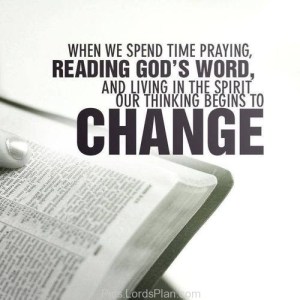
…which can only happen when we become intentional in spending time with God.

But first..what exactly is a “priority”?

According to the Random House Websters Dictionary...

  • priority is “something that’s regarded as more important…a right to precede above in rank, privilege, etc. …
  • …and “to prioritize” is a process by which we arrange, particularly in order of importance, relevance, value, etc.

Thus, when we consider what a priority is…and apply it to morality…our faith, we ultimately discover the importance of recognizing God’s priorities for our life.

Take Philippians 1, for instance, where in verses 9-10, Paul prays for the Philippians’ love to abound all the more so they could better discern and approve the things that are excellent4.

Essentially, Paul is saying: if you’re feeling overcommitted, overloaded, overwhelmed…if you’re mired in apathy, confusion, striving…or simply trying to decide what is best, what’s best for your spiritual well-being…and those around you…the answer is simple: love at all costs!
when-we-start-spending-time-with-god-178
‘Cause at the end of the day, we all need Jesus in the middle of our everything…not only so we can conquer the burdens of life…but so we can love better in every circumstance (hence Paul’s use of the word “abound”).

My thought is: let’s be unified in seeking first the Kingdom (Matthew 6:33) together…in being fervent in loving one another (1 Peter 4:8; Colossians 3:14)…so we may…

  • Better identify what’s most important in our own life…
  • Better concentrate on the relationships God has called us to…
  • Be quicker in our humble obedience…
  • Be more available to God, our family, those God has called us to be around…
  • Use time more effectively, including family and ministry time (and not sacrificing one for the other)…

…all the while being Spirit-led everywhere in between.

Stay tuned next time for “part 2” of this series, where I’ll discuss a couple practical pointers on how we can better engage God in our midst and live transformationally in 2016.

Footnotes

1) In prep for the Super Bowl

2) Take a good, hard look at gym attendance…and you’ll see what I mean

3) Granted, this is a popular trend this time of year

4) I don’t know about you, but I love this association, specifically how Paul links “the greatest gift of all” (i.e. “love”) to our call to judge righteously.

Photo creds: lightwork.typepad.com, quotesgram.com, indy.shine.fm

Year in Review: A Look Back at 2015

As 2015 comes to a close, Lyssah & I sit down and reflect on the year that was…

When you think back on 2015, what immediately comes to mind?

CF: Honestly, I’d have to say the view from our Amicalola Falls State Park lodge luncheon (see 1:22 in our ‘Year in Review’ video below). Talk about a stunning scene and a frameable moment all wrapped into one! But you know…the more I think about it, that breathtaking visual really captures our journey through 2015. ‘Cause though there were many ups and downs and plenty of action going on…there was still much to behold.

LF: I agree. There was lots of BIG change. 2015 has really felt like a runway preparing us for a new season we can’t even begin to fathom.

What were some of the highlights/defining moments?

CF: Without question, the highlight of the year for me was the pregnancy reveal at Logan’s. I mean…you can’t top that. As far as “runner ups” go, I’d say the Dave Ramsey Christmas party, our icy adventures in February, the Messenger Fellowship ordination ceremony, the day we found Selah, our gender reveal, both Georgia trips…and watching LEGACYouth reach yet another level in its growth as a ministry. So even though we didn’t get away as much this year, there were still many highlights to go around.

LF: Yeah, our “family growing” was an obvious highlight…from adopting little Selah to building baby. The funny thing is…I didn’t expect them to happen so close to each other, but nevertheless it has been wonderful. Being given a car…that was incredible. So much this year has just shouted out God’s faithfulness in huge ways. Losing my grandfather was also a defining moment.

Screen Shot 2016-01-02 at 7.46.27 PM
How would you compare the third year of marriage to the first two?

CF: Despite a more amplified year, I’d say our junior camp again of marriage was [far and away] the best yet. We know each other more intimately. We’re more demonstrative in our appreciation for each other. Plus, we’re more confident and secure in who we are as individuals and as a couple. No doubt, God tightened up our relationship and shone through our unity along the way.

LF: Wow! Has it been three years already? I think this year has been full of greater synergy and working together. Year one was about two individuals becoming one. Year two was about figuring out dreams and visions and shared goals. Year three has really been about starting to work towards those things together. Cam has had to carry a lot of that while I’ve been baking a baby, but it has still been awesome to build towards those goals and dreams together.

What lesson from 2015 are you eager to apply in 2016?
CF: For me, seeing the connection between Jehovah-Sabaoth (God our protector) and Jehovah-Jireh (God our provider…who knows what we need exactly when we need it) has been an incredible experience this year.

Looking back, there were a couple close calls/near-opportunities where we could have transitioned into [our idea of] a better place, but thankfully, the Lord protected us and kept us from getting ahead of His plan; however, there were also times when God totally blew us away with an unexpected (and very timely) gift (*Cough, new van, cough*).

So I’d have to say: watching God’s providence work in both the open and closed-door moments of life has been a highlight this year.

LF: God is faithful. He is enough. I don’t need to wait until it’s the last option to remember that.

My circumstances are not bigger than my God. If I am going through it, it is subject to Him and the more I press in to him during the circumstance, the more profitable it will be going through it.

I am stronger than I think and I don’t need to have that validated by anyone other than my God. He has written and wired me for the things I encounter, whether or not others see it right away.

It’s better to try and miss than fear and never try.

What do you hope you’ll be saying at this time next year?

CF: Lyssah, we’re home.”…”Happy Birthday, CJ!“…”Say, ‘Daddy’, CJ!“…

Seriously, the possibilities are endless.

Oh…and it’d be awesome for 2016 to be the year we finally do our debt-free scream. Eh, Lyssah?

LF: “We’re debt free!” (Probably not this time next year, but I can certainly hope).

Also…”Have you read my husband’s book?” or “I have a book deal!”

Better yet…”What a peaceful first Christmas for baby.”

—————————————————————————————————————————————–

—————————————————————————————————————————————–

2015 – By the Numbers

  • 7 – Pounds lost
  • 450.63 – Miles run
  • 375.76 – Miles walked during work hours
  • Estimated miles driven: 18, 457
  • Deep Fry blog posts: 41
  • His Girl Fryday blog posts: 24
  • Snowchased Snow Amounts: 18.2″

—————————————————————————————————————————————–

Photo credits: http://amicalolafallslodge.com

The Bent of the Tent-Maker

By: Jan Ferguson

Bi-vocational ministry. If you’re like me, some days I wonder what that really means. Okay, so down the definition rabbit hole we go… Bi-vocational ministry (I’m calling it bi-vo for short) is an interesting term. It literally means two vocations.

What does vocation mean? According to http://www.merriam-webster.com, the main meaning is: a strong desire to spend your life doing a certain kind of work. Other meanings suggest, anything you do for a job, entry into the priesthood, or a calling.

Now, most people don’t want two job let alone, two full time jobs. So, why do we do it? What drives the bi-vo minister? By day, mild mannered administrative assistant/house painter/substitute teacher/ etc. but nights and weekends, Super Pastor! Downloading countdown videos at the speed of, well high speed internet. Able to make three hospital calls in one evening – at different hospitals. Powerfully peppering social media with quotes, scriptures, prayers and invites. Finally crashing sometime after midnight only to get up early to do it all the next day, and the next. So, I ask again, why do we do it?

I believe we do it, because we love God and we are willing to lay down our lives for Him and the sake of the gospel. We are driven by the gifts and callings God has placed in our lives. Hopefully, we are driven by obedience to Jesus and the desire to see people saved and set free. But are all bi-vo ministers alike?

As I see it, there are two kinds of bi-vo ministers and those I know fall into one of two groups:

  • Tent makers who minister
  • Ministers who make tents

Note: If you’re wondering where on earth I came up with the tent maker occupation, it’s an homage to the apostle Paul, whose trade was tent making.

A tent maker (fill in the blank with the career/job of your choice) is driven by a career vocation. Based on the definition above, it can be the thing you wanted to spend your life doing. But tentmakers may also be a youth pastor, worship leader, pastor’s wife, etc. I know a pastor’s wife that considers nursing her vocation. She teaches Bible study and helps lead the church, but she is an example of a tent maker who serves as a minister. She doesn’t actually dream of dropping the nursing gig to do ministry full time. God has strategically placed her in the marketplace as her primary service. She is passionate about the word and the church and she uses her gifts and talents in the church. But nursing… that’s the thing that floats her boat.

A minister who makes tents (fill in the blank with the job you do) has a different bent. Often, this is the person whose heart and passion are solely for the work of the ministry. They would drop the day job in a heartbeat, but God has called him/her to a church or ministry that cannot support him/her at this time. This pastor/evangelist/worship leader/church secretary/etc. works a job outside the ministry to pay the bills. But – their thoughts are consumed with ministry – sermon/Bible study prep, the people they serve, updating the church website, and the like.

With this in mind, our motivation may be similar, but the challenges we face may be very different. Next time we’ll look at the challenges and roadblocks encountered by the minister who makes tents.

Photo creds: amazon.com

5 Ways to Conquer Sermon Prep Stress

Sermon prep for the bivocational pastor can be a challenging issue. From selecting the right topic to developing ideas in the midst of unrelated work, crafting a sermon requires forward thinking and resolute diligence. Whether you’re a novice bivocational pastor or a seasoned veteran, here are some ways I’ve learned to conquer sermon prep stress.

  1. Pray at all costs

It’s been said no man is greater than his prayer life. Considering prayer, quiet time, and sermon prep are mutually inclusive, one could also deduce how no pastor is greater than his sermon prep. Of course, ideas come and go and the needs of people change; however, the one thing that must never waver is the commitment to pray (for revelation, the people of your congregation, etc.) at all costs. preachingpyramid-1024x777

To put it another way, the foundation of any teaching must always begin with prayer since it allows God to be the driver as opposed to our own finitude. So whether you’re discouraged or simply have sermon writer’s block, pray through the grind and position yourself for illumination by carving out closet time between you and God. Oh, and while you’re at is, don’t forget to bring a note/iPad so you can jot down what God tells you for future reference (which reminds me…go see “War Room” when you have the chance; such a powerful film…you won’t regret it) .

  1. Look ahead

I’m a fan of living in the now; however, with sermon prep, looking ahead isn’t just a good idea; it’s absolutely necessary. For instance, there are times when God will unveil a sermon series to you, as opposed to a stopgap message. When this happens, there are two appropriate responses: 1) rejoicing and 2) projecting (i.e. looking ahead). Not to suggest a la carte messages are inferior; I’m just saying when you’re given a sermon series, it’s critical to a) let the Word/assignment marinate in your spirit so it can be processed and b) look ahead so it can be divvied up systematically.

  1. Take advantage of breaks

At my job, there are two types of seasons: busy seasons and “less busy” seasons. During “less busy” seasons, my workload will occasionally stall to the point I’m able to reference my youth pastor worklist (or my wife 😉 and chisel it down so I can direct my focus on other things (like this blog).

Granted, productivity can still happen during busy seasons; it just means anticipation must be met with greater intentionality. Case in point: during year-end closeout season (one of the busiest for accountants), I know at the very least, I have two fifteen-minute breaks and an hour lunch. This means regardless of how busy work gets, I can take advantage of 7.5 hours of potential prep time.

Of course, we all find ourselves in different boats on different waters in different seasons; however, the point here is: if you seek the opportune moment, you will surely find it (Matthew 7:7-8; Luke 11:9; Jeremiah 29:13).

  1. Flesh out the content

Some of my greatest pastoral mentors are known to manuscript their sermons. While I certainly understand the benefit of such an approach, I also know it can be more practical for some to develop a detailed “five point-ish” outline, with a clear-cut introduction and conclusion. Whatever method you use, make sure the content is fleshed out. By this, I mean a message with a coherent outline and an organic flow sprinkled with some applicable illustrations to help the audience track with the truth1.

  1. Develop a routine

Preaching is just as much week-by-week rhythm as it is in-the-moment delivery. While congregations and experiences vary, the common denominator for rotation speakers lies in developing a steady routine tailored to what works best for them. For me, I like devoting select days to content development/study and others to revision and delivery. Of course, each week is unique with the potential to go off-script. Yet, while those weeks can be unnerving, they don’t have to be as long as I reference an establish accountability system or development checklist. Doing so will not only sharpen the content, but enhance confidence leading up to the sermon date.

Perhaps you’ve discovered some other helpful tidbits aiding you in your sermon prep. If so, feel free to share them in the comment section below.

Footnotes

  1. I believe the most memorable sermons feature applicable illustrations. For me, if a powerful truth is presented without an analogy/work picture attached (or without it amplified on a big screen for me to read à tweet), it can sometimes go in one ear, out the other; however, as a youth minister, I’ve learned the value in bolding the truth by associated it to something presentable. At any rate, the goal is not to entertain and/or convince the audience of the truth’s relevance (i.e. let God do His job) as much as it is giving them a greater chance to remember it in the first place.

Photo credits: thefrontporch.org, preachersinstitute.com