

Last decade (2010-2019), I worked in state government: The Department of Labor and Workforce for 2.5 years, and TDOT (Tennessee Department of Transportation) for 7.5 years. As one might expect, the environments, well, they were kind of like your favorite soda but flat – very little in terms of bubbliness, morale, positivity, widespread humility, grace, selflessness, and other hallmarks of a healthy culture.
After my first year at TDOT, I started getting frustrated with God as to why He opened a door for me into a place I didn’t fit, let alone have a clear, defined future. At the time, I was two years into a six-year youth ministry assignment, which provided some sense of purpose punch. But by day, I sometimes wondered ‘God, why did you bring me to this desert? I know you made me for much more than this.’
After a few months of wrestling, I decided to meet up with my dad and my wife, Lyssah, for lunch. During our talk, we discussed our royal priesthood (1 Peter 2:9) identity and how the concept of being commissioned for ministry was largely confined to licensed liturgy (I.e. only pastors and those called to ‘ministry’ can be ordained, etc.). As we dissected this issue, Lyssah and I disclosed some of our frustrations, one of them being how much energy we were sowing outside our calling, or rather, our perception of calling.
But by conversation’s end, I started to realize how my construct of God-given purpose was off.
Our purpose isn’t given to us by our settings and surroundings, but is given as an inheritance, a faith downpayment, a gift from above that not only connects to our original design but one we’re called to exercise throughout our lives from home to church, from market to marketpla
Tweet
Once this lightbulb went off, I immediately understood why God called me to the desert – not only did He want to break off strongholds, like pride, ego, and faulty belief structures, but He wanted me to see how it was because He had more for me that He called me there.
For years, I compartmentalized my view of what being on mission, what being in ministry, looked like. Yes, I had a youth pastor outlet; however, I was still often annoyed given the pressure to cram a full-time effort within part-time hours. This is partly why my grudge against the state grew before my eyes were opened to see how God was calling me to lead in both church and marketplace arenas.
While there’s more I could say about this season, what I can speak to now concerns one of the initial impacts. Starting in 2015, I started to study the spiritual gifts (as unpacked in Paul’s letters) with a fresh pair of eyes, all the while creating content catered to two sets of vocationals:
- Those who had a leg in corporate and ministerial arenas.
- Those who were called to ministry outside the church.
In some of my explorations, I started to assess the spiritual gifts through work-based themes like work/home/church life balance, leadership, conflict resolution, networking, technology, goal setting, time management, etc. The more I dug in, the more I realized there is no hierarchy or exclusivity when it comes to “working with Jesus”, partnering with Him in daily tasks and fulfilling God’s purpose on our lives. We may be diverse in function but we’re co-equal in value given we’re co-laborers with Christ (1 Corinthians 3:9). The same worldly systems that promote entitlement, reciprocity, self-gratification/preservation/medication, etc. are the same systems that push leadership as a ladder to climb when the Word is clear in its trope of leading being the overflow of serving one another in the hope of unity, in the spirit of humility.
Concerning the spiritual gifts, not only are there more than we might remember, but our spiritual identity with respect to them is no stranger to God. For each person, there is a divine order with varying weights that often goes unknown or misunderstood in spiritual journeys. Accordingly, it is my belief that any faith-based institution should be keen on helping its participants discover their ‘loved by God’ identity through the gifts and then seeing how they can be at work…at work.
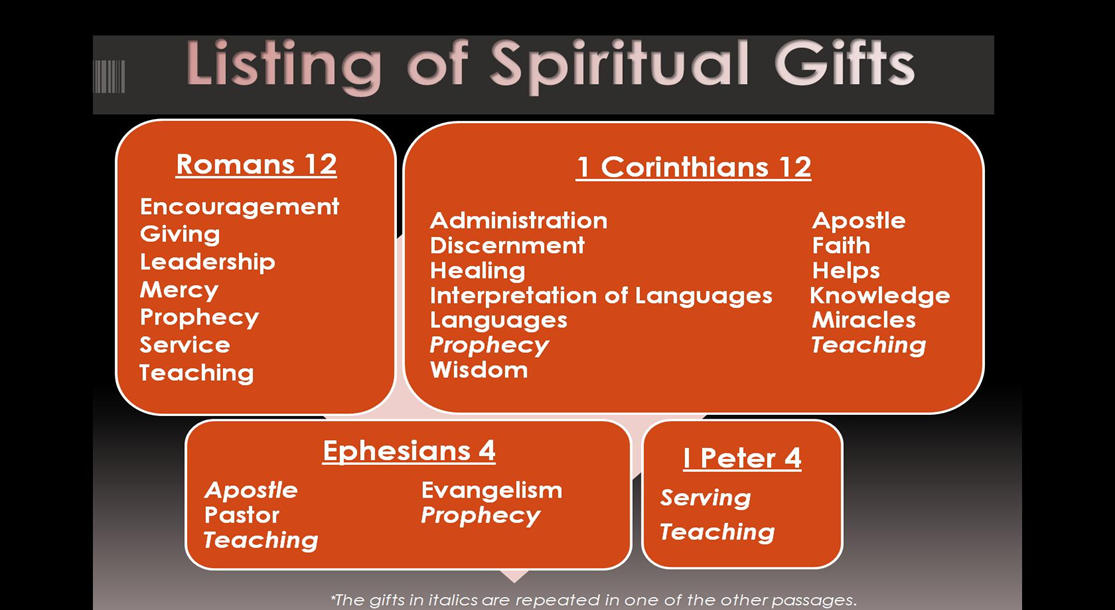
I like this graphic primarily due to its layout. While we don’t have time in this post to dive into all of them, I want to focus today on the seven gifts at the bottom of the screen, starting with the fivefold ministry gifts described in Ephesians 4: Apostles, Prophets, Evangelists, Pastors, and Teachers. These are leadership gifts given by Christ not just to the ordained ministers of the world but too all believers to equip the saints for ministry, build up the body of Christ, and foster unity and maturity in the faith.
As for the two in the bottom-right, these are grace gifts as defined in 1 Peter 4:10-11, service (deacon) and ‘teaching’ (elder) in an exhortation capacity, In this passage, Peter states how God has given every believer a spiritual gift to serve one another as good stewards of God’s grace, with the goal that all things glorify God through Christ. These gifts are not self-focused but are for the benefit and building up of the body at large with different gifts being empowered by the same Spirit and needing to be used with God’s strength for His glory.
Having said all this, here’s the ‘crashiest’ of courses you may ever receive on the seven leadership gifts and how they’re meant to function in the marketplace…
Prophets…call God’s people to God’s ways. They are more about developing the design of organizational mission, less about developing people. They ‘redeem’ an environment by expressing a wisdom that gives clarifies organization’s vision/mission for co-workers.
Evangelists…those who are gifted to reach unbelievers. They tend to be more gatherers with acts of service being their community gift. Evangelists are more concerned about developing the organization through developing people. They ‘redeem’ an environment by creating an inclusive team environment through love and acceptance.
Pastors…those who encourage believers with the spoken word. More concerned about developing people than managing systems. They ‘redeem’ their environment by creating joy through encouraging people on how important they are as people to the organization and by helping them see how their temperaments complement the organization.
Teachers…those who systematically make disciples and develop management systems. More concerned about preserving the organization. They ‘redeem’ their environment by raising team morale through breaking down systems into easy action steps and by helping them see how the systems help everyone reach their mutual goals.
Apostles…coordinate the other gifts and helps them work together. Leading and directing are their community gifts. They ‘redeem’ their environment by coordinating a team in a way that generates hope by maximizing each team member’s gift and designing products/projects that emphasize a redemptive gift of the organization.
Elders…those who impart themselves. More about managing people/Less about developing people. They are big picture minded in that that they see the value of systems, but they REALLY see the value of helping people find their places in the system. They are manager-developers who gravitate to systems but are motivated to help people find their seat on the bus.
Deacons…more about managing systems for the sake of people. They are motivated to implement proven systems that help people work together*. A deacon is part of the pastoral gift cluster, but in the workplace may not be in a direct support capacity but a ‘hidden’ support capacity. They ‘redeem’ their environment by creating an atmosphere of goodness and gratitude through giving and bringing order to the organizational environment.
*Note: A deacon’s gift is the broader concept of “serving others” through the use of whatever spiritual gifts one has received from God. This isn’t limited to a specific role, but encompasses a general ability to use God-given talents, like mercy, hospitality, administration, and giving, to serve the needs of the Christian community.
Graphic creds: Walk with Scripture
 hisgirlfryday.com